Cryptocurrency is not as complicated as it first appears. Most people who feel overwhelmed by it are reacting to the jargon, not the underlying concept. Strip that away and the core idea is simple: digital money that nobody owns or controls. No bank can freeze it. No government can print more of it. Transactions happen directly between people, anywhere in the world, at any time.
This guide covers everything a beginner needs to get started in 2026: what crypto is, how it works, how to buy it safely, how to store it, and what to watch out for. It does not assume any prior knowledge. It also does not tell you what to buy or promise any returns. What it does do is give you the information to make your own decisions without needing to trust strangers on the internet.
What is cryptocurrency?
Cryptocurrency is a form of digital money that exists only online and is secured by cryptography. Unlike the balance in your bank account, which is a record held by a financial institution, cryptocurrency is recorded on a shared public database called a blockchain. No single company, bank, or government controls that database. The record is maintained by a network of computers around the world, and anyone can check it.

The word “crypto” refers to the cryptographic techniques used to secure transactions and control the creation of new coins. Bitcoin was the first cryptocurrency, created in 2009 by a person or group using the name Satoshi Nakamoto. Since then, thousands of other cryptocurrencies have been created, each with different features and purposes. Some work like digital cash. Others power entire software platforms. Others are designed to maintain a stable price.
What makes cryptocurrency different from digital money in a bank account is that the bank does not exist here. You hold the asset directly. That means no middleman takes a cut of every transaction, no institution can freeze your funds, and no one needs permission to send or receive it. The tradeoff is that if you lose access to your crypto, there is no customer support line to call.
How does cryptocurrency work?
The technology behind cryptocurrency is called a blockchain. Understanding it at a basic level makes the whole space easier to follow.

What is a blockchain?
A blockchain is a public ledger that records every transaction ever made on a network. Imagine a shared spreadsheet that thousands of computers around the world hold copies of simultaneously. Every time someone sends cryptocurrency to someone else, that transaction is added to the spreadsheet as a new entry. Once added, it cannot be changed or deleted. That permanence is what makes the system trustworthy without requiring a central authority.
Transactions are grouped into blocks. Each block is linked to the one before it, forming a chain. Changing any single block would break the chain, which is immediately visible to every other computer on the network. This is what makes blockchain records tamper-resistant.
How crypto transactions work
When you send cryptocurrency to another person, you broadcast that transaction to the network. A group of participants called miners on proof-of-work networks like Bitcoin, or validators on proof-of-stake networks like Ethereum, verify that the transaction is legitimate. They check that you actually own the funds you are trying to send and that you have not already sent them to someone else.
Once verified, the transaction is added to the blockchain and becomes permanent. The whole process typically takes anywhere from a few seconds to several minutes depending on the network. Bitcoin transactions usually confirm within 10-60 minutes. Solana transactions confirm in under a second.
Who controls cryptocurrency?
Nobody and everybody. There is no central authority: no Federal Reserve, no board of directors, no single company. Control is distributed across all the participants in the network. Changes to a network’s rules require consensus from a large portion of participants. In practice this makes major changes slow and rare, which is part of what makes established cryptocurrencies predictable.
This decentralized structure is both the main feature and the main risk. There is no one to call if something goes wrong. Transactions are irreversible. Mistakes are permanent. Understanding that before you start is more useful than any investment tip.
For more on who built the first blockchain and why it was designed this way, see our guide on who created Bitcoin.
Types of cryptocurrency
Not all cryptocurrencies are the same. They fall into several categories based on what they are built to do.

Bitcoin (BTC)
Bitcoin is the original cryptocurrency and remains the largest by market cap. It was designed as a peer-to-peer payment system and is increasingly treated as a store of value, similar in concept to gold. Its supply is capped at 21 million coins, and no one can create more. Bitcoin has the longest track record of any cryptocurrency and is the most widely accepted.
Ethereum (ETH)
Ethereum is the second-largest cryptocurrency and the most widely
Altcoins
used platform for building decentralized applications. It introduced smart contracts, which are self-executing agreements written in code that run automatically when conditions are met. Most decentralized finance applications, NFTs, and a large portion of the token market are built on Ethereum.
Altcoins is the term for any cryptocurrency that is not Bitcoin. Some altcoins have their own blockchains with specific technical features: Solana is known for speed, Cardano for its research-driven approach, and Polkadot for connecting different blockchains. Others are tokens built on top of existing blockchains. The quality and purpose of altcoins vary enormously. Some have genuine utility. Many do not.
Stablecoins
Stablecoins are cryptocurrencies designed to hold a fixed value, usually pegged 1:1 to the US dollar. Tether (USDT) and USD Coin (USDC) are the two largest. They are backed by cash reserves and are widely used for trading, sending money internationally, and earning yield without exposure to price swings.
Meme coins
Meme coins are cryptocurrencies that started as jokes or internet trends. Dogecoin is the most well-known example. Some have acquired large communities and genuine trading volume. Most carry extremely high risk because their value depends almost entirely on social attention rather than technical utility. Price collapses of 80-95% from peak are common.
| Type | Examples | Primary purpose | Risk level |
|---|---|---|---|
| Layer 1 coins | BTC, ETH, SOL, ADA | Store of value, network fees, staking | Medium to high |
| Altcoins | DOT, ATOM, AVAX | Specific technical functions | High |
| Stablecoins | USDT, USDC, DAI | Stable value, payments, trading | Low to medium |
| Utility tokens | UNI, LINK, AAVE | Access to specific platforms or services | High |
| Meme coins | DOGE, SHIB | Speculation, community | Very high |
For a detailed breakdown of the difference between coins and tokens, see our guide on crypto token vs coin.
Crypto terms every beginner needs to know
Crypto has a lot of jargon. Learning the basic terms before you start makes everything else easier to follow. These are the ones that come up constantly.
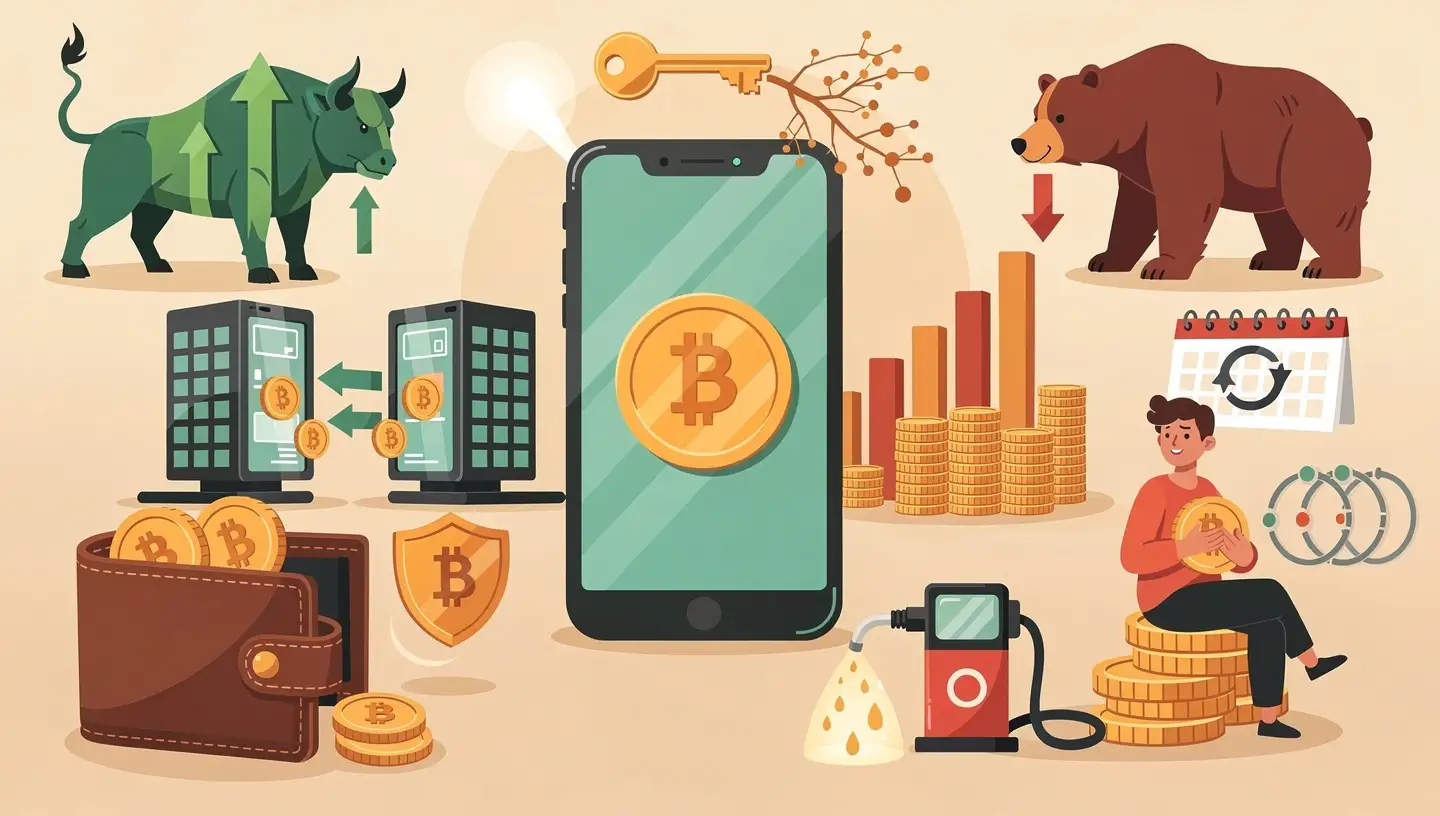
Wallet
A crypto wallet is where you store your cryptocurrency. It does not actually store the coins the way a physical wallet holds cash. What it stores is the private key that proves you own the coins recorded on the blockchain. Without the private key, you cannot access or move your funds. Wallets come in two forms: hot wallets (connected to the internet, convenient for regular use) and cold wallets (offline devices, more secure for long-term storage).
Exchange
A crypto exchange is a platform where you buy, sell, and trade cryptocurrency. Centralized exchanges (CEX) like Coinbase, Kraken, and Binance are run by companies and require identity verification. They hold your funds on your behalf. Decentralized exchanges (DEX) like Uniswap run on smart contracts and let you trade directly from your own wallet without creating an account.
Private key and seed phrase
Your private key is a long string of characters that proves ownership of your crypto. Your seed phrase (also called a recovery phrase or mnemonic) is a set of 12 or 24 words that can regenerate all your private keys if your wallet is lost or broken. Anyone who gets hold of either of these gets full access to your funds. Store your seed phrase written on paper, offline, in a physically secure location. Never photograph it or store it in cloud storage.
For a full explanation of how private keys and public keys work, see our guide on private key crypto.
Market cap
Market cap is the total value of all coins in circulation for a given cryptocurrency. It is calculated by multiplying the current price by the circulating supply. Market cap gives you a better sense of a cryptocurrency’s overall size than price per coin alone. A coin trading at $0.001 with a trillion tokens in circulation can have a larger market cap than one trading at $100 with a million tokens.
For a full explanation of how to use market cap when evaluating crypto, see our guide on what is market cap in crypto.
HODLing and DCA
HODLing is crypto slang for holding your cryptocurrency through market ups and downs rather than selling. It originated from a typo on a forum in 2013 and became a term for a long-term holding strategy. Dollar cost averaging (DCA) means buying a fixed amount of cryptocurrency on a regular schedule regardless of price. Instead of trying to time the market, you buy $50 of Bitcoin every week regardless of whether the price is up or down. Over time this averages out your purchase price.
Bull market and bear market
A bull market is a period when prices are rising broadly. A bear market is a period of falling prices, often defined as a drop of 20% or more from recent highs. Crypto has historically moved in multi-year cycles: extended periods of rising prices followed by sharp declines. Bitcoin has fallen more than 80% from its peak on multiple occasions and gone on to set new highs each time. That pattern is not a guarantee, but it is the historical record.
Gas fees
Gas fees are transaction fees paid to validators for processing transactions on a blockchain. On Ethereum, fees are paid in ETH regardless of which token you are sending. Gas fees fluctuate based on network congestion. During busy periods they can be several dollars or more per transaction. On cheaper networks like Solana and Polygon, fees are typically fractions of a cent.
How to buy cryptocurrency: step by step
Buying crypto for the first time takes about 20-30 minutes from start to finish. Here is the full process.
Step 1: choose a cryptocurrency exchange
A cryptocurrency exchange is your starting point. For beginners, a centralized exchange is the right choice. They are easier to use, have customer support, and handle the technical complexity on your behalf.
When comparing exchanges, check for: regulatory compliance in your country, strong security (two-factor authentication, insurance on deposits), the specific cryptocurrencies you want to buy, trading fees, and the quality of the mobile app. Coinbase, Kraken, and Binance are among the most widely used globally. Each has different fee structures and available assets.
| Factor | Why it matters |
|---|---|
| Regulatory status | Regulated exchanges offer more recourse if something goes wrong |
| Security features | 2FA, withdrawal whitelisting, and cold storage protect your funds |
| Supported cryptocurrencies | Not all exchanges carry every coin |
| Trading fees | Fees range from 0% to over 1.5% per trade depending on platform |
| Ease of use | A clear interface matters, especially when you are learning |
| Withdrawal options | Check that you can transfer funds to your bank and to a personal wallet |
Step 2: create and verify your account
Regulated exchanges require identity verification as part of KYC (Know Your Customer) rules. You will typically need to provide your full name, date of birth, address, and a government-issued ID such as a passport or driving licence. Some exchanges also require a selfie or short video. Verification usually takes a few minutes to a few hours.
Once your account is verified, enable two-factor authentication (2FA) immediately. This adds a second layer of security beyond your password. Use an authenticator app rather than SMS if the platform allows it, since SMS-based 2FA can be bypassed through SIM swapping attacks.
Step 3: deposit funds
You can fund your exchange account via bank transfer, credit or debit card, or sometimes PayPal. Bank transfers are usually the cheapest method but can take one to three business days. Card payments are instant but often carry processing fees of 1.5-3%. Start with an amount you are comfortable with. Most exchanges allow purchases as small as $10-20.
Step 4: choose which crypto to buy
For beginners, Bitcoin and Ethereum are the most common starting points. Both have long track records, are listed on every major exchange, and have enough trading volume that buying and selling is straightforward. They are also the most covered by research and news, which means information about them is easier to find and verify.
You do not need to buy a whole coin. Bitcoin can be purchased in fractions as small as one satoshi (0.00000001 BTC). $50 buys you a fraction of a Bitcoin, and that fraction has exactly the same properties as a whole coin.
Step 5: place your order
Two order types cover most beginner needs. A market order buys immediately at the current price. It executes instantly but you get whatever price the market is at that moment. A limit order lets you set the price you want to pay. The order sits open until the market reaches your price, then executes. For small purchases, market orders are simpler. For larger amounts where price matters more, limit orders give more control.
Step 6: transfer to a personal wallet
Leaving cryptocurrency on an exchange means the exchange controls the private keys, not you. The phrase used across the crypto community is: “Not your keys, not your coins.” For amounts you plan to hold long-term, transferring to a personal wallet removes the exchange as a point of failure. If the exchange is hacked, goes bankrupt, or freezes withdrawals, your funds on that exchange may be at risk. Your funds in your own wallet are not.
How to store crypto safely
Choosing where to store your cryptocurrency is as important as choosing what to buy. The wrong storage decision is one of the most common ways people lose funds.
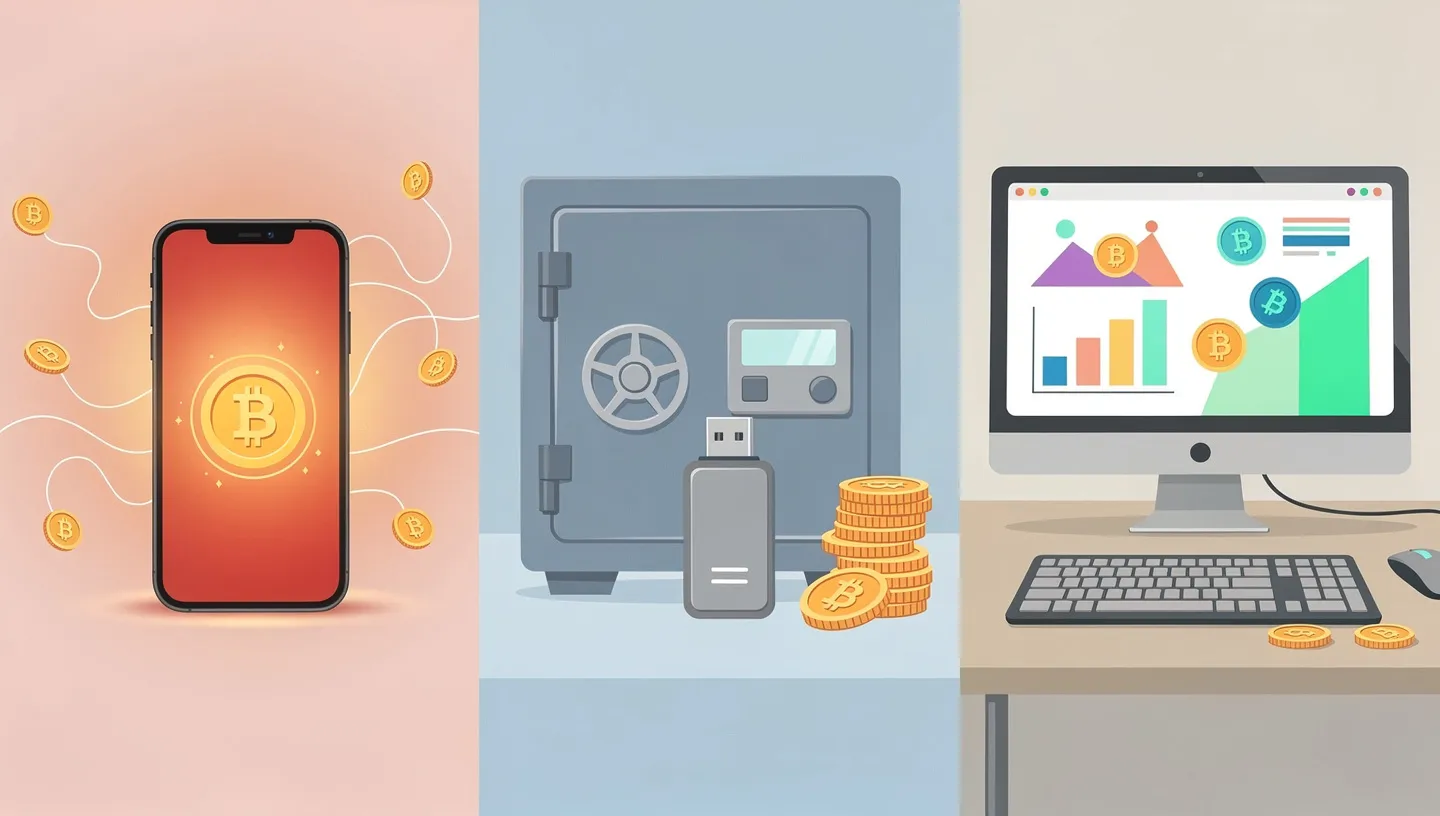
Hot wallets
Hot wallets are software applications connected to the internet. MetaMask, Trust Wallet, and Exodus are examples. They are free, easy to set up, and convenient for regular use or accessing DeFi applications. Because they are connected to the internet, they carry higher risk of compromise through malware, phishing attacks, or device theft. Hot wallets are suitable for amounts you actively use. They are not the right place for long-term savings.
Cold wallets
Cold wallets store private keys on a physical device that is not connected to the internet. Ledger and Trezor are the most widely used hardware wallets, priced between $60 and $200. When you want to sign a transaction, you connect the device, confirm on the hardware, and disconnect again. The private key never leaves the device. This makes remote attacks nearly impossible. Cold storage is the standard approach for anyone holding significant amounts of crypto long-term.
Exchange wallets
When you buy crypto on an exchange and leave it there, the exchange holds the private keys on your behalf. This is called custodial storage. It is convenient and fine for small amounts or active trading. It is not suitable for long-term storage of meaningful amounts. The collapse of FTX in November 2022, which locked millions of users out of their funds overnight, is the clearest recent example of what custodial risk looks like in practice.
For more on how staking works and how custody of your assets changes depending on the method, see our guide on what is crypto staking.
Best cryptocurrencies for beginners
There are tens of thousands of cryptocurrencies. Most are not worth your time as a beginner. The ones below have real trading volume, are listed on all major exchanges, and have enough history to evaluate.
- Bitcoin (BTC): The most established cryptocurrency, with the longest track record. Widely accepted, heavily researched, and the most liquid market. A reasonable starting point for anyone new to the space.
- Ethereum (ETH): The second-largest by market cap and the foundation of most DeFi applications, NFT markets, and token projects. Understanding Ethereum helps you understand much of the broader crypto market.
- Solana (SOL): A proof-of-stake network known for fast transaction times and low fees. More volatile than Bitcoin or Ethereum, but among the more established of the newer networks.
- Cardano (ADA): A proof-of-stake network with a research-focused development approach and flexible staking with no lock-up period.
- Tether (USDT) / USD Coin (USDC): Stablecoins pegged to the US dollar. Not investments in the traditional sense, but useful for keeping value in crypto without exposure to price swings.
This is not a list of recommendations. Every cryptocurrency carries risk, including total loss of value. Start with research, not with money.
For a broader look at the altcoin market and how different cryptocurrencies compare, see our guide on what is an altcoin.
Crypto investment strategies for beginners
Most people who lose money in crypto do so because they have no strategy. They buy when prices are rising because everyone else is buying, and they sell when prices are falling because everyone else is selling. That is the opposite of what works.
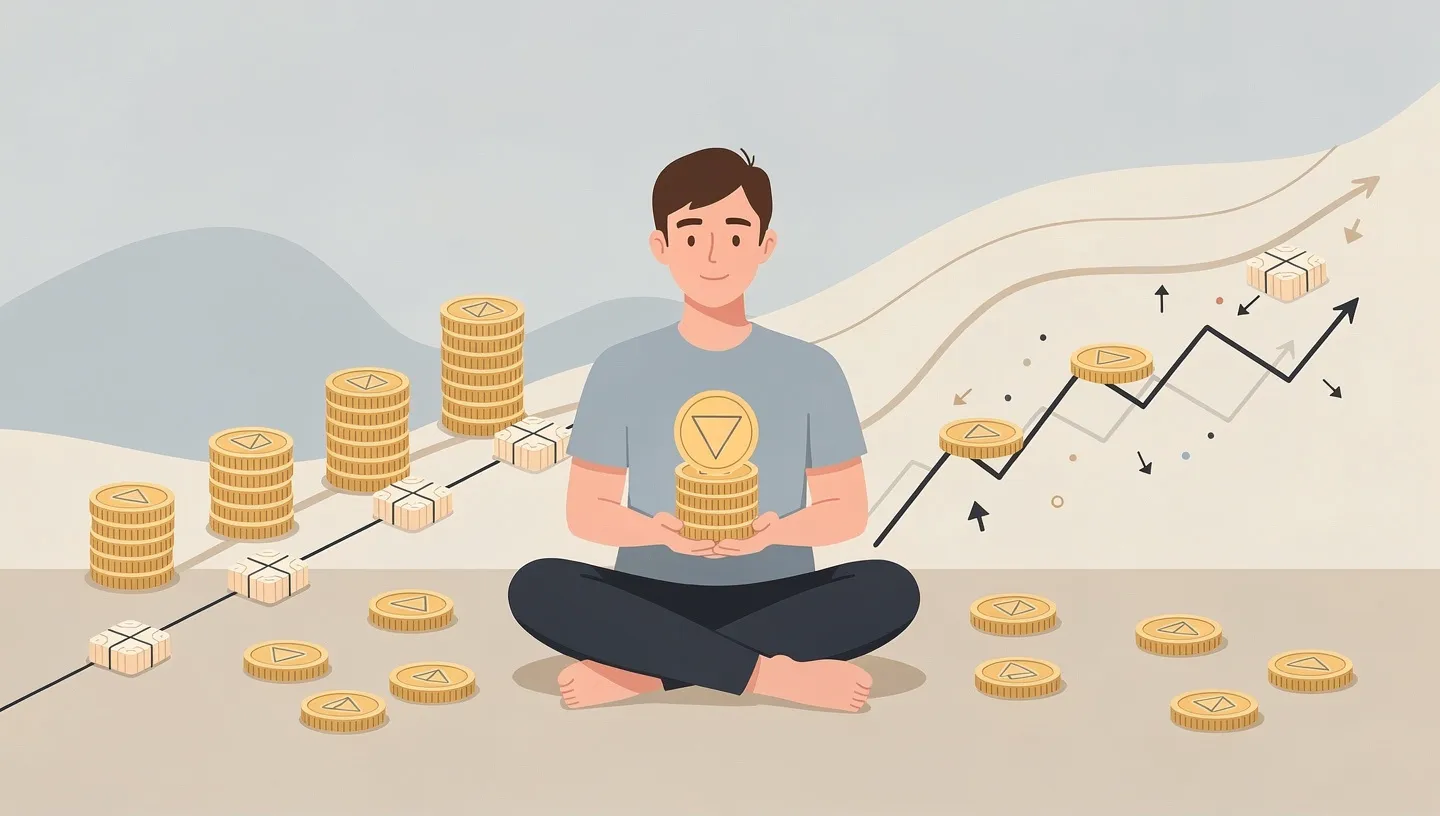
Dollar cost averaging (DCA)
Dollar cost averaging means buying a fixed amount on a regular schedule regardless of price. If you invest $100 in Bitcoin every month, you buy more when the price is low and less when it is high. Over time, your average purchase price tends to be better than trying to time the market. DCA removes the emotional decision-making from the process. You do not need to watch prices daily or react to news. You follow the schedule.
A simple example: $100 per month into Bitcoin over 12 months at varying prices gives you a different number of coins each month. When prices are down, your $100 buys more. When prices are up, it buys less. The average cost per coin across those 12 months is typically lower than if you had tried to pick the best single entry point.
HODLing (long-term holding)
Long-term holding means buying cryptocurrency with no intention of selling in the short term, regardless of price movements. This approach has historically worked well for Bitcoin and Ethereum. Both have experienced multiple drops of 50-80% from their highs and gone on to set new records. That pattern is not guaranteed to continue, but it is the historical track record.
The practical challenge with long-term holding is psychological. Watching a position drop 40% in a month is uncomfortable even when you planned to hold for years. Having a clear written plan before you invest, specifying under what conditions you would sell, makes it easier to stick to the strategy when markets move against you.
Trading vs. investing
Trading and investing are different activities with different skill requirements. Long-term investing (buying and holding) requires patience and a view on the long-term direction of an asset. Day trading requires technical analysis skills, fast decision-making, risk management tools, and the ability to handle frequent losses without abandoning the strategy.
Most beginners who try day trading lose money. The markets are competitive, fees compound quickly on frequent trades, and emotional decision-making is far more costly over short time horizons. If you are new to crypto, developing conviction about what you are holding and why is more useful than trying to profit from short-term price movements.
Crypto risks every beginner should understand
Crypto carries real risks. Understanding them before you invest makes it possible to manage them. Ignoring them does not make them go away.
Price volatility
Cryptocurrency prices are volatile. Bitcoin has dropped more than 80% from its peak on multiple occasions. Smaller cryptocurrencies have dropped 90-99% and never recovered. Volatility works in both directions, which is part of what attracts investors, but the downside can be severe and sustained. Only invest what you can afford to lose completely without affecting your financial life.
Scams and fraud
Crypto scams are pervasive. Common formats include: fake investment platforms that show artificial returns until you try to withdraw, phishing sites that look like real exchanges and steal your login credentials, “rug pulls” where developers abandon a project after raising funds, and social media impersonators claiming to double your crypto if you send it first. If something sounds too good to be true in crypto, it is. No legitimate service will ask for your seed phrase or private key.
Regulatory risk
Crypto regulation is still developing in most countries. Governments can introduce new rules that affect how crypto is taxed, which exchanges can operate, or which assets can be listed. China banned crypto trading and mining in 2021. The US SEC has taken legal action against several exchanges. These events affect prices and access. What is legal and straightforward today may face restrictions tomorrow.
Loss of access
If you lose your private key or seed phrase and have no backup, your funds are permanently inaccessible. There is no password reset. No customer service can help you. Blockchain transactions are irreversible. If you send funds to the wrong address, they are gone. These features are by design, not bugs. Handle your seed phrase with the same care you would give to a large amount of physical cash.
Exchange risk
Centralized exchanges are companies. They can be hacked, they can fail financially, and they can freeze withdrawals. The failure of FTX in November 2022 is the most prominent recent example. FTX was one of the largest exchanges in the world and collapsed within days, locking billions of dollars in customer funds. Leaving large amounts on any exchange for extended periods is a form of risk that is easy to avoid by moving funds to a personal wallet.
| Risk | What causes it | How to reduce it |
|---|---|---|
| Price volatility | Market speculation, news, liquidity | Only invest what you can afford to lose, use DCA |
| Scams | Fraudulent projects and platforms | Use established platforms, never share seed phrases |
| Regulatory change | Government policy shifts | Stay informed, use regulated exchanges |
| Loss of access | Lost keys or seed phrases | Back up seed phrase offline in multiple locations |
| Exchange failure | Insolvency, hacks, freezes | Transfer long-term holdings to a personal wallet |
Crypto security tips for beginners
Security in crypto is non-negotiable. Mistakes here are permanent and irreversible. These practices cover the most common ways people lose funds.
- Enable two-factor authentication (2FA) on every exchange account. Use an authenticator app rather than SMS. SMS codes can be intercepted through SIM swapping.
- Never share your seed phrase or private key with anyone. No legitimate service, exchange, or wallet provider will ever ask for it. Anyone who does is attempting to steal your funds.
- Check URLs before entering login credentials. Phishing sites are designed to look identical to real exchanges. Bookmark the correct URL and use only that bookmark to log in.
- Verify withdrawal addresses twice before sending. Paste the address, close the window, open a fresh copy, and check again. Some malware is designed to replace copied addresses with the attacker’s address.
- Start with small amounts. Make your first transactions with amounts you would not miss. Learn the process before moving larger sums.
- Store your seed phrase offline and in multiple physical locations. A fire, flood, or theft can destroy a single copy. Keep duplicates in different secure locations.
- Use different passwords for every account. A password manager handles this without requiring you to remember them all.
- Ignore unsolicited messages about crypto opportunities. If someone contacts you out of nowhere with an investment tip or asks you to connect your wallet to a link they sent, do not engage.
For a detailed explanation of how private keys and seed phrases work, and what it means to be in control of your own funds, the guide on private key crypto covers it fully.
Crypto taxes: what beginners need to know
Most countries treat cryptocurrency as a taxable asset, not a currency. The specific rules vary by jurisdiction, but some general principles apply widely.
In the United States and United Kingdom, buying cryptocurrency and holding it is generally not a taxable event. The taxable events are: selling crypto for fiat money, trading one cryptocurrency for another, using crypto to buy goods or services, and receiving staking rewards or mining income. Each of these may trigger a capital gain or a taxable income event depending on local law.
When you sell crypto, your capital gain is the difference between what you paid for it (your cost basis) and what you sold it for. If you bought Bitcoin at $30,000 and sold at $90,000, your capital gain is $60,000. Losses can typically be used to offset gains.
The practical implication: keep records of every transaction from day one. Record the date, the amount, the price in your local currency at the time of the transaction, and what you did with it. Some exchanges provide transaction histories. Tax software like Koinly or CoinLedger can import those histories and calculate your liability. The rules around crypto taxes are still evolving in many countries. Consulting a tax professional familiar with crypto is the safest approach.
Common beginner mistakes in crypto
Most beginner losses come from the same patterns. Knowing them in advance is more useful than learning them by experience.
- Investing more than you can afford to lose. Crypto is volatile enough that significant drawdowns are normal. Never put in money that would change your life if it went to zero.
- Treating a low price as a signal to buy. A coin trading at $0.001 is not cheap if it has a trillion tokens in circulation and a $1 billion market cap. Price per coin means nothing without context.
- Buying during peak hype (FOMO). The best-known time to buy something is usually not the best time to buy it. When a coin is on the front page of every news site, the people who bought it early are ready to sell.
- Leaving all funds on an exchange. Exchanges fail. FTX, Celsius, Voyager, and others all collapsed with customer funds on them. Hardware wallets cost $60-200 and remove that risk entirely for long-term holdings.
- Not backing up the seed phrase. Devices break. If the wallet device is destroyed or lost and there is no seed phrase backup, the funds are gone permanently.
- Following social media tips without research. Paid promotions, celebrity endorsements, and anonymous forum posts drive more losses in crypto than any other single factor. Research the project, not the hype around it.
- Ignoring tax obligations. Every taxable transaction that goes unrecorded is a problem waiting to happen. Start tracking from the beginning, not after the fact.
- Trying to day trade without experience. Most traders lose money. The ones who profit consistently have years of practice, strict risk management, and tools that beginners do not have yet.
Where to learn more
Getting started in crypto requires building knowledge across several areas: how different networks work, what gives a project value, and how to read the market without reacting to noise. These guides on this site cover the core topics in detail.
- What is Bitcoin: a full explanation of how Bitcoin was designed and how it works
- How does Bitcoin work: the technical mechanics of the Bitcoin network
- Bitcoin history: the full price and event timeline from 2009 to today
- What is crypto staking: how to earn passive income on proof-of-stake networks
For anyone interested in what happens beyond basic buying and holding, two important areas are decentralized finance and non-fungible tokens. Our guides on what is DeFi and what is an NFT cover both from the beginning.
For a broader overview of what cryptocurrency is as a category, the best starting point is what is cryptocurrency.
CoinMarketCap and CoinGecko are the two most widely used tools for tracking prices, market caps, and trading volumes across all cryptocurrencies.
Frequently asked questions
How much money do I need to start with crypto?
Most exchanges allow purchases as small as $10-20. There is no minimum that makes sense for everyone. The right starting amount is whatever you are completely comfortable losing, since the possibility of loss is real. Many experienced investors recommend starting small, around $50-100, to learn the process without significant financial exposure before committing larger amounts.
Is it too late to invest in crypto in 2026?
That depends on your time horizon and what you expect from the investment. Roughly 5-6% of the global population owns any cryptocurrency as of 2026, which suggests the adoption curve is still relatively early compared to other major asset classes. Whether any specific cryptocurrency will be worth more in five years is not knowable. The historical record for Bitcoin and Ethereum shows long-term appreciation through multiple severe downturns, but past performance does not guarantee future results.
What is the safest cryptocurrency for beginners?
No cryptocurrency is safe in the sense that the price cannot fall. Bitcoin and Ethereum are the most established and most liquid, which means they have the longest track records and the most information available for research. They are less likely to go to zero than smaller, newer projects. Stablecoins like USDT and USDC hold a fixed value but carry their own risks around the backing of the peg.
Can I lose all my money in crypto?
Yes. Many cryptocurrencies have gone to zero. Even established assets like Bitcoin have dropped 80-85% from peak to trough. Losing 100% of an investment is possible, particularly in smaller or newer projects. This is why experienced investors recommend only putting in amounts you can afford to lose entirely without affecting your financial situation.
Do I need ID to buy crypto?
On any regulated centralized exchange, yes. KYC verification requires a government-issued ID, and often proof of address. This is a legal requirement, not a platform choice. Decentralized exchanges do not require ID since there is no company running them, but they require more technical knowledge to use safely.
How do I know if a crypto project is a scam?
Warning signs include: anonymous teams with no verifiable history, promises of guaranteed returns, pressure to invest quickly before an opportunity closes, requests to send crypto to receive more back, projects with no clear use case beyond price speculation, and tokens that can only be bought but not sold. Legitimate projects have named teams, verifiable code, clear use cases, and do not promise returns.
What is the difference between crypto trading and investing?
Investing generally means buying and holding for a longer period with a view on where the asset will be in months or years. Trading means buying and selling more frequently to profit from short-term price movements. Trading requires more skills, more attention, and carries more risk from fees and short-term volatility. Most beginners are better served by a long-term holding approach while they learn the market.
What is the difference between a coin and a token?
A coin runs on its own blockchain. Bitcoin is a coin. Ether is a coin. A token is built on top of another blockchain using a smart contract. Tether (USDT) is a token that runs on Ethereum and other networks. The technical distinction matters when it comes to which wallet you need and which network fees you pay.