Think of a crypto exchange as a marketplace where buyers and sellers of cryptocurrency meet. One person wants to sell Bitcoin. Another wants to buy it. The exchange brings them together, records the transaction, and takes a small fee for the service. That is the core of what every crypto exchange does, whether it is a global platform processing billions of dollars a day or a small decentralized protocol running entirely on smart contracts.
Before exchanges existed, getting hold of cryptocurrency meant mining it yourself or finding a seller directly through obscure online forums. Exchanges changed that by providing a reliable, accessible infrastructure for trading digital assets at transparent prices. Today there are hundreds of them, with different fee structures, supported assets, security records, and levels of regulatory oversight.
What is a crypto exchange?
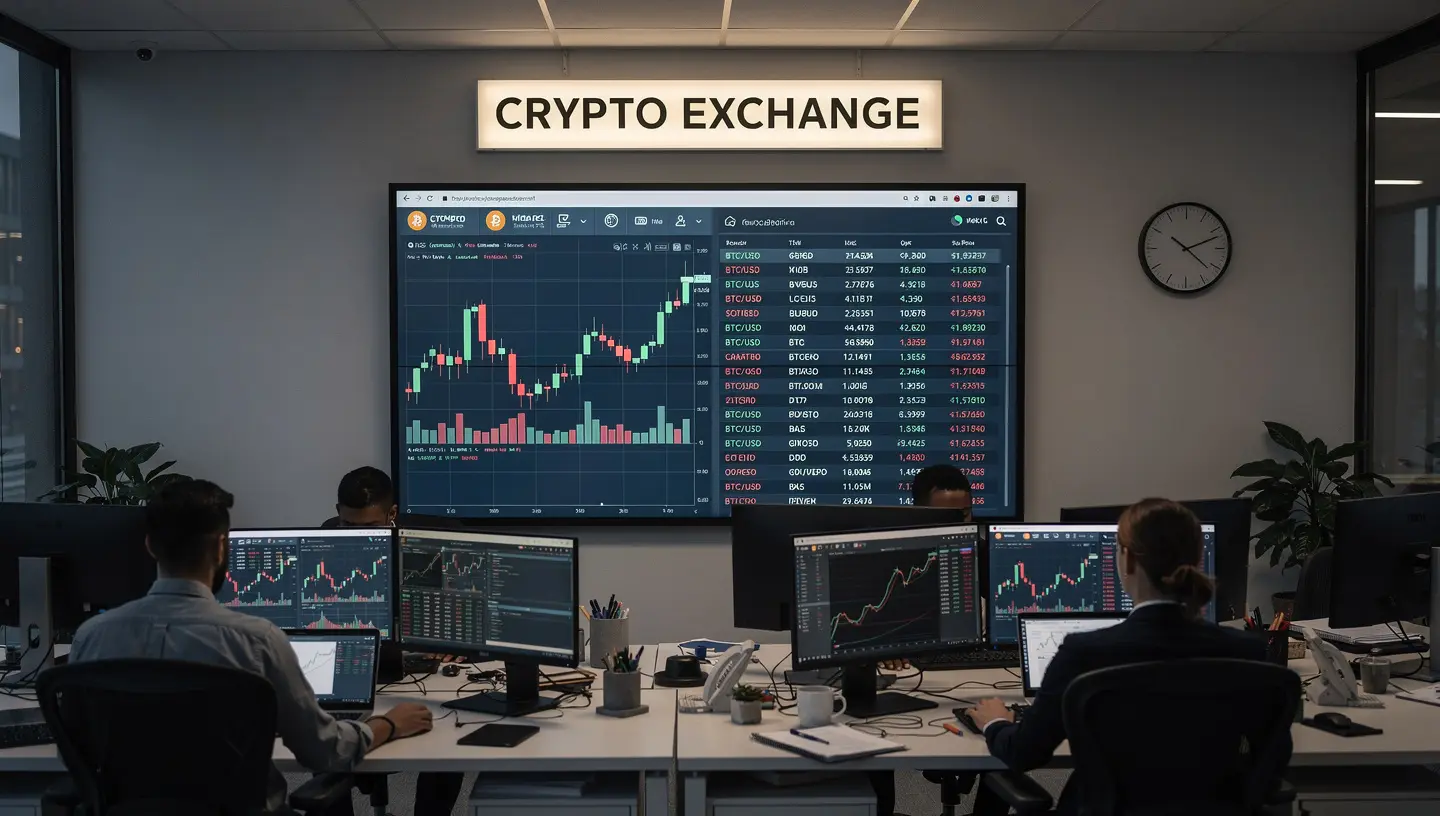
A crypto exchange is an online platform that allows users to buy, sell, and trade cryptocurrencies. It works in a similar way to a traditional stock exchange: orders from buyers and sellers are collected, matched against each other, and executed at a price both parties agree to. The key difference is that crypto exchanges operate 24 hours a day, seven days a week, with no opening bell and no closing time.
Exchanges publish the rate for each trading pair they support. A trading pair is simply the two assets being exchanged, for example BTC/USD (Bitcoin sold for dollars) or BTC/ETH (Bitcoin traded for Ethereum). The exchange earns revenue by collecting a small fee on each completed transaction.
Some exchanges allow users to deposit traditional currency and buy cryptocurrency directly. Others only support crypto-to-crypto trading, where you must already own some cryptocurrency to participate. Both types serve different needs and suit different types of users.
How does a crypto exchange work?
Understanding the mechanics behind a crypto exchange makes it much easier to trade without surprises. The system involves a few moving parts that all interact in real time.
The order book
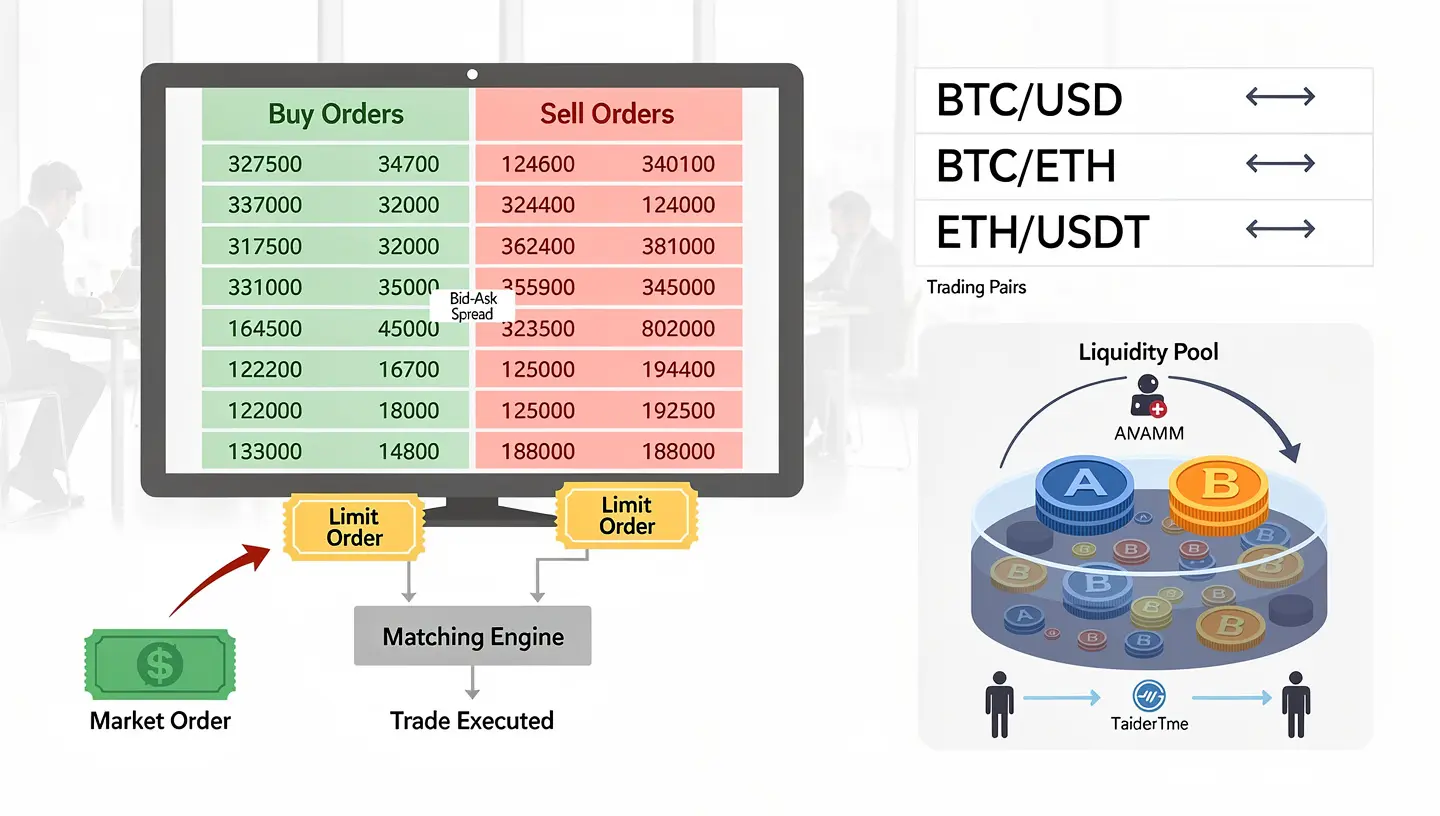
The order book is the heart of any centralized exchange. It is a continuously updated list of all open buy and sell orders, sorted by price. Buy orders appear on one side, sell orders on the other. The difference between the best available buy price and the best available sell price is called the bid-ask spread.
Here is a concrete example. Suppose the top sell orders for Bitcoin look like this:
- 0.1 BTC available at $50,000 per coin
- 0.3 BTC available at $50,300 per coin
- 0.2 BTC available at $50,400 per coin
If you submit a market order to buy 0.3 BTC, the exchange fills it at the best available prices: 0.1 BTC at $50,000 and 0.2 BTC at $50,400, for a total of $15,080. The exchange matches your order against the cheapest available sellers in sequence until the full amount is filled.
Market orders vs. limit orders
There are two main types of orders on any crypto exchange.
A market order buys or sells at the best price currently available in the order book. It executes immediately but you do not control the exact price. During fast-moving markets, the price you pay can differ slightly from what you saw before confirming.
A limit order lets you set the price at which you are willing to buy or sell. The exchange holds your order in the order book until a matching counterparty appears at that price. If the price never reaches your target, the order stays open or expires without executing. Limit orders give you price control but no guarantee of execution.
How orders are matched
Every centralized exchange has a matching engine that pairs buy and sell orders automatically. The matching follows two rules: price first, then time. The best-priced order takes priority. Among orders at the same price, the one placed earlier gets matched first. This is called the first-in, first-out (FIFO) principle.
Decentralized exchanges use a different mechanism entirely. Instead of an order book and matching engine, they rely on liquidity pools, which are reserves of tokens deposited by users who earn a share of transaction fees in return. An algorithm called an Automated Market Maker (AMM) calculates the price of each trade based on the ratio of tokens in the pool.
Trading pairs explained
Every transaction on a crypto exchange involves a trading pair. You are always buying one asset by selling another. BTC/USD is a fiat-to-crypto pair: you sell US dollars to buy Bitcoin. BTC/ETH is a crypto-to-crypto pair: you sell Ethereum to buy Bitcoin. The exchange sets and displays the current rate for each pair based on the orders in the book or the pool.
The number of trading pairs an exchange supports directly affects what you can trade there. A platform with 50 pairs covers the major assets. One with 500 pairs opens up access to a wide range of altcoins that smaller platforms do not carry.
For a broader look at how blockchain technology processes and verifies these transactions behind the scenes, see our guide on how Bitcoin works.
Types of crypto exchanges
Not all crypto exchanges are built the same way. They differ in who controls the assets, what verification they require, and how trades are executed.
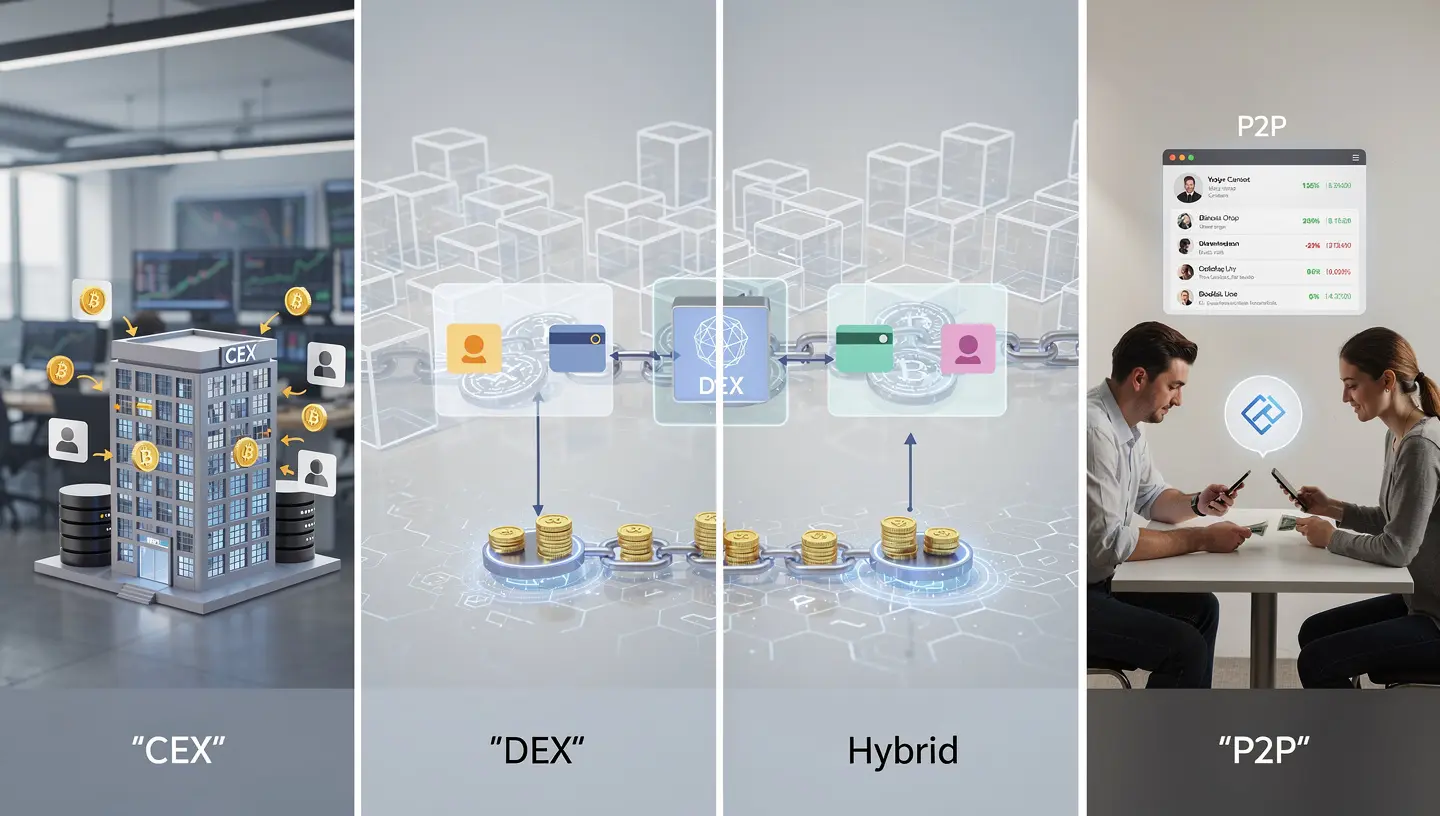
Centralized exchanges (CEX)
A centralized exchange (CEX) is run by a company that acts as an intermediary between buyers and sellers. The company manages the platform, holds user funds, operates the matching engine, and sets the fee structure. Users open accounts, complete identity verification, deposit funds, and trade through the platform’s interface.
CEX platforms are the most widely used entry point for new crypto buyers because they accept deposits in traditional currency, have customer support, and offer simple buy interfaces alongside more advanced trading tools. Examples include Coinbase, Binance, Kraken, Gemini, and Bitstamp.
The tradeoff is custody. When you trade on a CEX, the exchange holds your private keys. Your balance is a record in their database, not a balance on the blockchain. If the exchange is hacked, goes bankrupt, or freezes withdrawals, your access to those funds depends entirely on what the exchange does next.
Decentralized exchanges (DEX)
A decentralized exchange (DEX) has no central company managing it. Trades are executed automatically by smart contracts on the blockchain. Users connect their personal wallets directly to the exchange and trade without creating an account or passing identity verification.
Instead of an order book, most DEX platforms use liquidity pools. Users deposit pairs of tokens into a pool and earn a share of the fees charged to traders who use it. An AMM algorithm determines the price of each trade based on the proportion of each token in the pool. Uniswap, Curve, and dYdX are among the most widely used DEX platforms.
DEX trading keeps you in full control of your private keys at all times. There is no exchange that can freeze your funds or go bankrupt. The risks are different rather than absent: smart contract vulnerabilities have led to hundreds of millions of dollars in losses across various DEX protocols, and the user experience is more demanding for people who are new to crypto.
Hybrid exchanges
Hybrid exchanges attempt to combine the speed and usability of centralized platforms with the self-custody of decentralized ones. Orders are typically matched off-chain for speed, but settlement happens on-chain, meaning funds never leave the user’s wallet until the trade is finalized. Hybrid models are still relatively uncommon but represent an active area of development as the industry looks for ways to address both the custodial risk of CEX platforms and the complexity of DEX platforms.
Peer-to-peer (P2P) exchanges
Peer-to-peer (P2P) exchanges connect buyers and sellers directly without routing trades through a central order book. The exchange platform provides the matching and escrow service, but the trade is settled directly between two individuals who agree on price and payment method. P2P exchanges are commonly used in countries where direct fiat-to-crypto conversion is restricted, because they support a wider variety of local payment methods including bank transfers, cash, and mobile money services.
| Feature | Centralized exchange (CEX) | Decentralized exchange (DEX) |
|---|---|---|
| Custody of funds | Exchange holds your keys | You hold your own keys |
| KYC required | Yes | No |
| Fiat deposits | Yes (bank transfer, card) | No |
| Trade execution speed | Fast | Variable |
| Beginner-friendly | High | Low to medium |
| Platform risk | Higher (exchange hack, insolvency) | Lower (smart contract risk instead) |
| Examples | Coinbase, Binance, Kraken | Uniswap, Curve, dYdX |
For more on the smart contracts that power decentralized exchanges, see our guide on what is a smart contract.
Fiat-to-crypto vs. crypto-to-crypto exchanges
Beyond the CEX/DEX split, exchanges also differ in what types of assets they accept for deposits.
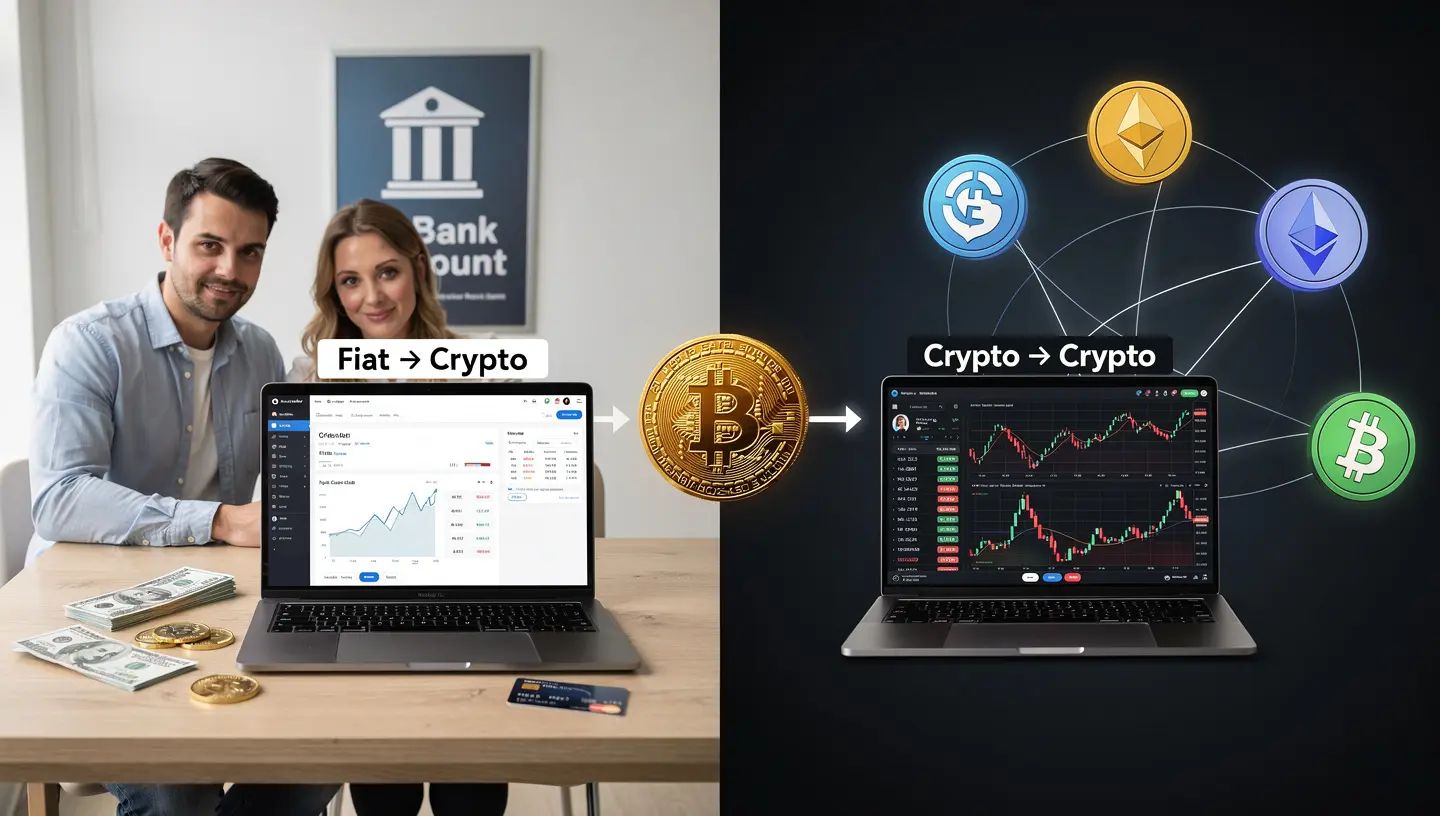
A fiat-to-crypto exchange accepts deposits in traditional currency such as dollars, euros, and pounds, via bank transfer, credit card, or other payment methods. Users can buy cryptocurrency directly with money from their bank account. These platforms are the standard starting point for anyone who does not already own cryptocurrency. They require identity verification to comply with financial regulations. Coinbase, Kraken, and Bitstamp are fiat-to-crypto exchanges.
A crypto-to-crypto exchange only accepts cryptocurrency deposits. There is no way to deposit dollars or euros directly. Users must already hold some cryptocurrency, typically Bitcoin or a stablecoin, before they can trade. These platforms often support a wider range of altcoins than fiat-to-crypto exchanges. Binance operates both models but is well known for its depth in crypto-to-crypto pairs.
Most major exchanges now support both models. A user can deposit fiat, buy Bitcoin, and then trade that Bitcoin for a longer list of altcoins, all within the same platform.
For an overview of the wider altcoin market and how different assets trade relative to Bitcoin, see our guide on what is an altcoin.
How to use a crypto exchange: step by step
Opening an account and making your first trade follows a consistent process across most major centralized exchanges.
- Choose a reliable exchange. Check the platform’s regulatory status in your country, its fee structure, the cryptocurrencies it supports, and its security track record. Do this before registering, not after.
- Create your account. Provide your email address and set a strong, unique password. Do not reuse passwords from other services.
- Complete KYC verification. Most regulated exchanges require a government-issued ID and proof of address. Some also require a live photo or short video. Verification usually takes a few minutes to a few hours.
- Enable two-factor authentication (2FA). Do this before depositing anything. Use an authenticator app rather than SMS if the platform offers the choice.
- Deposit funds. Choose your method: bank transfer (slower but lower fees), credit card (instant but 1.5-3% fee), or transfer from another crypto wallet.
- Place your order. Select the trading pair, choose between a market order (instant, at current price) or a limit order (at your chosen price), enter the amount, and confirm.
- Withdraw to your own wallet. For any amount you plan to hold long-term, transfer it off the exchange to a personal wallet you control. The phrase used throughout the crypto community is: “Not your keys, not your coins.”
For a complete beginner’s walkthrough that covers wallets, storage, and security alongside trading, see our crypto for beginners guide.
Exchange wallets: hot and cold storage
When you deposit cryptocurrency onto a centralized exchange, the exchange holds your private keys. Your balance exists as a record in the exchange’s internal database, not as a balance sitting directly on the blockchain. The exchange is making a promise to you that those funds are yours and available when you want them.
Reputable exchanges keep the large majority of user funds in cold storage: hardware devices or other offline systems physically disconnected from the internet. Only a small working reserve, kept in hot wallets that are online and accessible, is used to process daily withdrawals. Bitstamp, for example, keeps 95% of assets in cold storage. This structure limits the damage from a successful hack because the attacker can only reach the hot wallet funds, not the full reserve.
Cold storage does not protect against insolvency or fraud. FTX kept funds in cold storage too, but misused customer assets in ways that had nothing to do with hot or cold wallet management. The safest position for long-term holdings is a personal hardware wallet you control, not an exchange wallet of any kind. Ledger’s explanation of why key ownership matters covers this in detail.
For a detailed explanation of private keys, how they work, and why controlling them matters, see our guide on private key crypto.
Popular crypto exchanges: what they are known for
The list of active exchanges shifts regularly as platforms launch, merge, and in some cases close. These are the most widely used as of 2026.
Coinbase
Coinbase is the largest crypto exchange in the United States by regulated trading volume. It is publicly listed on Nasdaq, which gives it a level of financial disclosure not common in the industry. It is known for its straightforward interface aimed at beginners, a strong regulatory compliance track record, and its separately available Coinbase Advanced platform for more experienced traders. Fees are higher than most competitors on the basic interface.
Binance
Binance is the largest crypto exchange in the world by trading volume. It supports over 600 cryptocurrencies and has the deepest order book liquidity for most major pairs. It offers a native exchange token (BNB) that reduces trading fees when used. Binance has faced regulatory scrutiny in multiple countries and has adapted its operations accordingly.
Kraken
Kraken has one of the longest security records in the industry and has never been successfully hacked at a scale that caused user losses. It is known for strong regulatory compliance, a wide selection of supported countries, and features that suit both beginners and experienced traders. Kraken also offers staking services for several proof-of-stake networks.
Gemini
Gemini was founded by the Winklevoss twins and is regulated by the New York State Department of Financial Services. It is one of the most tightly regulated exchanges in the US market. It carries a smaller selection of assets than Binance but is known for security and compliance. Gemini has an insurance fund covering assets held in its hot wallet.
Uniswap (DEX)
Uniswap is the largest decentralized exchange by trading volume. It runs on Ethereum and several other networks. No account is needed. Users connect a personal wallet and trade directly against liquidity pools. It supports thousands of ERC-20 tokens that no centralized exchange carries. It has no customer support and no recourse for user errors.
For context on how DeFi protocols like Uniswap operate as a category beyond individual exchanges, see our guide on what is DeFi.
How to choose a crypto exchange
The right exchange depends on what you want to do, where you are located, and how much risk you are comfortable with. These are the factors that matter most.
Security and regulatory compliance
Check whether the exchange is licensed in your country. In the United States, relevant regulators include FinCEN, the SEC, and state-level agencies like the New York DFS. In the UK, the FCA registers crypto asset businesses. In the EU, MiCA regulation is setting a new standard. A regulated exchange is not risk-free, but it is subject to capital requirements, audit obligations, and consumer protection rules that unregulated platforms are not.
Look at the exchange’s security history. Ask whether it has been hacked, how it responded, and whether affected users were compensated. Exchanges that publish regular proof of reserves audits, showing on-chain evidence that they hold enough assets to cover user balances, offer more transparency than those that do not.
Fee structure
Most exchanges use a maker-taker fee model. Makers add liquidity to the order book by placing limit orders that are not immediately filled. Takers remove liquidity by placing orders that match immediately. Makers typically pay lower fees (0–0.25%) than takers (0.1–0.5%). Fees often decrease as your trading volume increases.
Check also for withdrawal fees, which are charged when you move crypto off the exchange, and deposit fees, which some platforms charge for card purchases (typically 1.5–3%). The cheapest exchanges for active traders may not be the cheapest for occasional buyers who pay by card.
Supported assets and trading pairs
If you only want Bitcoin and Ethereum, almost any major exchange will work. If you want access to a wider range of altcoins, check the specific assets you are interested in before choosing a platform. Some assets are listed on only a handful of exchanges, and trading volume for rare pairs can be thin enough to affect price significantly on larger orders.
User interface and available tools
Beginner-focused platforms like Coinbase’s standard interface keep things simple: pick an asset, enter an amount, confirm the purchase. More advanced platforms offer candlestick charts, technical indicators, order book depth views, margin trading, and futures contracts. Choosing a platform that matches your actual skill level avoids paying for complexity you will not use or being confused by a platform that does not show what you need.
| Exchange | Good for | Trading fee (maker/taker) | Regulatory status |
|---|---|---|---|
| Coinbase | US beginners, regulated access | 0%/0.6% (basic) | Publicly listed, US regulated |
| Binance | High volume, wide asset selection | 0.1%/0.1% (standard) | Regulated in select markets |
| Kraken | Security, compliance, staking | 0.16%/0.26% | US, EU, UK licensed |
| Gemini | Regulatory certainty, US market | 0.2%/0.4% | NYDFS regulated |
| Uniswap (DEX) | No-KYC, altcoin access, DeFi | 0.05–1% (pool fee) | No central entity to regulate |
Crypto exchange fees explained
Fees on crypto exchanges come in several forms, and the total cost of using a platform is not always obvious from the headline trading fee alone.
| Fee type | Typical range | When it applies |
|---|---|---|
| Maker trading fee | 0–0.25% | Placing a limit order that adds liquidity to the book |
| Taker trading fee | 0.1–0.5% | Placing a market order that removes liquidity immediately |
| Withdrawal fee | Fixed per coin | Moving crypto from the exchange to a personal wallet |
| Deposit fee (card) | 1.5–3% | Funding your account with a credit or debit card |
| Conversion fee | Varies | Simple buy/sell interfaces that bundle spread and fee together |
Some exchanges reduce fees for users who hold or pay with a native platform token. Binance users paying fees in BNB receive a 25% discount. The total annual cost of trading matters more than any single fee figure: a platform charging 0.1% per trade costs meaningfully more than one charging 0.05% if you trade frequently.
To understand how market cap data helps you evaluate the assets you are trading on these exchanges, see our guide on what is market cap in crypto.
Crypto exchange security: what to look for
Security on a crypto exchange operates at multiple levels. No platform is immune to attack, but the difference between exchanges that have handled incidents well and those that have not is significant.
- Cold storage proportion. Reputable exchanges hold 90–95% of assets offline. Ask or look for public disclosures on this.
- Two-factor authentication (2FA). Enable this on every account. Use an authenticator app, not SMS. SIM-swapping attacks can intercept SMS codes.
- Withdrawal address whitelisting. Some exchanges let you lock withdrawals to pre-approved addresses only. Enabling this means an attacker who gains access to your account cannot withdraw to an unknown address.
- Proof of reserves. Exchanges that publish cryptographic proof of reserves are showing evidence that user balances are fully backed. This is not standard practice but is increasingly common after the FTX collapse demonstrated how opaque exchange finances can hide serious problems.
- Incident history. Major exchange hacks include Mt. Gox (850,000 BTC in 2014), Bitfinex (120,000 BTC in 2016), and several smaller incidents since. The most important question is not whether an exchange has had a security incident, but how it responded and whether users were made whole.
The most consistent security recommendation across all sources reviewed for this article: do not leave long-term holdings on any exchange. Move assets you are not actively trading to a hardware wallet you control. CoinGecko’s exchange rankings include trust scores and audited reserve data for the most widely used platforms.
Common misconceptions about crypto exchanges
Several widely held beliefs about crypto exchanges are either incorrect or only partly true.
- “Crypto exchanges are anonymous.” Regulated centralized exchanges require full identity verification. Even decentralized exchanges are increasingly subject to regulatory scrutiny as governments develop clearer crypto frameworks.
- “The exchange holds my crypto.” Technically accurate but misleading. The exchange holds the private keys associated with your balance. Your funds exist as a record in their system. If the exchange fails, your claim on those assets depends on the legal process that follows, not on blockchain ownership.
- “A larger exchange is always safer.” FTX was the second-largest exchange in the world by trading volume before it collapsed in November 2022. Size reflects trading activity, not financial soundness or management integrity.
- “DEX platforms are fully safe.” Smart contract vulnerabilities have resulted in large losses across multiple DEX protocols. The risk is different from a CEX but not absent. Audited smart contracts reduce this risk but do not eliminate it.
- “Fees only matter for large trades.” On frequent small trades, fees compound quickly. A 0.5% fee on 100 trades a year costs 50% of a single trade’s value across the year in total fees. Fee structure matters at every trade size.
Risks of using a crypto exchange
Using any crypto exchange involves accepting certain risks. Understanding them before you start is more useful than discovering them afterwards.
- Counterparty risk. When funds are on a centralized exchange, you are exposed to that company’s financial health, management decisions, and security practices. If the exchange fails, your assets may be inaccessible or lost entirely.
- Regulatory risk. Governments can restrict or ban specific exchanges, require new compliance steps that affect access, or change how crypto assets are treated under law. What is available today may not be available in the same form tomorrow.
- Phishing and fraud. Fake exchange websites, emails impersonating exchange support, and social engineering attacks targeting account credentials are all active threats. Bookmark the correct URL and never click exchange links in unsolicited emails.
- Slippage. On large orders or in markets with thin liquidity, the price you see before confirming a trade can differ from the price at which the trade actually executes. This difference is called slippage and is most significant on DEX platforms or for large trades in low-volume pairs.
- Platform downtime. Exchanges have experienced outages during periods of high market volatility, exactly when users most need to execute trades. This has caused real financial harm to traders who could not exit positions during sharp price moves.
For a full explanation of what crypto staking on exchanges involves and how it differs from self-custody staking, see our guide on what is crypto staking.
Frequently asked questions
What is the difference between a crypto exchange and a crypto wallet?
A crypto exchange is a platform where you buy, sell, and trade cryptocurrencies. A crypto wallet stores the private keys that give you access to your funds on the blockchain. Exchanges typically provide a built-in wallet for trading purposes, but that wallet is custodial, meaning the exchange controls the keys. A personal crypto wallet gives you direct control. Many people use exchanges to trade and wallets to store long-term holdings.
Do I need ID to use a crypto exchange?
On most regulated centralized exchanges, yes. KYC verification, which involves submitting a government-issued ID and proof of address, is a legal requirement for exchanges operating under financial regulations in most major jurisdictions. Decentralized exchanges do not require ID because there is no central company managing them. However, converting DEX-traded assets back to fiat currency typically requires going through a regulated exchange that does require verification.
What happens to my crypto if an exchange goes bankrupt?
Your assets become part of the bankruptcy proceedings. In most jurisdictions, crypto exchange customers are treated as unsecured creditors, meaning they stand behind secured creditors in the repayment queue. FTX customers received partial recovery over years of legal proceedings. There is no guarantee of full recovery. This is the primary reason long-term holdings should be kept in a personal wallet rather than on an exchange.
What is the safest crypto exchange?
No exchange is entirely without risk, but exchanges with long operating histories, strong regulatory compliance, published proof of reserves, and no major uncompensated security incidents are generally safer than newer or less transparent alternatives. Kraken and Coinbase are frequently cited for their compliance records. Gemini maintains insurance on hot wallet assets. That said, the safest storage for meaningful holdings remains a personal hardware wallet.
What is slippage on a crypto exchange?
Slippage is the difference between the price you expected when placing an order and the price at which the order actually executes. It happens when there are not enough orders at the displayed price to fill your entire trade, so the exchange fills the remainder at progressively worse prices. Slippage is most significant on large orders, in low-volume markets, and on DEX platforms during periods of rapid price movement.
What is KYC on a crypto exchange?
KYC stands for Know Your Customer. It is a regulatory requirement that financial platforms verify the identity of their users before allowing certain activities. On a crypto exchange, KYC typically involves submitting a government-issued photo ID, proof of residential address, and sometimes a live photo or video. It is designed to prevent money laundering and other financial crimes. Most major centralized exchanges require KYC before allowing fiat deposits or withdrawals above a minimum threshold.
Should I keep my crypto on an exchange or in a wallet?
For active trading, keeping some funds on an exchange is practical since you need them there to trade. For long-term holdings or amounts you do not plan to move soon, a personal wallet is significantly safer. The exchange holds your keys, not you. A hardware wallet costing $60–200 removes exchange counterparty risk entirely for assets you control. The standard guidance across the crypto community is: trade on exchanges, store in personal wallets.
What is the difference between a crypto exchange and a crypto broker?
A crypto exchange connects buyers and sellers directly, publishing prices set by the market. You trade with other users. A crypto broker acts as the seller itself: you buy from the broker at a price it sets, which typically includes a markup above the market price. Brokers are simpler to use but tend to be more expensive for the same amount of crypto. Some platforms blend both models depending on the product used.