Think of the main Bitcoin blockchain as a busy highway with a single lane. Every car, every transaction, has to merge into that one lane, wait its turn, and pay a toll to get through. The Bitcoin Lightning Network is the HOV lane built alongside it: a faster, cheaper path for vehicles that qualify. Transactions move off the main road, get processed almost instantly at a fraction of the cost, and only touch the main highway when the trip begins and ends.
More precisely, the Lightning Network is a Layer 2 payment protocol built on top of the Bitcoin blockchain. It does not create a new coin or alter the Bitcoin protocol in any way. It uses Bitcoin’s existing infrastructure to process transactions off-chain, meaning outside the main blockchain, through a network of payment channels between users. Those channels settle to the Bitcoin blockchain only when they are opened and closed. Everything in between happens off-chain, instantly and at almost no cost.
One common misconception worth clearing up immediately: the Lightning Network does not have its own token. When you transact on Lightning, you are sending real Bitcoin. Lightning is a protocol, not an altcoin.
Bitcoin’s scalability problem: why Lightning was built
To understand why the Lightning Network exists, you need to understand what Bitcoin cannot do on its own.
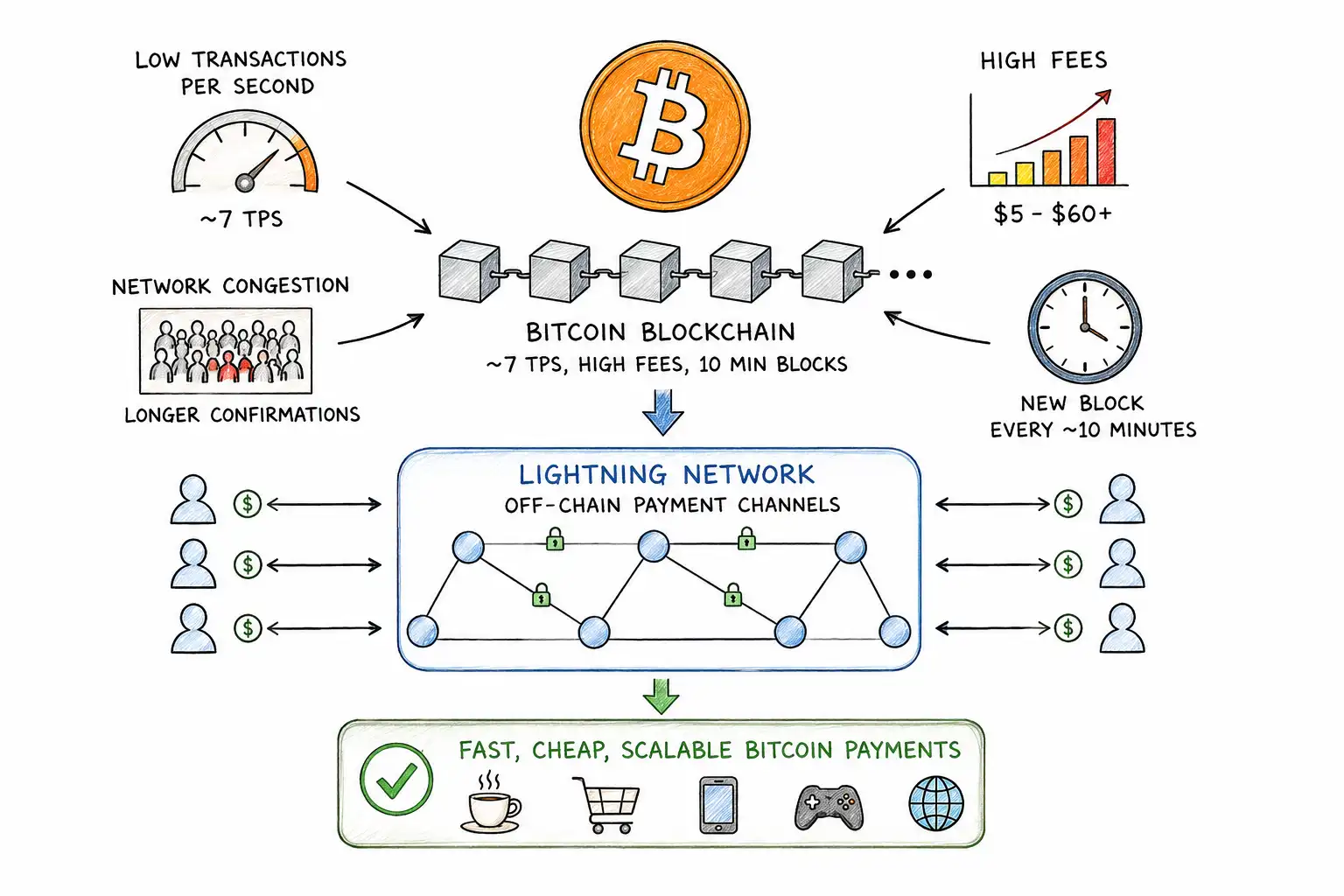
Satoshi Nakamoto’s original white paper described Bitcoin as a “peer-to-peer electronic cash system.” That vision of billions of people making small everyday payments in Bitcoin, from buying a coffee to paying a phone bill, runs into a hard technical wall when you look at what the Bitcoin blockchain can actually handle.
- Transactions per second: The Bitcoin network processes approximately 7 transactions per second. Visa handles around 24,000 per second. For Bitcoin to function as global digital cash, that gap needs closing.
- Transaction fees: Fees on the Bitcoin mainnet fluctuate based on how congested the network is. In April 2021, the average fee exceeded $60. Paying $5 to $60 in fees to buy a $4 coffee makes no practical sense.
- Network congestion: Bitcoin produces a new block approximately every 10 minutes. Each block holds a limited number of transactions. During periods of high demand, users compete to have their transactions included, driving fees up and confirmation times longer.
The Lightning Network was built to address all three of these limitations without changing Bitcoin’s core protocol. Rather than trying to alter Bitcoin itself, which has happened before with contentious hard forks like Bitcoin Cash, Lightning adds a layer on top, preserving Bitcoin’s security and decentralization while dramatically improving its usability for everyday payments.
For a full breakdown of how the Bitcoin blockchain processes transactions at the base layer, see our guide on how Bitcoin works.
How does the Bitcoin Lightning Network work?
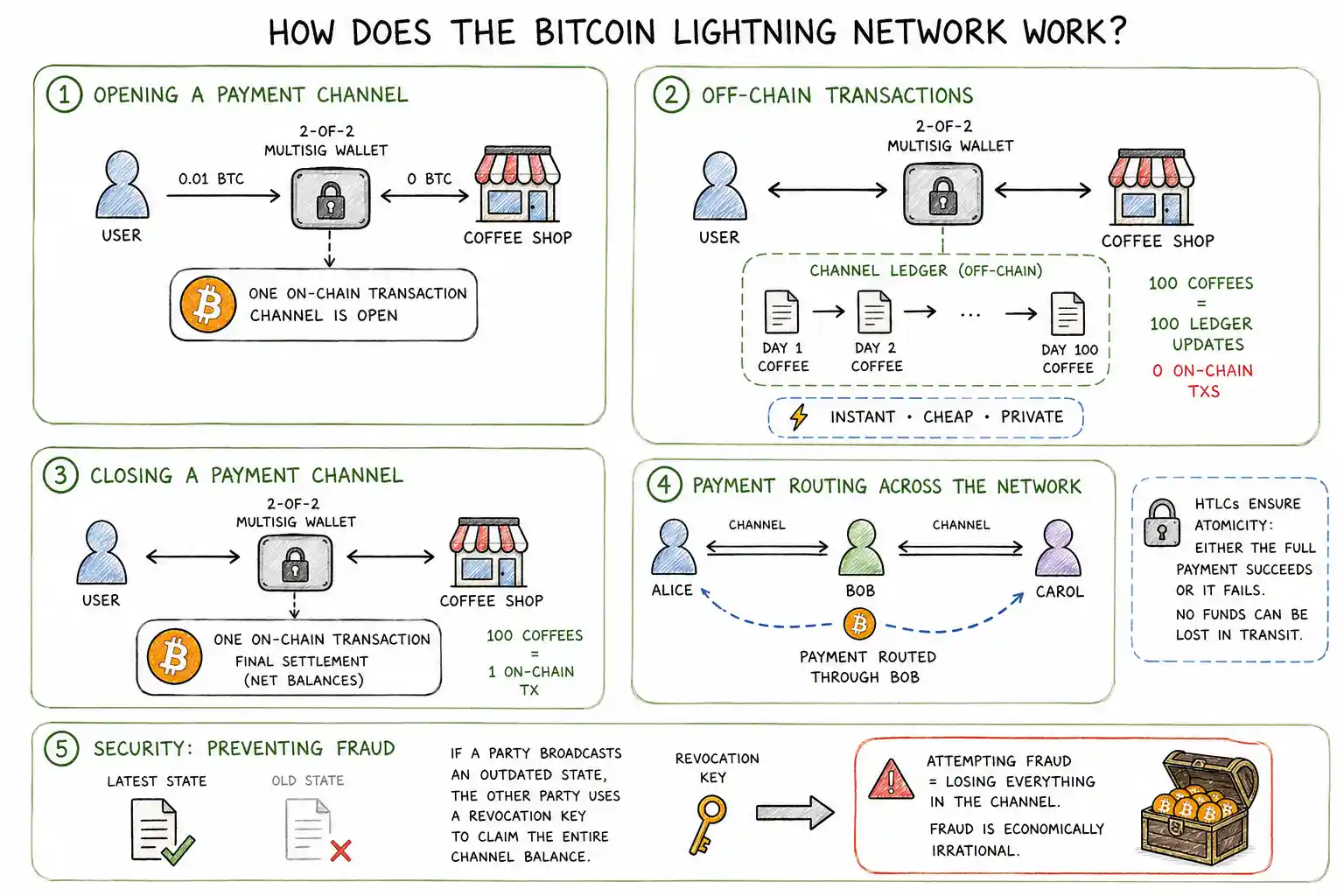
Lightning works through a system of bidirectional payment channels. Two parties open a channel, transact freely within it, and eventually close the channel to settle on the Bitcoin blockchain. The mechanics involve a few moving parts.
Opening a payment channel
To open a payment channel, two users create a multisignature wallet, a shared wallet that both control with their respective private keys. They each deposit an agreed amount of Bitcoin into it. This initial deposit is recorded on the Bitcoin blockchain as a single on-chain transaction. The funds are now locked into the channel and available for transactions between the two parties.
A practical example: a regular customer and a coffee shop open a channel. The customer deposits 0.01 BTC. This creates the channel and records one transaction on the Bitcoin blockchain. Everything that follows happens off-chain.
Off-chain transactions
Once the channel is open, the two parties can send each other unlimited transactions. Each transaction updates a shared ledger inside the channel, a running record of who owns what. None of these transactions are broadcast to the Bitcoin blockchain. They happen instantly, with fees that are fractions of a cent.
The coffee shop customer buys a coffee every morning. Each purchase updates the channel ledger. One hundred coffees over two months result in one hundred ledger updates, not one hundred blockchain transactions. The blockchain sees none of it until the channel closes.
Closing a payment channel
Either party can close the channel at any time. When they do, the final state of the ledger, the net balance after all transactions, is broadcast as a single transaction to the Bitcoin blockchain. Each party receives their correct balance. One hundred coffees become one Bitcoin transaction.
Only the opening and closing of a channel ever touch the main blockchain. This is how Lightning achieves its compression: thousands of payments collapse into two on-chain transactions.
Payment routing across the network
Lightning does not require every pair of users to have a direct channel. If Alice has a channel with Bob, and Bob has a channel with Carol, Alice can pay Carol by routing the payment through Bob. The network automatically finds the best path across available channels.
This routing is secured by Hashed Time-Locked Contracts (HTLCs), a type of smart contract that enforces atomicity. Either the full payment reaches its destination or it fails entirely. No funds can disappear partway through a multi-hop transaction. Nodes along the path see only the previous and next hop, not the origin or destination of the payment.
Security: preventing fraud
A legitimate concern with off-chain systems is that one party might try to cheat by broadcasting an outdated balance sheet that shows them holding more Bitcoin than they actually own after recent transactions. Lightning prevents this with revocation keys. Each party holds a revocation key for the other party’s previous commitment transactions. If someone broadcasts an old state, the other party can use that revocation key to claim the entire channel balance as a penalty. The financial cost of attempting fraud is losing everything in the channel, which makes the attempt irrational in practice.
| Feature | Bitcoin (Layer 1) | Lightning Network (Layer 2) |
|---|---|---|
| Transaction speed | ~10 minutes average | Milliseconds to seconds |
| Transaction fees | $1–$60+ depending on congestion | Fractions of a cent |
| Throughput | ~7 transactions per second | Up to 1 million per second (theoretical) |
| Privacy | All transactions publicly visible | Only channel open/close recorded on-chain |
| Minimum payment | Limited by on-chain fee economics | Sub-satoshi payments possible |
For more on how Bitcoin’s proof-of-work consensus compares to other validation mechanisms used by different networks, see our guide on proof of work vs proof of stake.
A brief history of the Lightning Network
The Lightning Network has a clear origin story that tracks from a white paper to a working global payment network over roughly a decade.
2015: Joseph Poon and Thaddeus Dryja publish the Lightning Network white paper, proposing off-chain payment channels as a solution to Bitcoin’s scalability problem.
May 2016: The Lightning testnet goes live, allowing developers to test the protocol without real funds at risk.
January 2017: The first Lightning Network implementation, lnd by Lightning Labs, is released in alpha stage.
August 2017: Segregated Witness (SegWit) activates on the Bitcoin mainnet. SegWit fixes a transaction malleability issue that was a necessary technical precondition for Lightning to work securely on mainnet.
December 2017: The first real-world Lightning transaction takes place. Developer Alex Bosworth pays his phone bill using Lightning.
2018: Lightning Network launches on Bitcoin mainnet. In a notable callback, Laszlo Hanyecz, who in 2010 made the first known Bitcoin commercial transaction by buying two pizzas for 10,000 BTC, uses Lightning to buy two pizzas again, this time through an off-chain payment.
The Lightning Torch
In January 2019, a pseudonymous Twitter user named Hodlonaut sent 100,000 satoshis to a trusted recipient using Lightning, asking them to add 10,000 satoshis and pass it on. The “Lightning Torch” traveled 292 times across the network, passing through the hands of Jack Dorsey, Lightning Labs CEO Elizabeth Stark, and Binance CEO Changpeng Zhao, among others. It ended at 4,390,000 satoshis, donated to Bitcoin Venezuela, a nonprofit promoting Bitcoin in Venezuela. The exercise was one of the most effective public demonstrations of Lightning working at scale.
For the full story of how Bitcoin developed from the first transaction to its current role in the global financial system, see our Bitcoin history guide.
Benefits of the Bitcoin Lightning Network
Instant payments
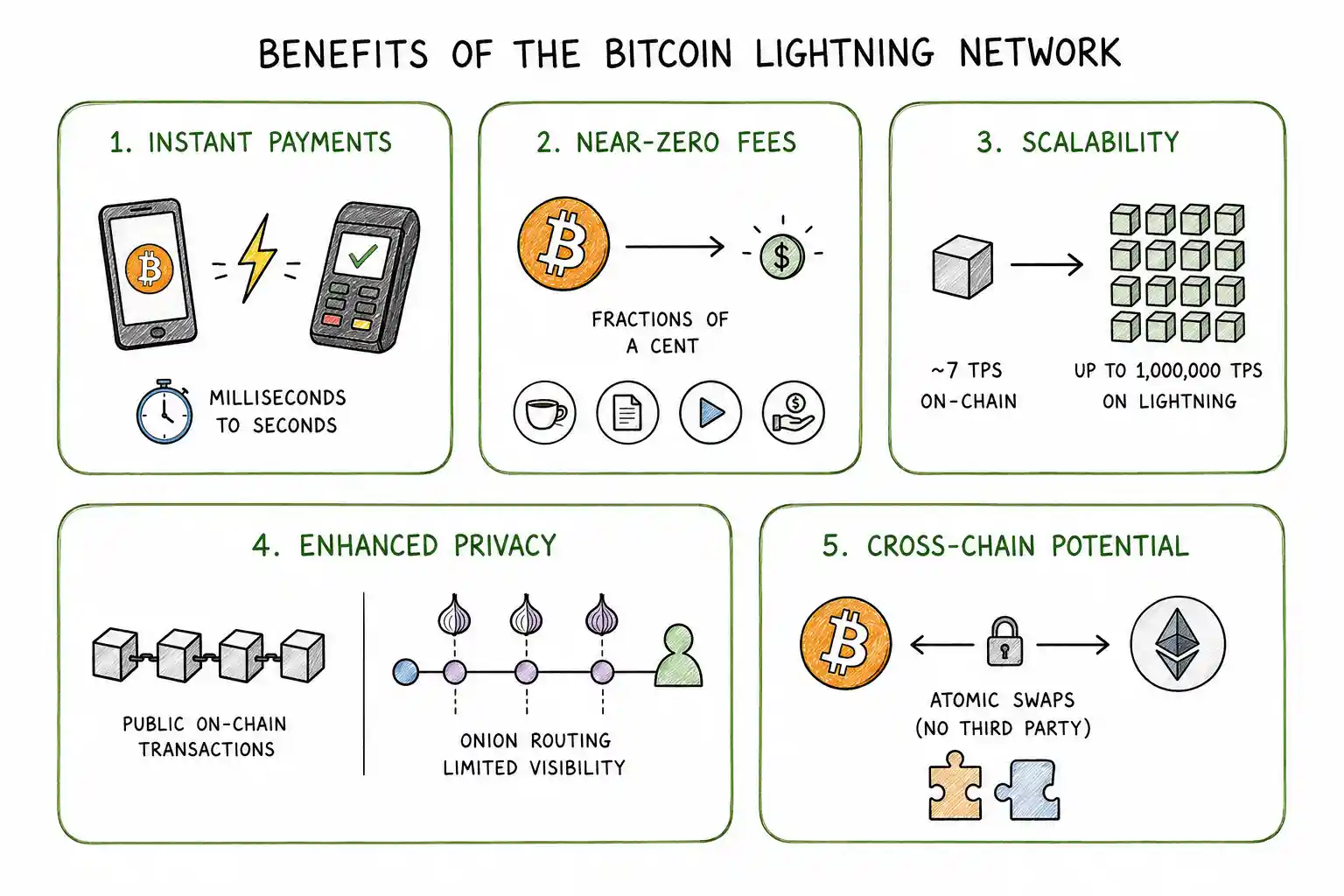
Lightning transactions settle in milliseconds to seconds. There is no block confirmation to wait for, no 10-minute average confirmation window. A payment at a coffee shop or online checkout completes faster than a credit card swipe. This makes Bitcoin practical for everyday commerce in a way the base layer cannot match.
Near-zero transaction fees
Fees on Lightning are fractions of a cent regardless of the payment size. This makes micropayments economically viable for the first time. Sending $0.10 on the Bitcoin mainnet might cost more in fees than the payment itself. On Lightning, the fee is negligible. This opens up use cases that were previously unworkable: tipping content creators, pay-per-article access, pay-per-second streaming, and any other application that requires small, frequent transfers.
Scalability
The Bitcoin blockchain processes approximately 7 transactions per second. Lightning’s theoretical ceiling is up to 1 million transactions per second. The capacity is limited only by the number of active channels and nodes on the network, not by block size or block time. This puts Lightning in a different category from the main blockchain when it comes to handling high transaction volumes.
Enhanced privacy
Every transaction on the Bitcoin blockchain is publicly visible. Using Lightning, only the opening and closing of a channel is recorded on-chain. Individual payments within the channel are not broadcast globally. The routing protocol adds another layer: each node along a payment path knows only the previous and next hop, not the source or final destination. This onion routing design means even the intermediary nodes have limited visibility into what they are routing.
Cross-chain potential
Lightning’s design theoretically supports atomic swaps, which are direct exchanges between different blockchains that use compatible cryptographic hash functions, without a third-party custodian. If two chains can support the same hash function, a Lightning-style channel can settle trades between them. This is still in relatively early stages of development but represents a longer-term direction for the protocol.
How to use the Bitcoin Lightning Network
Getting started with Lightning is more accessible than it was in 2018. Modern wallets handle most of the technical complexity automatically.
Step 1: Choose a Lightning-compatible wallet
Your choice of wallet determines how much control and how much simplicity you get. The main options:
- Phoenix (non-custodial, mobile): automatically manages channels in the background. You control your keys. Good balance of simplicity and self-custody.
- Breez (non-custodial, mobile): includes a podcast player with streaming payments and a point-of-sale mode for merchants.
- Muun (non-custodial, mobile): beginner-friendly interface, non-custodial with automatic channel management.
- Zeus (non-custodial, advanced): designed for users running their own Lightning node. More control, more complexity.
- Cash App (custodial): the simplest onboarding for complete beginners. Cash App holds the keys on your behalf, which means less responsibility but also less control.
- Strike (custodial): focused on cross-border remittances and Bitcoin-denominated tips.
The custodial vs. non-custodial distinction matters. Custodial wallets like Cash App and Strike hold your private keys on your behalf; they are easier to use but introduce third-party risk. Non-custodial wallets like Phoenix and Breez give you full control over your funds. For more on why private key control matters, see our guide on private key crypto.
Step 2: Fund your Lightning wallet
Transfer Bitcoin from a regular Bitcoin wallet to your Lightning wallet, or buy Bitcoin directly within the Lightning wallet if the app supports it. The minimum funding amount varies by wallet. Non-custodial wallets typically require a small on-chain transaction to fund the initial channel, which carries a one-time fee. After that, moving funds within Lightning costs almost nothing.
Step 3: Open a channel or connect to the network
Modern Lightning wallets like Phoenix open and manage channels automatically. When you send or receive your first Lightning payment, the wallet creates the necessary channel in the background without requiring any manual action. More advanced users running their own node can open channels manually toward specific well-connected nodes to improve routing reliability and capacity.
Opening a channel requires an on-chain Bitcoin transaction, so there is a small one-time fee. This fee covers the cost of recording the channel opening on the Bitcoin blockchain.
Step 4: Send and receive payments
To receive a payment, generate a Lightning invoice, a string of characters or a QR code that encodes the payment amount and destination. Share it with the sender. Payment arrives in seconds. Lightning addresses (formatted like an email address, for example satoshi@strike.me) allow others to send you Bitcoin at any time without generating a new invoice each time.
To send a payment, scan or paste a Lightning invoice, confirm the amount, and approve. The network routes the payment automatically. You do not need to know or manage the path it takes.
Lightning Network use cases
The combination of instant settlement and near-zero fees opens up applications that Bitcoin’s base layer cannot support economically.
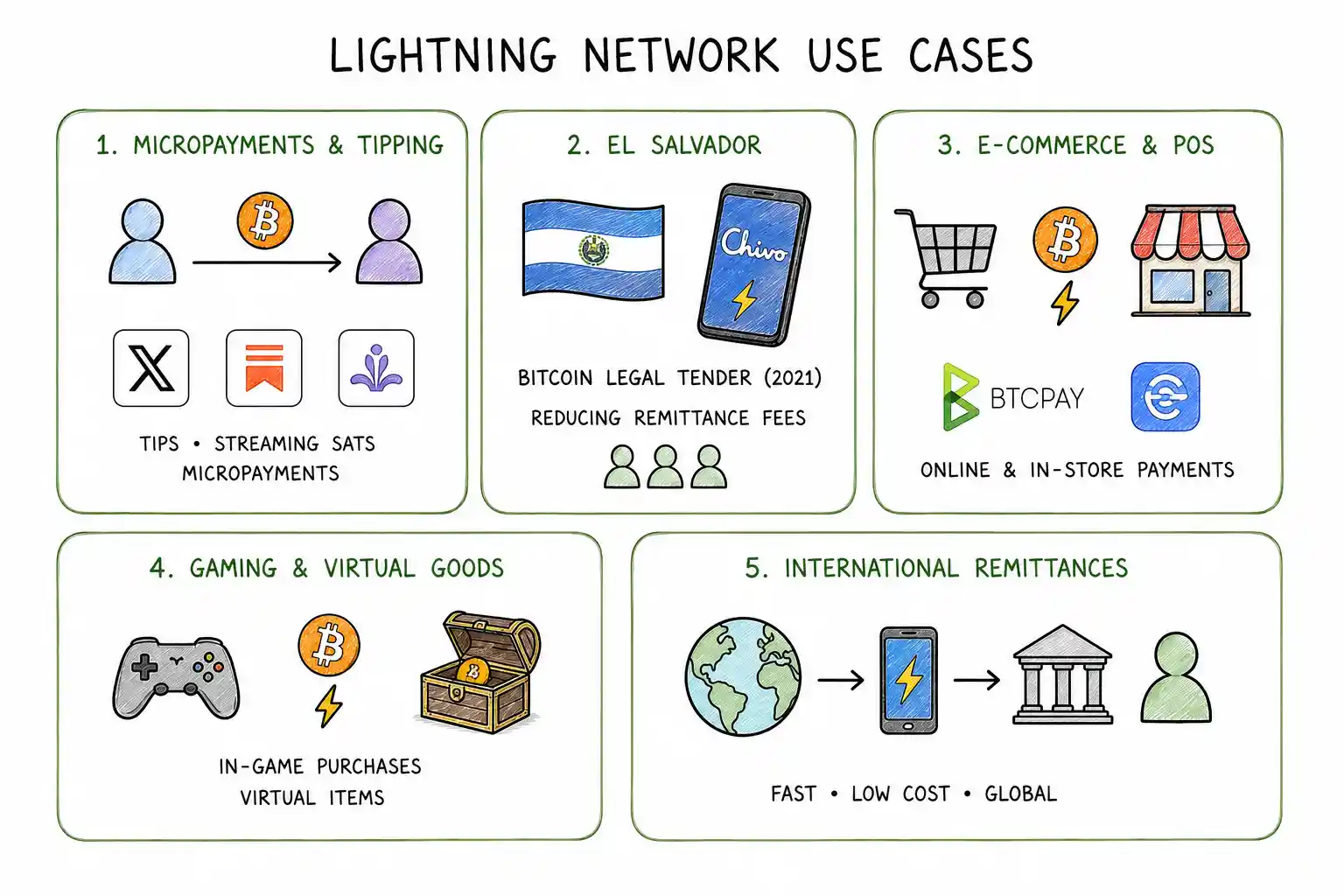
Micropayments and tipping: Twitter/X allows users to send Bitcoin tips to creators using Lightning through Strike integration. Substack supports Bitcoin payments. Podcast apps like Fountain and Breez allow “streaming sats,” tiny fractions of a Bitcoin sent per second of audio content listened to. Tipping creators directly with sub-cent payments was not viable on the Bitcoin mainnet.
El Salvador: When El Salvador made Bitcoin legal tender in 2021, the government built Chivo, a Lightning-compatible wallet deployed to citizens. The stated goal was to reduce the estimated $400 million per year Salvadorans pay in fees sending remittances from abroad. It was the first national-scale deployment of Lightning as a payment infrastructure.
E-commerce and point of sale: BTCPay Server, a self-hosted payment processor, supports Lightning payments for online merchants. Brick-and-mortar stores can accept Lightning payments through apps like Breez’s point-of-sale mode.
Gaming and virtual goods: Instant micropayments make Lightning suitable for in-game purchases, virtual item transactions, and pay-per-play models where mainnet fees would consume more value than the transaction itself.
International remittances: Strike and similar apps route cross-border transfers through Lightning, converting local currency to Bitcoin on one end and back to local currency on the other, with the Lightning settlement taking seconds at near-zero cost.
To understand how DeFi applications on other networks handle some of these same use cases in a different technical environment, see our guide on what is DeFi.
Lightning Network limitations and challenges
Channel management complexity
Opening and closing channels requires on-chain Bitcoin transactions with associated fees. For users running their own Lightning node, managing channel capacity, rebalancing channels, and optimizing routing is technically demanding. Modern wallets abstract most of this complexity away, but users who want full control need to invest time in understanding how channels work.
Liquidity requirements
Every payment channel has a fixed capacity determined by how much Bitcoin was locked in at opening. A payment cannot exceed the capacity of the channel path it travels through. Inbound liquidity, meaning the ability to receive payments, requires that someone else has opened a channel to you with funds on their side. New users often find it difficult to receive Lightning payments until they have established inbound liquidity.
Online requirement
To receive Lightning payments, a node generally needs to be online. If you are offline when someone tries to pay you, the payment may fail or need to be rerouted. Watchtower services can monitor your channels while you are offline and protect against fraud, but they add complexity. Custodial wallets handle this by keeping the node online for you, at the cost of giving up key custody.
Routing failures
Lightning routes payments through available channels. If there is insufficient liquidity at some point along the best path, the payment fails and the network tries an alternative route. Routing failures are less frequent than in Lightning’s early days, but they still occur, particularly for larger amounts in less-connected parts of the network.
Security vulnerabilities
Researchers have identified several categories of potential attacks on the Lightning Network. Griefing attacks lock up a target’s Lightning funds without stealing them, preventing the channel from processing transactions. Pinning attacks and time-dilation attacks require simultaneous changes to both Lightning implementations and Bitcoin Core to fully address. Developers consider finding and documenting these vulnerabilities as a normal and necessary part of maturing the protocol. The level of technical expertise required to execute most of these attacks is high, and no large-scale theft exploiting them has been publicly documented.
Lightning Network vs. other Bitcoin Layer 2 solutions
Lightning is not the only approach to scaling Bitcoin transactions. Understanding how it compares to alternatives helps clarify what it is best suited for.
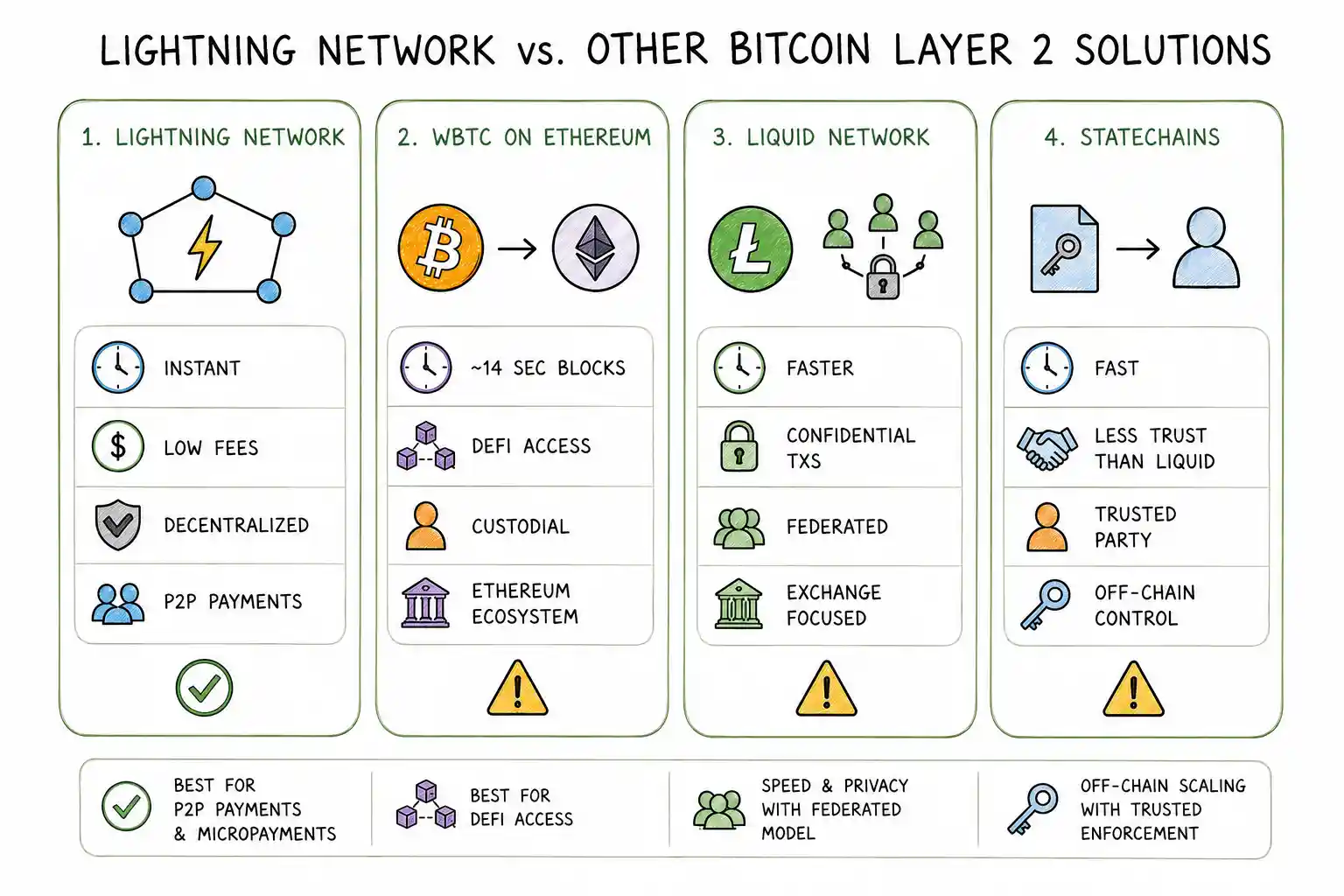
Wrapped Bitcoin (WBTC) on Ethereum: More than 150,000 BTC sits on Ethereum as WBTC, a tokenized representation of Bitcoin that can be used in Ethereum-based DeFi protocols. Ethereum’s block time of approximately 14 seconds is already faster than Bitcoin’s 10 minutes. WBTC also gives Bitcoin holders access to decentralized lending, trading, and liquidity pools. The tradeoff is custodial risk: a centralized custodian holds the real Bitcoin and issues the WBTC. Lightning is peer-to-peer and does not require trusting a custodian.
Liquid Network: A federated sidechain for Bitcoin operated by Blockstream and a consortium of exchanges. Liquid processes transactions faster than the Bitcoin mainnet and supports confidential transactions. It is not decentralized in the same way as Lightning: control rests with a defined set of federation members.
Statechains: A protocol that transfers control of an unspent transaction output (UTXO) off-chain by handing over the private key to a new owner, using a trusted party to enforce the transfer sequence. Fewer trust assumptions than Liquid but still relies on a third party.
Each approach makes different tradeoffs between speed, decentralization, DeFi access, and user experience. Lightning remains the most established option for peer-to-peer Bitcoin micropayments. WBTC and Ethereum Layer 2 solutions lead for DeFi access. The spaces serve different needs and are not direct substitutes.
For more on Bitcoin’s position relative to other cryptocurrencies and how capital moves across different networks, see our guide on Bitcoin dominance.
What is the future of the Bitcoin Lightning Network?
As of March 2026, the Lightning Network has over 17,000 public nodes and approximately 40,000 public payment channels, with around 4,900 BTC locked in public capacity. The actual network is larger; a significant portion of channels are private and not included in these figures.
Several developments are shaping what comes next:
Taproot: The Taproot upgrade to Bitcoin, activated in November 2021, improves the privacy of Lightning channel opening and closing transactions. Under Taproot, these on-chain transactions are indistinguishable from regular Bitcoin transactions to chain analysis tools, reducing the fingerprinting of Lightning activity.
Splicing: An in-development feature that allows funds to be added to or removed from an open channel without closing it first. Currently, adding funds to a channel requires closing it, sending the funds, and opening a new one: three on-chain transactions. Splicing would reduce this to one.
Lightning addresses: The lightning address standard, formatted like an email address, removes the need to generate a new invoice for every payment. This significantly simplifies the user experience for receiving payments and has been adopted by a growing number of wallets and services.
The central challenge remains centralization. Routing payments across the network naturally favors well-connected, high-capacity nodes that sit at the center of the graph. In practice, Lightning has developed some hub-and-spoke characteristics, with large nodes routing a disproportionate share of traffic. Whether the network can maintain meaningful decentralization at scale is an ongoing question.
For a broader perspective on how Bitcoin’s design was intended to work and what Satoshi Nakamoto’s original goals were, see our piece on who created Bitcoin.
Current Lightning Network statistics are tracked in real time at mempool.space/lightning and 1ML.com, which both provide node counts, channel counts, and total network capacity.
Frequently asked questions
What is the Bitcoin Lightning Network in simple terms?
The Lightning Network is a payment layer built on top of Bitcoin that allows users to send Bitcoin instantly and at almost no cost. It does this by opening private payment channels between users where transactions are processed off the main Bitcoin blockchain. Only when a channel is opened or closed does a transaction appear on the Bitcoin blockchain itself. Everything in between happens off-chain in seconds.
Does the Lightning Network have its own token or coin?
No. The Lightning Network has no native token or separate currency. All transactions use real Bitcoin (BTC). There is no “Lightning coin” or “LN token.” Lightning is a protocol, a set of rules for how Bitcoin transactions can be processed off-chain. If you see a product or service claiming to offer a Lightning token, treat that with serious skepticism.
Is the Bitcoin Lightning Network safe?
Lightning is considered reasonably safe for everyday use, but it carries risks that do not apply to holding Bitcoin on the main blockchain. The main risks are: channel counterparty behavior (mitigated by revocation keys), routing failures on larger payments, and the need to be online to receive payments. Researchers have identified theoretical attack vectors like griefing attacks, but large-scale losses from these have not been publicly documented. For amounts you plan to hold long term, the Bitcoin mainnet remains the more conservative option.
Who created the Lightning Network?
The Lightning Network was proposed by Joseph Poon and Thaddeus Dryja in a white paper published in 2015. Lightning Labs, co-founded by Elizabeth Stark, has been the primary development organization behind the most widely used implementation. Three major implementations exist today: LND by Lightning Labs, Core Lightning by Blockstream, and Eclair by ACINQ.
What wallets support the Bitcoin Lightning Network?
Widely used Lightning-compatible wallets include Phoenix, Breez, Muun, and Zeus on the non-custodial side, and Cash App and Strike on the custodial side. Phoenix and Breez are the most recommended for users who want to control their own keys without dealing with manual channel management. Cash App has the simplest onboarding for complete beginners. Wallet support for Lightning continues to grow across both mobile and desktop platforms.
What is the difference between Bitcoin and the Lightning Network?
Bitcoin is the base layer blockchain, the source of truth for all final balances and the network that provides security through proof-of-work mining. The Lightning Network is a payment layer built on top of it. Bitcoin without Lightning processes about 7 transactions per second with fees that vary from $1 to $60 or more. Lightning handles the same Bitcoin payments at millions of transactions per second with fees below a cent. The two are not competing systems: Lightning depends on Bitcoin and settles back to it.
How much does it cost to use the Lightning Network?
Sending and receiving payments on Lightning costs fractions of a cent in most cases. The main costs to be aware of are: a one-time on-chain Bitcoin fee to open a channel (variable, depends on mainnet congestion at the time), routing fees paid to nodes that relay a payment (typically very small, often zero on short paths), and a one-time on-chain fee to close a channel when you are done. For users on custodial wallets like Cash App or Strike, these costs are mostly handled invisibly by the service.
Can Lightning Network transactions be reversed?
No. Like Bitcoin transactions on the mainnet, Lightning payments are final once confirmed. There is no chargeback mechanism, no dispute resolution process, and no third party who can reverse a completed Lightning payment. This is by design: it is one of the properties that makes Lightning suitable as a settlement layer, but it also means that sending to the wrong address or sending the wrong amount has no remedy.