Bitcoin is a digital payment system that runs on a network of computers with no bank or government in the middle. When you send bitcoin to someone, a global network of computers verifies the transaction, records it permanently, and does all of this without asking permission from any financial institution. Understanding how that actually happens requires understanding three things: the problem Bitcoin was built to solve, the blockchain it runs on, and the mining process that keeps it honest.
This guide walks through each of those in plain terms.
- Bitcoin is a peer-to-peer electronic payment system that requires no trusted third party
- Transactions are recorded on a shared public ledger called the blockchain
- Miners add new transactions to the blockchain by solving a mathematical puzzle
- Ownership of bitcoin is established through private keys, not usernames or accounts
- New bitcoin enters circulation through mining, at a rate that halves roughly every four years
What problem did Bitcoin solve?
Before Bitcoin, any attempt to build a digital payment system without a bank ran into the same obstacle. When you send a physical note to someone, you no longer have it. But when you send a digital file, you can keep a copy. Applied to money, this creates a problem called double-spending: you could theoretically send the same digital coin to two different people at the same time, and both transactions would look equally valid on the receiving end.

Previous digital payment systems handled this by running everything through a central authority. A bank checks your balance before approving a transfer. That works, but it also means you need to trust the bank. You need their permission to open an account, send money, and receive it. There is a single institution in the middle that can freeze your funds, refuse a transaction, or fail entirely.
Bitcoin’s creator, writing under the name Satoshi Nakamoto, published a solution in October 2008. Instead of a central authority keeping the record of who owns what, the record would be kept by a network of thousands of computers simultaneously. Every computer on the network holds the same copy. When a new transaction is added, every copy updates at the same time. Because no single computer controls the record, there is no single point that can be corrupted, censored, or shut down.
The double-spending problem is solved by making it effectively impossible to insert a conflicting transaction after the fact, which is where the blockchain and the mining process come in.
How does a Bitcoin transaction work?
When you send bitcoin to another person, your Bitcoin wallet creates a transaction. That transaction contains three things: the amount being sent, the recipient’s wallet address, and a digital signature created using your private key. The signature proves you authorised the transfer without revealing the private key itself.
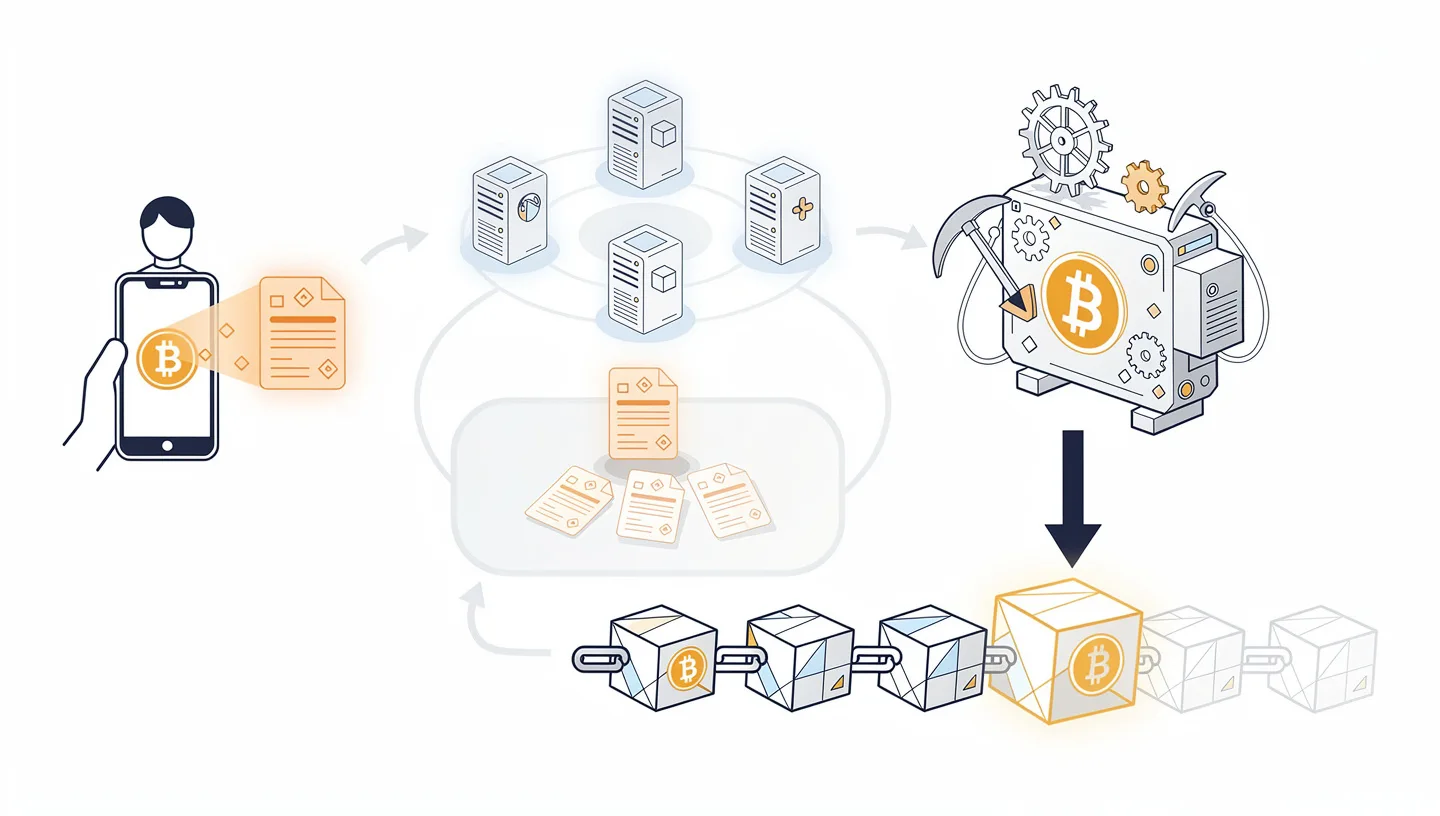
Once created, the transaction is broadcast to the Bitcoin network. Every computer connected to the network receives a copy of it. These computers, called nodes, check the transaction against the existing record to confirm that you actually own the bitcoin you are trying to send and that you have not already spent it elsewhere. If the transaction is valid, nodes hold it in a waiting area called the mempool (short for memory pool) until a miner picks it up.
From the mempool, a miner collects a batch of pending transactions and attempts to add them to the blockchain as a new block. When that block is successfully added, the transactions inside it are considered confirmed. The more blocks that are added on top of it after that point, the more permanent the record becomes.
For most everyday transfers, one confirmation is enough. For larger amounts, six confirmations is the commonly accepted standard, meaning six blocks have been added after the one containing your transaction. Each block takes roughly ten minutes on average, which means six confirmations takes about an hour.
What is the Bitcoin blockchain?
The blockchain is the public record of every Bitcoin transaction ever made. It is stored simultaneously on thousands of computers around the world, and every copy is identical. It is called a blockchain because data is grouped into blocks that are linked together in a chain.
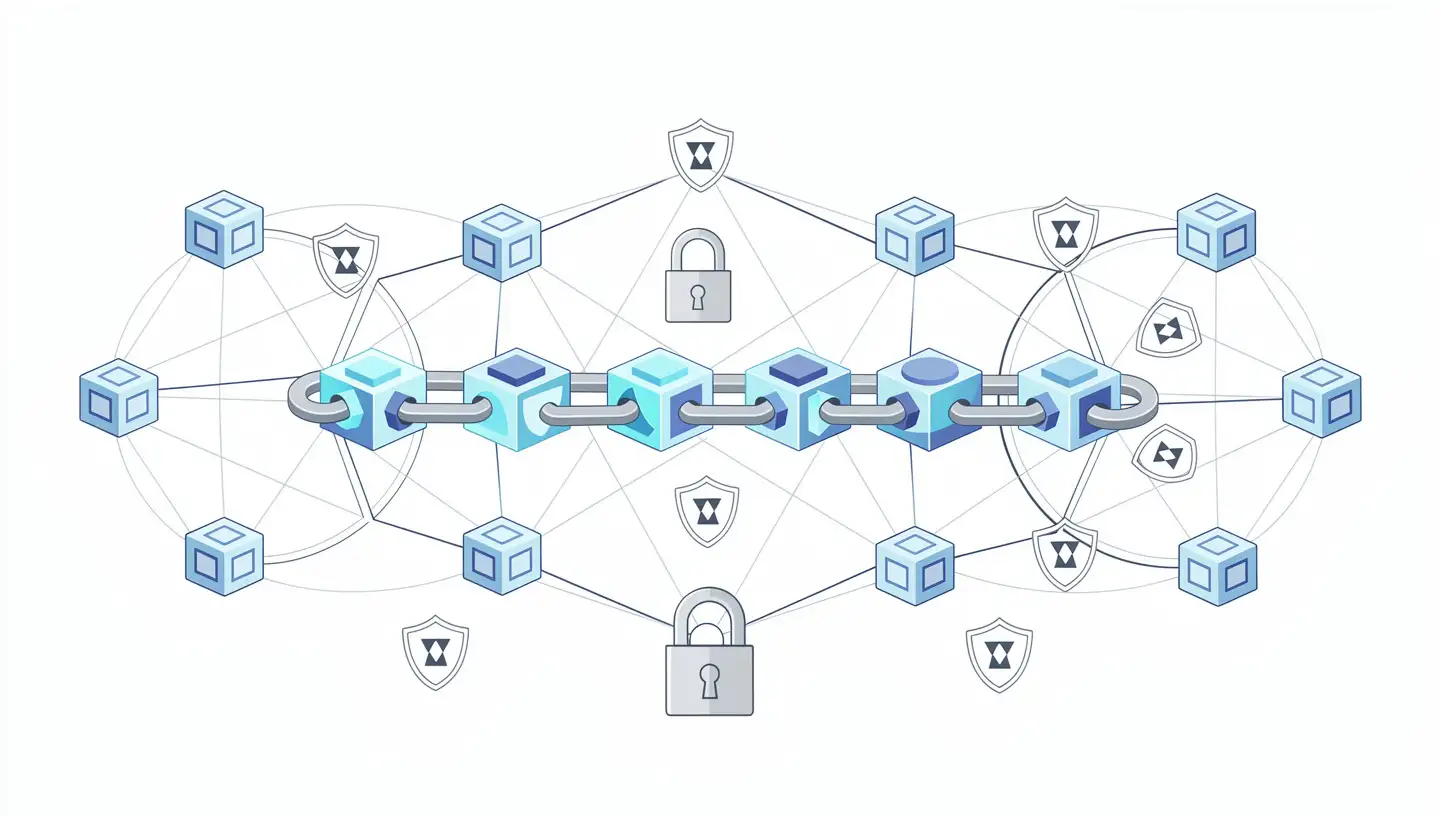
Each block contains a batch of confirmed transactions, a timestamp, and a unique identifier called a hash. A hash is a fixed-length string of characters generated by running the block’s data through a mathematical function called SHA-256. Change anything inside the block, even a single character, and the hash changes completely. Each block also contains the hash of the block before it. This creates the chain: every block references its predecessor, all the way back to the very first block, which is called the genesis block.
This linking structure is what makes the blockchain tamper-resistant. To alter a transaction in an old block, you would have to recalculate the hash of that block, then recalculate every block after it, all while the rest of the network keeps adding new blocks at its normal pace. In practice this is not feasible on a large, established network like Bitcoin.
You can read a full explanation of how blockchain technology works in our guide to what is blockchain technology and how does it work.
What is Bitcoin mining?
Mining is the process by which new transactions are grouped into blocks and permanently added to the blockchain. It is also the process by which new bitcoin enters circulation.
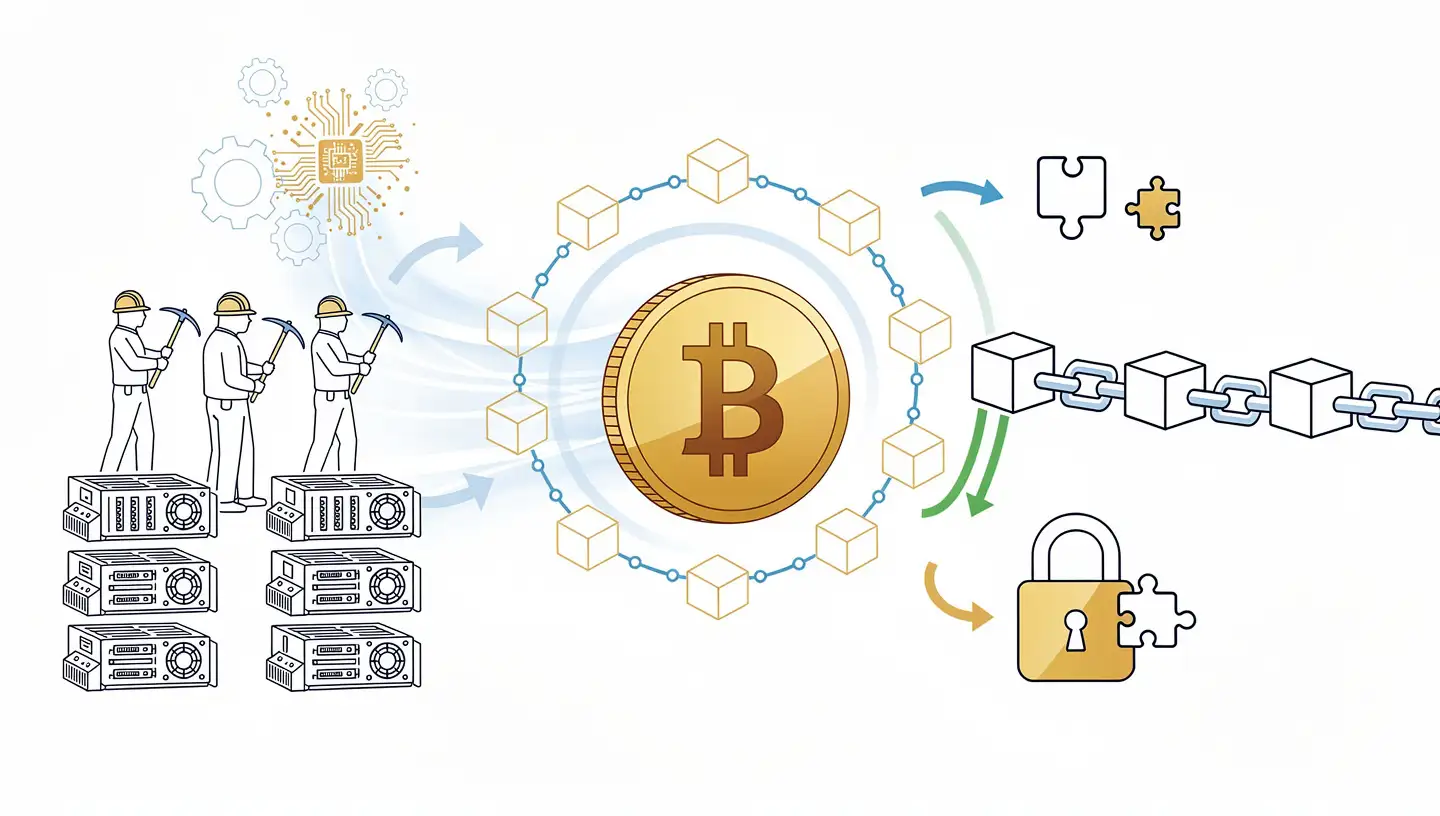
The two functions are deliberately linked: miners do the work of maintaining the record, and they get paid in newly created bitcoin for doing it.
What is proof of work?
Proof of work is the mechanism Bitcoin uses to decide which miner earns the right to add the next block. Miners compete to solve a mathematical puzzle. The puzzle requires them to find a number, called a nonce, that when combined with the block’s data and run through the SHA-256 hash function, produces a hash that meets a specific target. The target looks like a hash that starts with a certain number of leading zeros. The more zeros required, the harder the puzzle.
There is no shortcut to finding the nonce. Miners have to try numbers one by one, billions of times per second, until they find one that works. The first miner to find a valid nonce broadcasts the completed block to the network. Other nodes check the result, and if the block is valid, they add it to their copy of the blockchain and begin working on the next block. The winning miner receives the block reward.
What is a hash and a nonce?
A hash is the output of a mathematical function that takes any amount of data as input and produces a fixed-length output. The same input always produces the same output. Change anything in the input, even by one character, and the output changes entirely. SHA-256 is the specific function Bitcoin uses. It always produces a 64-character string.
A nonce stands for “number used once.” It is a number that miners insert into the block header and adjust repeatedly, trying to find a combination that produces a hash below the target. Because the hash function is unpredictable, the only way to find the right nonce is by trial and error. This is what makes mining computationally expensive and why it requires specialised hardware.
What does a miner actually do?
In practical terms, a miner is a computer running specialised software and hardware designed to calculate as many hashes per second as possible. The hardware used today is called ASIC (application-specific integrated circuit), which is built for nothing but Bitcoin mining. A single modern ASIC can calculate tens of trillions of hashes per second.
Mining operations range from single machines run by individuals to large warehouses full of ASICs that run around the clock. Because the competition is intense, many miners join mining pools, where they combine their computing power and share the rewards proportionally, reducing the variance in their income.
Who decides which transactions are valid?
The short answer is: the network does. Bitcoin’s network consists of two types of participants: nodes and miners. They are different things with different roles, and both are necessary.
A node is a computer running the Bitcoin software that holds a full copy of the blockchain. Nodes check every transaction against the rules of the protocol and reject anything that breaks those rules, such as a transaction where the sender tries to spend bitcoin they do not own, or a block that does not meet the required proof of work. Nodes also relay valid transactions and blocks across the network.
Miners are a specific type of node that performs the additional task of creating new blocks. A miner proposes the next block by doing the proof-of-work calculation. But the block only becomes part of the accepted blockchain if other nodes verify it and accept it. A miner cannot unilaterally rewrite the record. The rest of the network would reject an invalid block.
This separation is important. It means the rules of Bitcoin are not enforced by any single entity. Every node enforces them independently. Any single node can be taken offline without affecting the network. Any single miner can drop out without stopping transactions.
How does Bitcoin prevent fraud and double-spending?
Once a transaction is confirmed in a block, reversing it would require an attacker to redo the proof-of-work for that block and every block added after it, faster than the rest of the network is adding new blocks. This is known as a 51% attack, because it would require the attacker to control more than 51 percent of all the computing power on the network.
On the Bitcoin network, the combined computing power of all miners is enormous. As of 2025, it is measured in hundreds of exahashes per second. Controlling 51 percent of that would require an investment in hardware and electricity that would cost billions of dollars, and the cost would grow as more miners join the network. The economic incentive to attack the network is also undermined by the fact that a successful attack would likely destroy confidence in Bitcoin, collapsing the value of the coins an attacker would have just spent billions to acquire.
For these reasons, the Bitcoin network has been running continuously since January 2009 without the blockchain itself ever being successfully altered. Individual wallets and exchanges have been hacked, but the underlying transaction record has not.
What is the Bitcoin halving and why does it matter?
When a miner successfully adds a new block, they receive a reward of newly created bitcoin. This is called the block reward. It is the only way new bitcoin enters circulation. The block reward is not fixed permanently. It is cut in half approximately every 210,000 blocks, which works out to roughly every four years. This event is called the halving.
The halving schedule is built into Bitcoin’s code and cannot be changed without the agreement of the entire network. Here is how the reward has changed over time:
- 2009: 50 BTC per block
- 2012: 25 BTC per block
- 2016: 12.5 BTC per block
- 2020: 6.25 BTC per block
- 2024: 3.125 BTC per block
The halving continues until the total supply reaches 21 million bitcoin, which is expected around the year 2140. After that, miners will earn only transaction fees rather than a block reward. The fixed and predictable supply schedule is one of Bitcoin’s core design decisions. It is what makes Bitcoin’s supply fundamentally different from a currency that a central bank can expand at will.
How does Bitcoin ownership work?
Bitcoin ownership is not tied to a name, an email address, or an account at a company. It is established entirely through cryptography.
Public and private keys
Every bitcoin holder has two mathematically related keys. The public key is derived from the private key and can be shared openly. The private key is a randomly generated number that must be kept secret. Together they work like a lock and a unique key: anyone can send bitcoin to a public key, but only the holder of the corresponding private key can spend it.
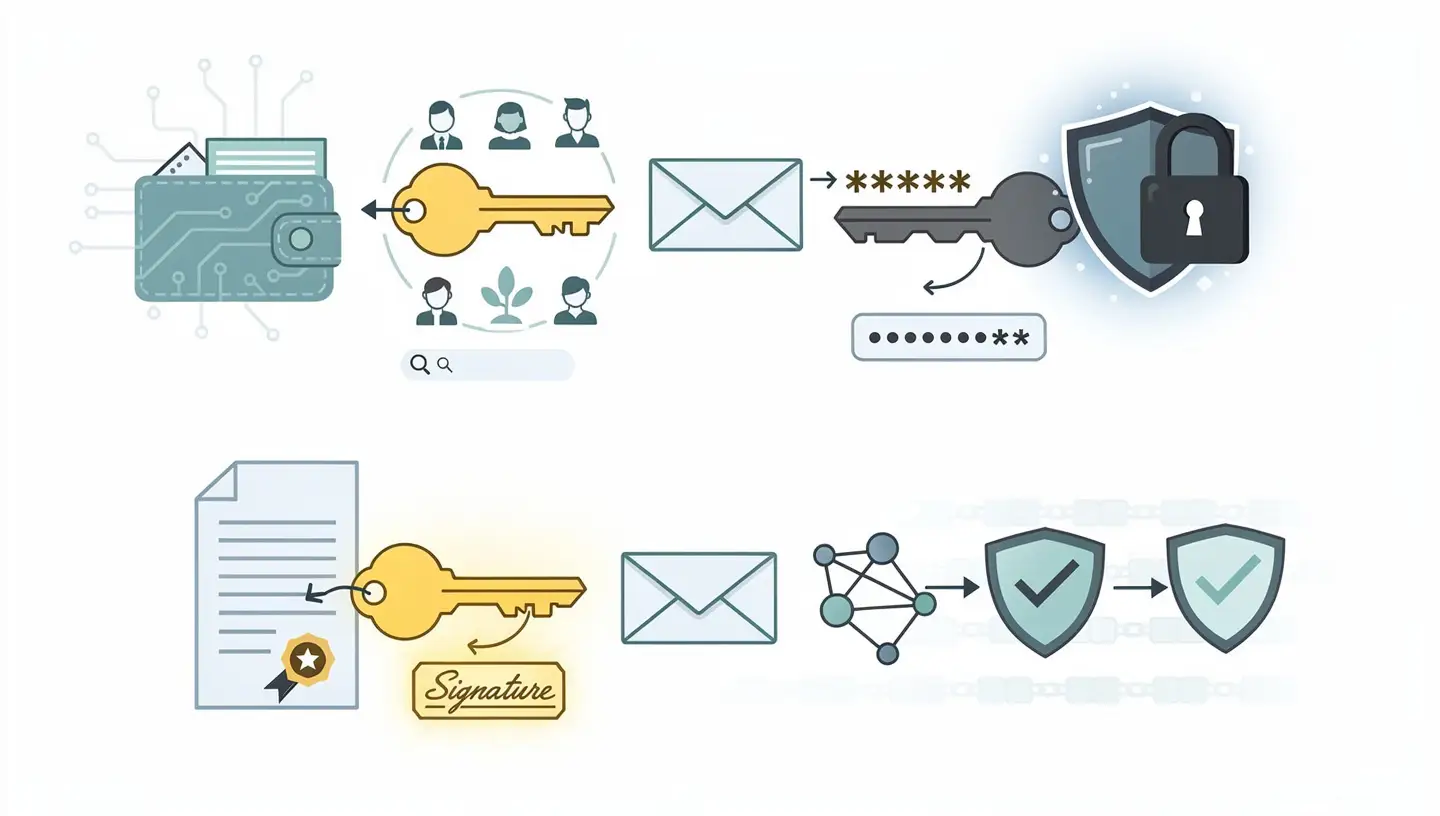
When you create a transaction to send bitcoin, your wallet uses your private key to generate a digital signature. This signature proves you authorised the transfer without revealing the private key itself. Nodes on the network can verify the signature using the public key, confirming it is genuine, and then check the blockchain to confirm you own the bitcoin you are sending.
In crypto, a private key is the only proof of ownership that matters. If you lose it, you lose access to your bitcoin permanently. If someone else gets it, they can take your bitcoin and there is no way to reverse that. This is fundamentally different from a bank account, where a lost password can be recovered and a fraudulent transaction can be disputed.
Bitcoin addresses
A bitcoin address is derived from the public key. It is the string of letters and numbers you share with someone when you want to receive bitcoin, similar in function to a bank account number. Most wallets generate a new address for each transaction to improve privacy, though all addresses associated with a wallet are controlled by the same private key.
Every address and its entire transaction history is publicly visible on the blockchain. Anyone can look up an address and see every transaction it has ever been involved in. The addresses themselves are not tied to actual identities unless a connection is made through an exchange that requires identity verification.
How long does a Bitcoin transaction take?
The time it takes for a Bitcoin transaction to be confirmed depends on two things: how busy the network is, and how much you pay in transaction fees.
New blocks are added to the Bitcoin blockchain on average every 10 minutes. That is not a guarantee, it is an average. The Bitcoin protocol automatically adjusts the difficulty of the mining puzzle every 2,016 blocks, roughly every two weeks, to keep the block time close to 10 minutes regardless of how much computing power is on the network at any given time.
When you create a transaction, you specify a fee. Miners tend to prioritise transactions with higher fees, because they keep those fees in addition to the block reward. If the network is congested and many transactions are waiting in the mempool, a low fee can mean your transaction sits unconfirmed for hours. A higher fee moves it to the front of the queue.
| Confirmations | Approximate time | Typical use |
|---|---|---|
| 0 (unconfirmed) | Immediate | Small, low-risk transactions only |
| 1 confirmation | ~10 minutes | Most everyday transactions |
| 3 confirmations | ~30 minutes | Medium-value transfers |
| 6 confirmations | ~60 minutes | Large transactions, exchanges |
Six confirmations is the widely accepted standard for treating a Bitcoin transaction as irreversible. At that point, an attacker would need to redo six blocks’ worth of proof-of-work to alter the record, which is computationally and economically impractical.
Why does Bitcoin have value?
The value of bitcoin is ultimately set by what buyers and sellers agree on at any given time. But there are several factors that underpin the demand side of that equation.
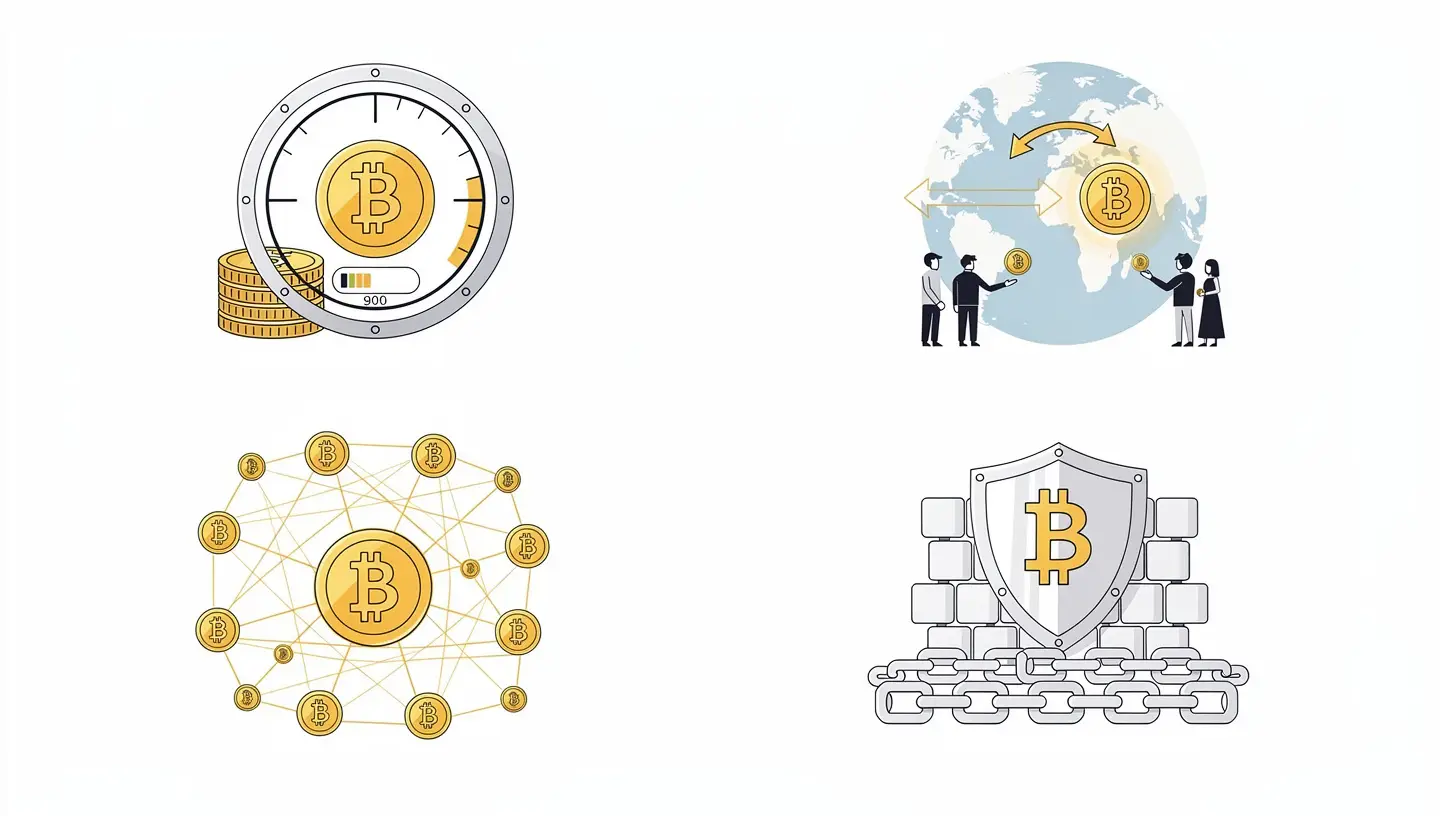
Scarcity. There will only ever be 21 million bitcoin. That limit is written into the code and enforced by the network. No government can decide to create more of it. This is a fundamentally different supply model from any government-issued currency, and it is the primary reason Bitcoin is often compared to gold. You can read more about Bitcoin specifically in our guide to what is Bitcoin.
Utility. Bitcoin can be sent to anyone in the world, at any time, without a bank. For cross-border payments, remittances, and transfers where traditional banking is slow or expensive, bitcoin offers a practical alternative. That utility creates demand independent of speculation.
Network effect. Bitcoin has been operating since 2009 and has the largest and most secure network of any cryptocurrency. The more people and institutions hold and accept it, the more useful it becomes. More useful means more demand. More demand means higher price, which attracts more participants, reinforcing the cycle.
Trust in the protocol. Bitcoin’s rules have not changed in any fundamental way since it launched. The supply cap, the halving schedule, and the proof-of-work mechanism have all operated exactly as designed. That consistency builds trust over time, and trust is a prerequisite for any form of money.
The bottom line
Bitcoin works by replacing the trusted institution in the middle of a financial transaction with a mathematical system and a network of computers that enforce the rules independently. Transactions are broadcast to the network, verified by nodes, grouped into blocks by miners, and recorded permanently on the blockchain. The proof-of-work mechanism makes falsifying records impractical. The fixed supply schedule and halving mechanism mean that new bitcoin enters circulation at a predictable, diminishing rate until the cap is reached.
The system has been running without interruption since January 2009. In that time, it has processed hundreds of millions of transactions without the blockchain itself being compromised. That track record is part of what gives the system credibility and part of what makes it different from every previous attempt at digital money.
For the wider context of where Bitcoin fits in the cryptocurrency market, our guide to what is cryptocurrency covers the full picture.
If you want to understand who built this system and why, our guide to Bitcoin history covers the story from the 2008 whitepaper to today.
For further reading from primary sources, the original Bitcoin whitepaper by Satoshi Nakamoto is the nine-page document that described this system before a line of code was written. The bitcoin.org how it works page offers the official concise overview.
Frequently asked questions
Who controls the Bitcoin network?
No single person, company, or government controls Bitcoin. The network is maintained by thousands of independent nodes and miners around the world. Changes to Bitcoin’s rules require agreement across the network. Any change that does not have broad consensus will be rejected by nodes that continue following the existing rules. This is why Bitcoin’s fundamental properties, like the 21 million supply cap, have remained unchanged since 2009.
Can Bitcoin be hacked?
The Bitcoin blockchain itself has never been successfully hacked. The cryptographic structure of the blockchain and the scale of the mining network make altering confirmed transactions computationally impractical. What has been hacked are third-party services built on top of Bitcoin, such as exchanges and wallets, where the vulnerability was in the service’s own security rather than in the Bitcoin protocol itself. Holding bitcoin in a wallet where you control your own private key removes that third-party risk.
What happens when all 21 million bitcoins are mined?
After the last bitcoin is mined, around the year 2140, miners will no longer receive a block reward for adding new blocks. Their compensation will come entirely from transaction fees paid by users. Whether transaction fees will be sufficient to keep miners securing the network at that point is an open question that depends on how Bitcoin adoption and transaction volumes develop over the next century.
How is Bitcoin different from Ethereum?
Bitcoin was designed as a peer-to-peer digital currency and store of value, with a fixed supply and a focus on security and simplicity. Ethereum was designed as a programmable blockchain where developers can build and run applications using smart contracts. Bitcoin does not support smart contracts in the same way. Ethereum does not have a fixed supply cap. Both use blockchain technology but were built for different purposes. If you want to understand the broader category, our guide to what is an altcoin explains how Bitcoin compares to the rest of the cryptocurrency market.
What is a Bitcoin node?
A Bitcoin node is a computer running the Bitcoin software that holds a complete copy of the blockchain and independently enforces the network’s rules. Anyone can run a node on a standard computer. Nodes do not earn bitcoin for the work they do, unlike miners. Their role is to verify transactions and blocks and to reject anything that breaks the rules. The more nodes on the network, the more resilient and decentralised Bitcoin becomes.
Is Bitcoin mining still profitable?
Whether Bitcoin mining is profitable depends on three things: the current bitcoin price, the efficiency of the mining hardware, and the cost of electricity. After each halving the block reward drops, which reduces revenue for miners. If the bitcoin price rises enough to compensate, mining can still be profitable. For most individuals, the cost of competitive ASIC hardware and electricity means that mining is not a practical way to acquire bitcoin compared to simply buying it on an exchange.