When someone says Bitcoin is worth more than Ethereum, they are usually comparing prices per coin. But price per coin tells you almost nothing about the actual size of a cryptocurrency. A coin trading at $0.001 could represent a larger total value than one trading at $500, depending on how many coins exist. That is where market cap comes in.
Crypto market cap is the total current value of all coins or tokens of a given cryptocurrency in circulation. It is the standard metric used to rank and compare cryptocurrencies, and it gives a far more accurate picture of a project’s scale than the price of a single coin. Bitcoin has the largest market cap of any cryptocurrency, which is why it sits at the top of every rankings list, not because of any single coin’s price.
What is market cap in crypto?
Market capitalization comes from traditional stock markets, where it is used to measure the total value of a publicly listed company. You calculate it by multiplying the share price by the total number of shares outstanding. The same principle applies to crypto.
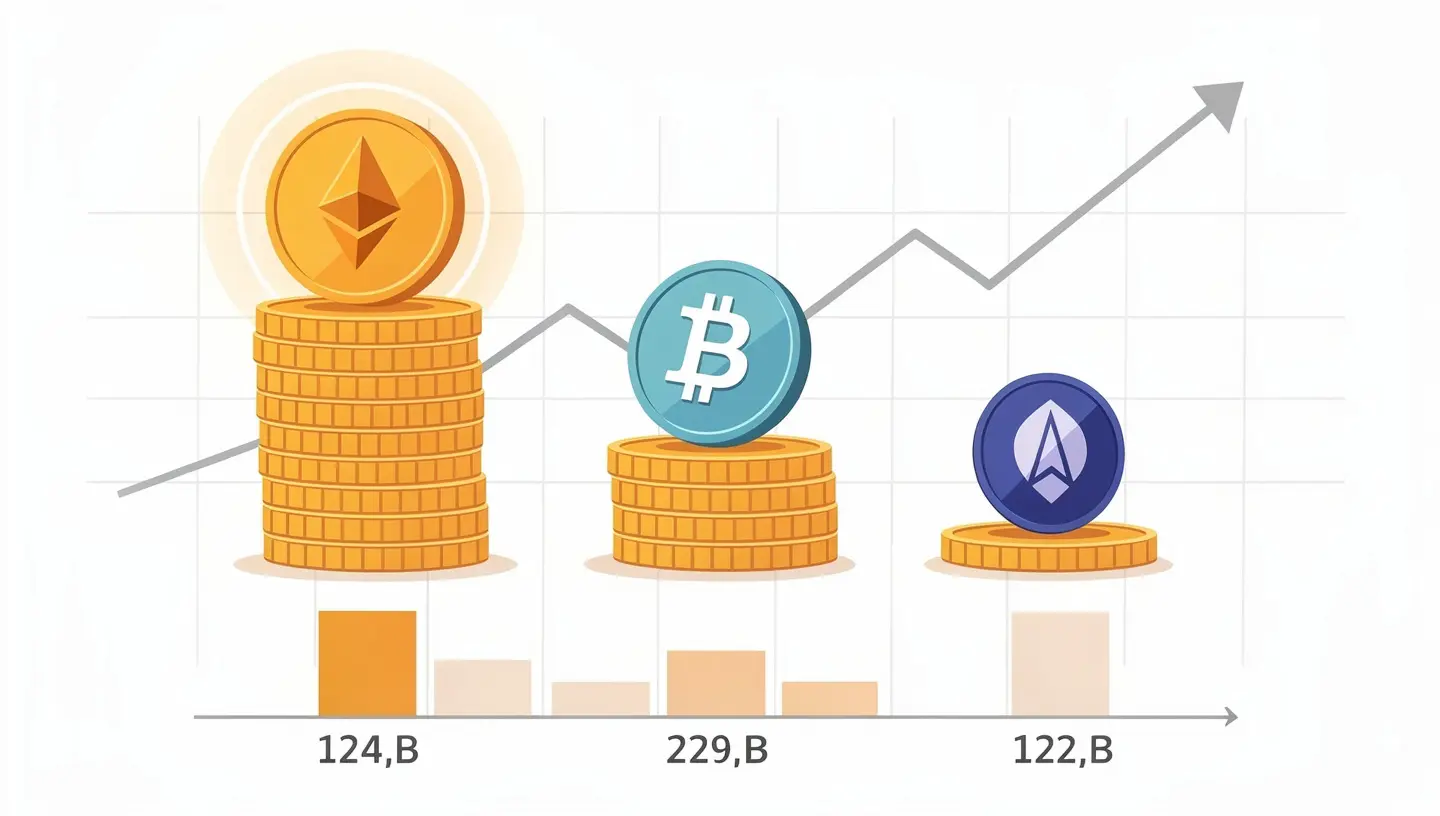
In the context of cryptocurrency market cap, the formula is:
Market Cap = Current Price per Coin x Circulating Supply
So if a cryptocurrency has 50 million coins in circulation and each coin is worth $20, its market cap is $1 billion. That single number tells you the total market value assigned to that project at that moment in time.
The reason market cap matters more than price becomes obvious with an example. Take two fictional cryptocurrencies:
- Coin A: 400,000 coins in circulation, each worth $1. Market cap: $400,000.
- Coin B: 100,000 coins in circulation, each worth $2. Market cap: $200,000.
Coin B has a higher price per coin. But Coin A is twice as large by market cap. If you were comparing these two projects by price alone, you would reach the wrong conclusion about which one represents more total value. This is why crypto data platforms like CoinMarketCap and CoinGecko rank assets by market cap rather than price.
How to calculate crypto market cap
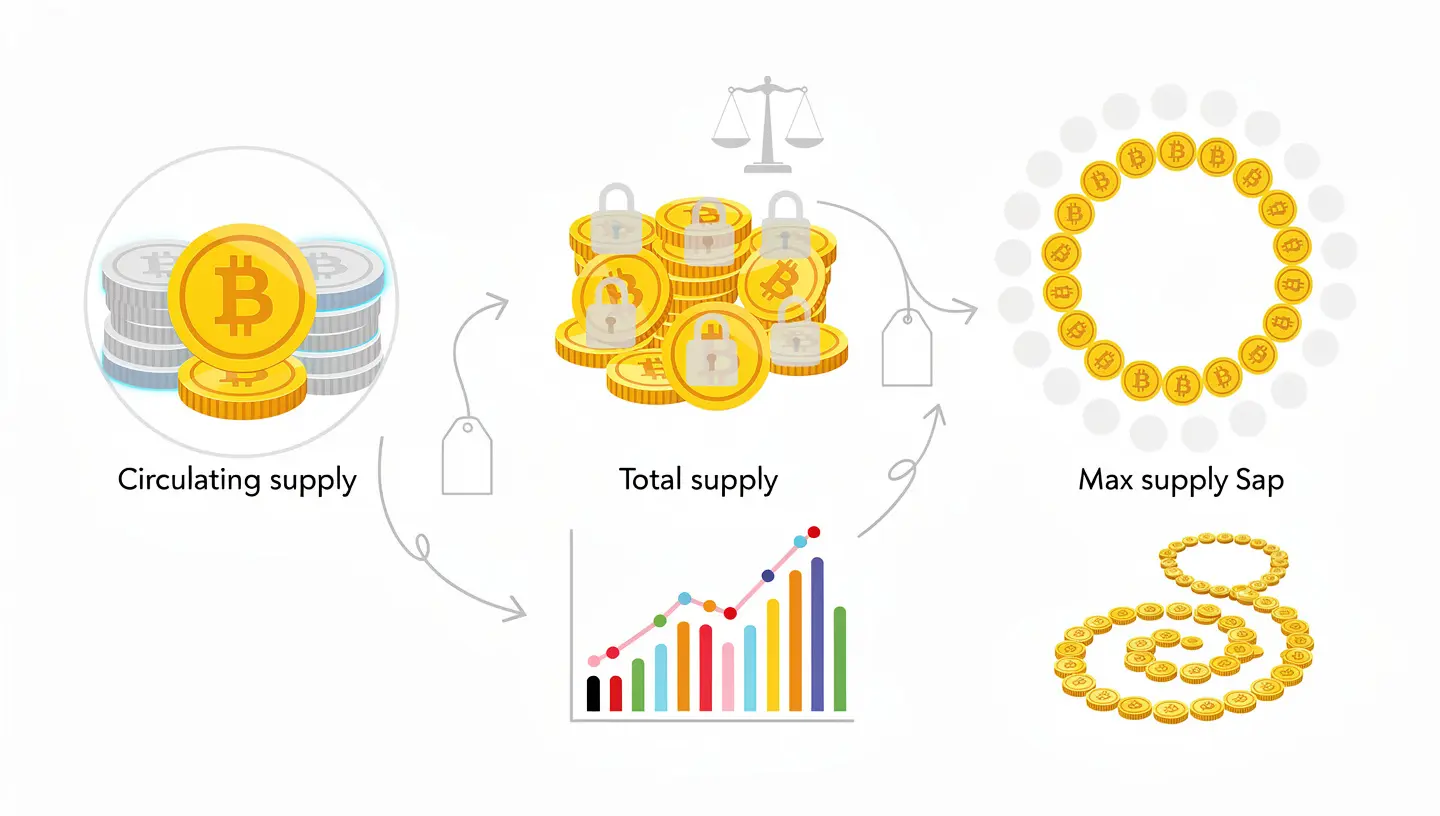
The formula itself is straightforward. The harder part is knowing which supply figure to use, because there are three different versions, and each one gives you a different number.
Circulating supply
Circulating supply is the number of coins that are publicly available and actively traded on the market right now. This is the figure used in the standard market cap calculation. For Bitcoin, the circulating supply is approximately 19.7 million BTC as of 2025, out of a maximum of 21 million that will ever exist.
Total supply
Total supply is all the coins that have been created, including those that are locked, reserved for the project team, or held in a treasury. These coins cannot be bought or sold yet. They are counted in total supply but not in circulating supply.
Max supply
Max supply is the absolute maximum number of coins that will ever exist for a given cryptocurrency. Bitcoin has a hard cap of 21 million. Some cryptocurrencies have no max supply, meaning new coins can be created indefinitely. When a project has no max supply, that is worth noting as a factor that could put downward pressure on the price over time.
The difference between these three figures matters. A coin may have a small circulating supply today but a large max supply, meaning millions of additional tokens could enter the market in the future. If you only look at the current market cap based on circulating supply, you may not see the full picture of what that coin’s value might look like once all tokens are released.
For more on how different cryptocurrencies are structured and what drives their value, see our guide on what is cryptocurrency.
Why market cap matters more than price
One of the most common mistakes among newer crypto investors is treating a low-priced coin as a bargain. The logic goes: if Bitcoin is worth $90,000 per coin and this other coin is worth $0.01, surely the cheaper one has more room to grow. That reasoning ignores supply entirely.
Consider a token priced at $0.01 with 100 billion tokens in circulation. Its market cap is $1 billion. For that token to reach $1 per coin, its market cap would need to reach $100 billion. That would make it larger than all but a handful of cryptocurrencies in the world. Reaching that level of growth is a fundamentally different challenge from a $10 coin with 10 million tokens in circulation and a $100 million market cap.
Price per coin and market cap are not the same thing. A token can be priced in fractions of a cent and still have a multi-billion dollar market cap because of how many tokens exist. Market cap is what tells you the true size of a cryptocurrency, not the number on the price tag.
This is also why comparing Bitcoin to Ripple (XRP) by price alone gives a distorted picture. XRP has a much larger total supply than Bitcoin, which is reflected in the price per coin. Market cap corrects for that difference and lets you compare the two on equal terms.
For context on how Bitcoin’s fixed supply of 21 million coins was designed and why it matters, read our guide on what is Bitcoin.
Large-cap, mid-cap, and small-cap crypto explained
Cryptocurrencies are divided into three categories based on their market cap.
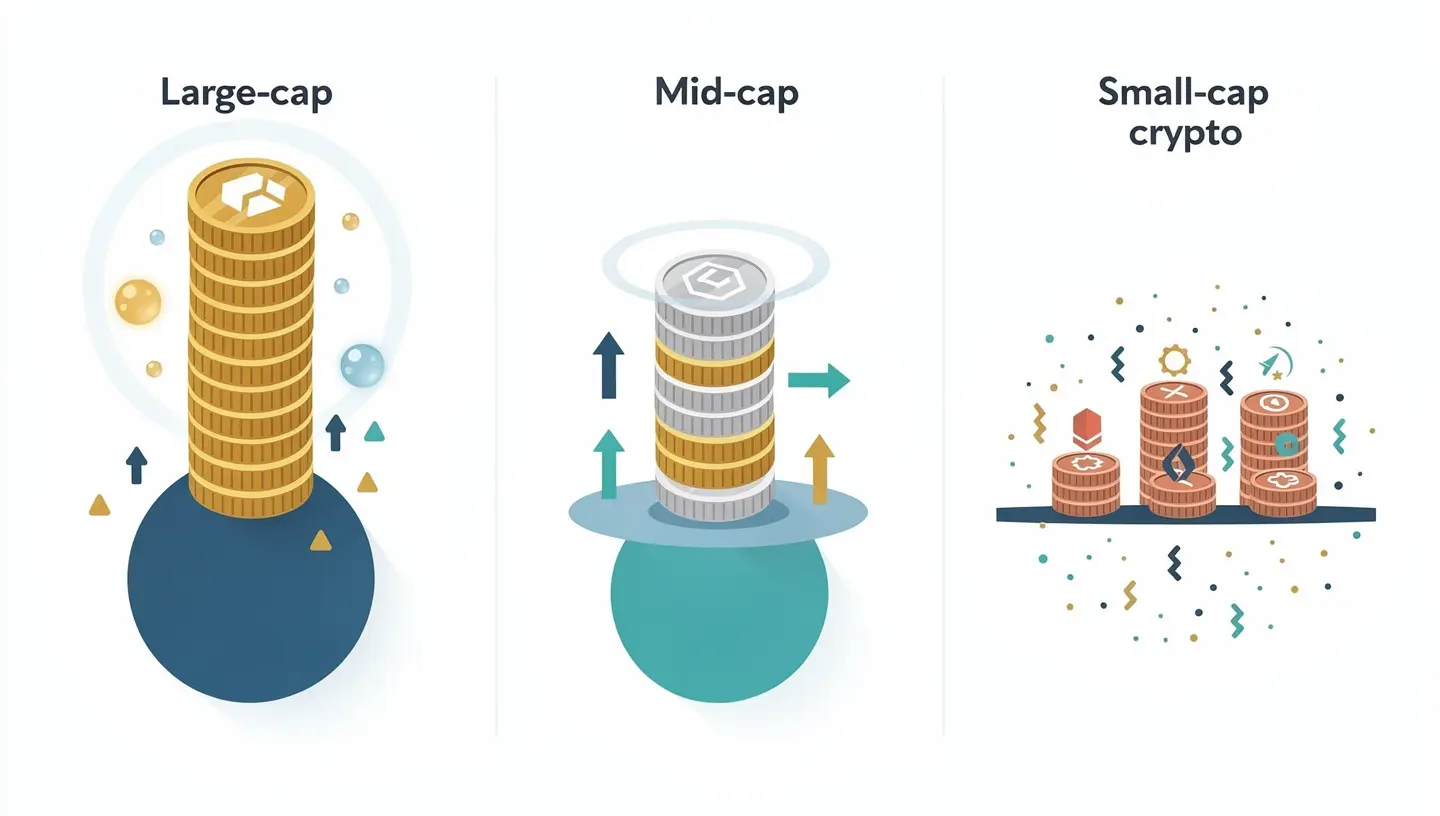
These categories are borrowed from stock market terminology and carry similar implications for risk and stability.
Large-cap cryptocurrencies (over $10 billion)
Large-cap cryptocurrencies have a market cap above $10 billion. Bitcoin and Ethereum are the two largest and most widely recognized examples. As of mid-2025, Bitcoin’s market cap exceeded $2 trillion and Ethereum’s exceeded $300 billion. Other large-cap coins include XRP, Solana (SOL), Binance Coin (BNB), and Tether (USDT).
Large-cap assets are generally seen as more stable within the crypto space because they have a larger and more established base of investors, higher trading volumes, and a longer track record. That said, “stable” in crypto is relative. Bitcoin has fallen more than 80% from its all-time high on multiple occasions. Large-cap status reduces volatility compared to smaller projects, but it does not eliminate it.
Mid-cap cryptocurrencies ($1 billion to $10 billion)
Mid-cap cryptocurrencies have a market cap between $1 billion and $10 billion. This category includes projects with established products and growing communities that have not yet reached the scale of the largest assets. Traders often look at mid-cap coins for growth potential. The risk level is higher than large-cap assets, but mid-cap projects typically have enough trading volume and exchange coverage to be reasonably liquid.
Small-cap cryptocurrencies (under $1 billion)
Small-cap cryptocurrencies have a market cap below $1 billion. This is where volatility is highest. Small-cap coins can double or lose half their value in a single day based on a news event, a tweet, or a shift in overall market sentiment. They are listed on fewer exchanges, often have thinner order books, and are more susceptible to price manipulation. Some small-cap projects go on to become large-cap assets. Many more fail entirely.
| Category | Market cap range | Risk level | Examples |
|---|---|---|---|
| Large-cap | Over $10 billion | Lower (relative to crypto) | Bitcoin, Ethereum, XRP, Solana |
| Mid-cap | $1 billion to $10 billion | Medium | Varies by market cycle |
| Small-cap | Under $1 billion | High to very high | Newer projects, niche tokens |
For an overview of the different types of cryptocurrencies beyond Bitcoin, including how altcoins fit into these market cap categories, see our guide on what is an altcoin.
What is fully diluted valuation (FDV)?
Fully diluted valuation, commonly called FDV, is the market cap a cryptocurrency would have if every token that will ever exist were already in circulation. You calculate it by multiplying the current price by the max supply rather than the circulating supply.
FDV = Current Price x Max Supply
The difference between market cap and FDV can be significant. If a coin has 100 million tokens in circulation today but a max supply of 1 billion, only 10% of its total supply is currently tradeable. The FDV would be ten times the current market cap. As the remaining 900 million tokens are released over time through mining rewards, team vesting schedules, or investor unlocks, they add to the circulating supply. If demand does not grow at the same rate, the additional supply puts downward pressure on the price.
A large gap between market cap and FDV is a signal worth investigating. It does not automatically mean a project is bad, but it means you should understand when the remaining tokens will enter circulation and at what pace. Projects sometimes structure token releases over several years, which spreads out the supply impact. Others release large amounts quickly, which can hit price hard if the market is not ready to absorb them.
Circulating supply market cap and FDV are both useful. Market cap tells you the current picture. FDV tells you what that picture could look like once all tokens exist.
What is the total crypto market cap?
The total crypto market cap is the sum of the market caps of every cryptocurrency listed and tracked across all exchanges. It is the headline number that tells you the overall size of the entire crypto asset class at any given moment.
As of mid-2025, the global crypto market cap was in the range of $2.3 to $3.9 trillion, having reached an all-time high above $4 trillion in July 2025. For comparison, the total crypto market cap was less than $200 billion as recently as 2019.
Within the total market cap, Bitcoin dominance is a closely watched figure. It shows what percentage of the entire crypto market cap belongs to Bitcoin alone. When Bitcoin dominance is high, above 55-60%, it typically signals that investors are concentrated in the most established asset. When dominance falls, capital is often rotating into altcoins, a period traders refer to as altcoin season.
Tracking total market cap alongside Bitcoin dominance gives you a two-part view of where the market is in its cycle and how sentiment is distributed across different assets.
For an overview of how Bitcoin started and how its dominance developed over the years, read our Bitcoin history guide.
Market cap vs. trading volume
Market cap and trading volume are both important metrics, but they measure entirely different things.
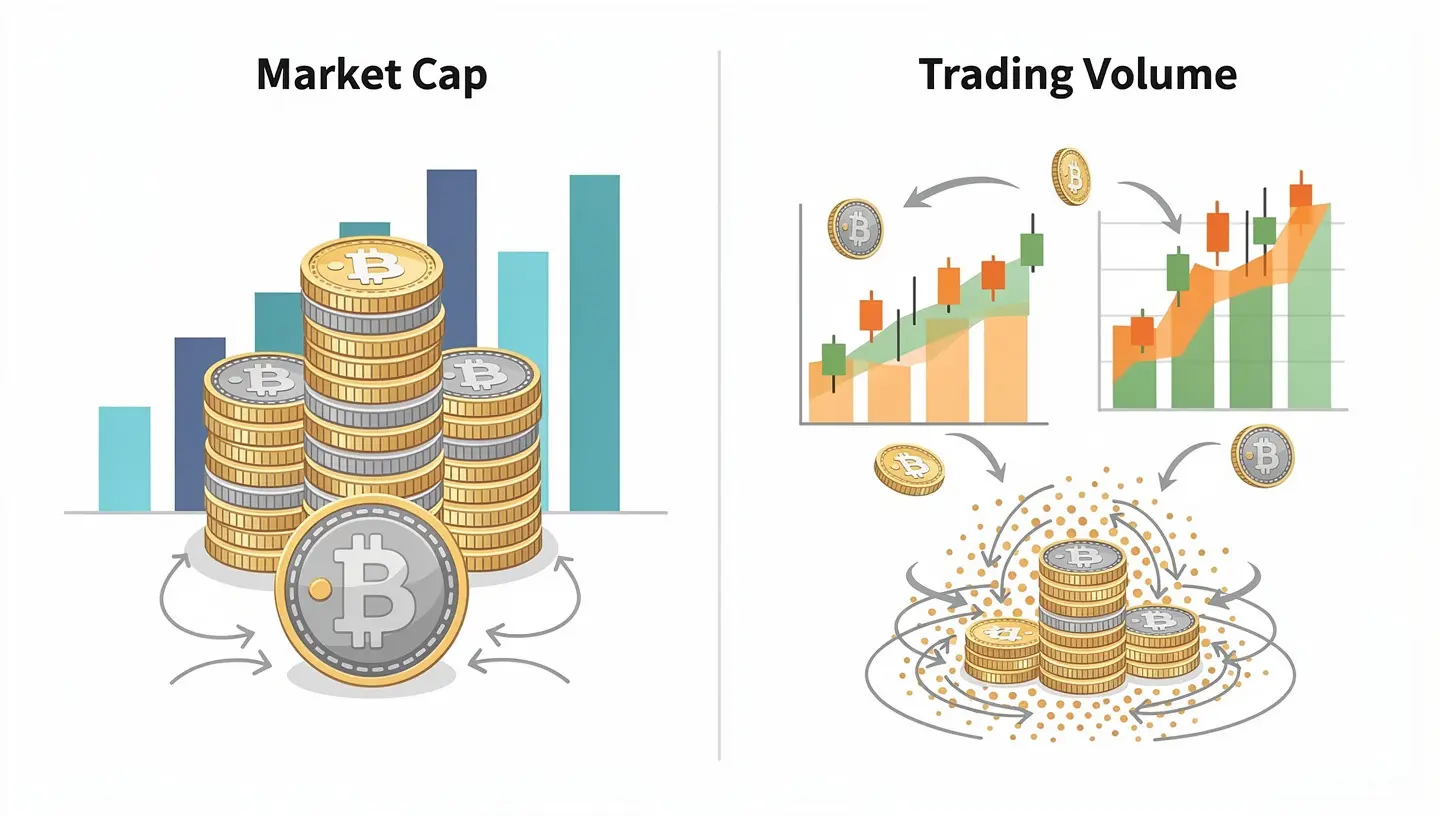
Understanding the difference prevents a common mistake.
Market cap measures the total value of all coins in circulation at the current price. It is a static snapshot of overall size.
Trading volume measures how much of a cryptocurrency was bought and sold in a given period, usually 24 hours. It reflects activity and liquidity.
A cryptocurrency can have a high market cap but low daily trading volume, meaning it is technically large but not actively traded. In practice, this makes it difficult to buy or sell large amounts without moving the price. If you try to sell a significant position in a low-volume coin, there may not be enough buyers at the current price, so you end up selling at a lower price to fill the order. This is called slippage.
Conversely, some smaller coins have trading volumes that are high relative to their market cap. This can indicate speculative activity, people buying and selling rapidly, rather than genuine adoption or holding by long-term investors.
When assessing any cryptocurrency, look at both market cap and 24-hour trading volume together. A general rule used by experienced investors is that a healthy coin should have a daily trading volume of at least 1-5% of its market cap. Lower than that suggests limited liquidity.
Limitations of market cap as a metric
Market cap is a useful starting point, but it has real limitations. Using it as your only measure leads to flawed conclusions.
| Market cap tells you | Market cap does not tell you |
|---|---|
| Total current market value at the listed price | How much money has actually been invested in the project |
| Relative size compared to other cryptocurrencies | Whether the project has real users or genuine demand |
| Which market cap category (large, mid, small) it falls into | Code quality, developer activity, or team credibility |
| A rough signal of liquidity and stability | How easily you can buy or sell without moving the price |
| The overall trend direction of the market | Future price movement or growth potential |
There are several specific ways market cap can mislead:
- Locked and unreleased tokens. If a large portion of total supply is held by the founding team or early investors under vesting schedules, the circulating supply market cap looks smaller than the true picture. Once those tokens unlock, they can hit the market and push the price down.
- Lost coins. Some Bitcoin from the early years is in wallets whose private keys no longer exist. Those coins count toward circulating supply and therefore market cap, but they will never be traded. The market cap is slightly overstated as a result. For more on how private keys work and why losing them means losing access permanently, see our guide on private key crypto.
- Price manipulation in thin markets. A low-volume coin can have its price inflated through coordinated buying, which makes the market cap look larger than it really is. This does not reflect genuine demand.
- No reflection of fundamentals. Two coins can have identical market caps while being completely different in terms of technology, adoption, revenue, and long-term viability. Market cap does not distinguish between them.
- Cash inflow vs. market cap are not the same. If a coin’s price rises because of demand, the market cap increases. But this does not mean the same amount of new money entered the market. A $1 billion increase in market cap does not mean $1 billion was invested. It means the price moved, which multiplied out across the circulating supply gives a higher number.
How to use market cap when evaluating a crypto investment
Market cap works best as a filter, not a final answer. Here is a practical approach to using it alongside other data.
Start with market cap to understand size and risk profile. If you are comparing two coins you are not familiar with, check their market caps first. A large-cap coin carries different risk than a small-cap one. Neither is automatically better, but they require different expectations and time horizons.
Then check FDV against market cap. If the FDV is significantly higher than the current market cap, investigate the token release schedule. Find out how many tokens will be unlocked in the next 12-24 months and who holds them. Team and investor allocations with aggressive unlock schedules are a risk factor.
Compare market cap to 24-hour trading volume. Low volume relative to market cap is a warning sign for liquidity. If you plan to sell a position quickly, you need enough volume to absorb your sale without collapsing the price.
Look at the project fundamentals, not just the number. Market cap tells you what the market currently values a project at. It does not tell you whether that valuation is justified. Review the use case, the team, the user base, and the on-chain activity. Two projects at the same market cap can differ enormously in quality.
Think in cap categories when building a portfolio. Many investors structure their crypto holdings by including a base of large-cap assets for stability, a smaller allocation to mid-cap projects with growth potential, and a limited amount in small-cap positions where higher risk is acceptable. The right balance depends on individual risk tolerance and time horizon. No specific allocation is suitable for all investors.
For a look at how different types of cryptocurrency projects are structured and how they differ from Bitcoin, read our guide on how Bitcoin works.
Frequently asked questions
What is a good market cap for crypto?
There is no single answer. A “good” market cap depends on what you are looking for. If you want relative stability and an established track record, large-cap coins with market caps above $10 billion are the standard choice. If you are willing to take on more risk for potentially higher returns, mid-cap and small-cap coins offer that, at the cost of greater volatility and the possibility of losing most or all of your investment. Market cap is just one part of the evaluation, not the whole picture.
Does a higher market cap mean a better investment?
Not necessarily. A higher market cap generally signals a more established asset with a larger investor base, which can mean lower volatility within crypto. But it also means the potential for percentage gains is typically smaller compared to newer, smaller projects. A coin does not become a good or bad investment based on market cap alone. Fundamentals, use case, tokenomics, and market conditions all factor in.
What is Bitcoin’s market cap?
Bitcoin’s market cap fluctuates with its price and circulating supply. As of mid-2025, Bitcoin’s market cap exceeded $2 trillion, making it the largest cryptocurrency by a wide margin. Bitcoin typically accounts for between 50 and 60 percent of the total crypto market cap, a figure tracked as Bitcoin dominance.
Can market cap predict price movement?
No. Market cap reflects current price multiplied by circulating supply. It changes when price changes. It does not tell you which direction price will move next. Investors use market cap alongside other data to understand the context of a cryptocurrency, but no single metric reliably predicts price direction in a market as volatile as crypto.
What is the difference between market cap and trading volume?
Market cap is the total value of all coins in circulation at the current price. It is a snapshot of overall size. Trading volume is how much of a coin was bought and sold in a given time period, typically 24 hours. Volume measures activity and liquidity. A coin can have a high market cap but low trading volume, which makes large positions difficult to enter or exit without moving the price.
What is a fully diluted market cap?
Fully diluted market cap, also called FDV (fully diluted valuation), is the market cap a cryptocurrency would have if every token in its maximum supply were already in circulation. You calculate it by multiplying the current price by the max supply rather than the circulating supply. FDV gives you a sense of what the project’s valuation could look like once all future token releases have occurred.
What is the total crypto market cap?
The total crypto market cap is the combined market cap of every tracked cryptocurrency. As of mid-2025, it ranged between approximately $2.3 and $3.9 trillion. You can check the current figure in real time on platforms like CoinMarketCap or CoinGecko, which update continuously.
Why do small-cap coins have higher volatility?
Small-cap coins have lower trading volumes and fewer active investors. A relatively small amount of buying or selling has a proportionally larger impact on price. They are also listed on fewer exchanges, have thinner order books, and attract more speculative trading than larger, more established assets. All of these factors combine to create larger and faster price swings compared to large-cap coins.