Picture a savings account where your balance earns interest every month. You do not move the money, you do not trade it, and you do not lend it to a stranger on the internet. You simply leave it in place and the bank pays you for doing so. Crypto staking works on the same basic principle, except the bank is replaced by a blockchain network, the interest is paid in cryptocurrency, and the reason you get rewarded has nothing to do with a financial institution needing your deposits. It has everything to do with keeping a decentralized network running honestly and securely. This guide covers what cryptocurrency staking is, how the mechanics work from the ground up, what you can realistically earn, and what risks you take on when you lock your coins into a staking contract.
What Is Crypto Staking?
Crypto staking is the process of locking your digital tokens to a blockchain network for a set period of time in exchange for rewards, usually paid as a percentage of the tokens you staked. When you stake, your coins are not sitting idle. They are being used by the network as collateral to validate transactions and produce new blocks. In return for putting up that collateral and accepting the associated rules, the network pays you staking rewards.
Not every cryptocurrency supports staking. Only coins that run on a proof-of-stake (PoS) consensus mechanism, or a variation of it, allow token holders to participate this way. Bitcoin, for instance, does not support staking because it runs on proof of work (PoW). Ethereum moved to proof of stake in September 2022 and became the largest proof-of-stake network in existence by market capitalisation. To understand why staking exists in the first place, it helps to understand what problem proof of stake was designed to solve.
For a broader picture of how digital currencies work before diving into staking mechanics, see what is cryptocurrency.
Proof of Stake vs. Proof of Work
Both proof of stake and proof of work are consensus mechanisms, meaning they are the rules a blockchain follows to agree on which transactions are legitimate and which are not. They just reach that agreement in very different ways.
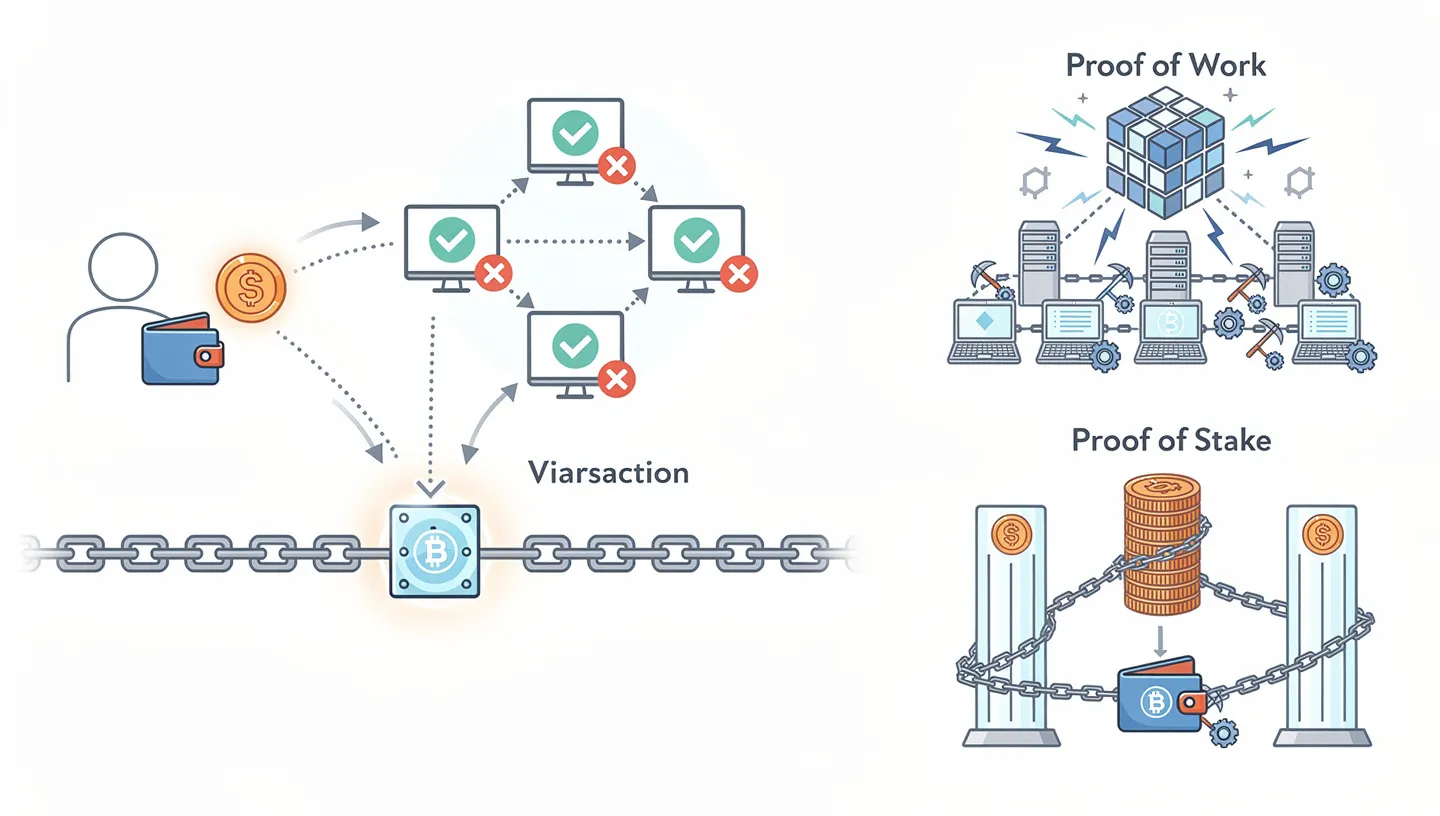
With proof of work, used by Bitcoin, participants called miners compete to solve complex mathematical puzzles. The first miner to crack the puzzle wins the right to add the next block of transactions to the chain and collects the block reward. This process consumes enormous amounts of electricity because thousands of machines run simultaneously, all burning energy in a race that only one can win.
Proof of stake removes the competition entirely. Instead of burning energy, participants lock up, or stake, their own cryptocurrency as collateral. The network then randomly selects one participant to validate the next block, with the odds of selection weighted in favour of those who have staked more. Because there is no puzzle-solving race, proof-of-stake networks use a fraction of the energy that proof-of-work networks require. The Ethereum Foundation reported that the shift to proof of stake cut Ethereum’s energy consumption by more than 99 percent.
The key difference in plain terms: proof-of-work miners spend money on hardware and electricity to earn the right to validate. Proof-of-stake validators lock up cryptocurrency as a financial commitment to earn that same right.
How Does Crypto Staking Work?
The mechanics of crypto staking involve several moving parts, but the core loop is straightforward. Token holders commit their coins to the network, the network uses those committed coins to select validators, validators do the work of confirming transactions, and everyone who participated receives a share of the rewards generated by that block.

What makes the system trustworthy is that validators put their own money on the line. If a validator tries to approve fraudulent transactions or goes offline when it is their turn to validate, the network punishes them financially through a mechanism called slashing. Slashing takes a percentage of the staked coins away from the offending validator permanently. This financial penalty turns honest behaviour from a moral choice into a rational economic one.
The Role of Validators and Delegators
Two groups of participants make staking function. The first group is validators. A validator is a node operator who runs the software required to verify transactions and propose new blocks. To become a validator on Ethereum, for example, you need to stake a minimum of 32 ETH and run a node that stays online and performs its duties reliably. Validators earn the majority of block rewards because they carry the most responsibility and the most risk.
The second group is delegators. Most people who stake cryptocurrency do so as delegators rather than validators. A delegator locks up their tokens and assigns, or delegates, their staking power to an existing validator. The validator does the technical work, the delegator provides the capital, and both parties split the staking rewards according to the terms set by the validator. Delegating is how ordinary holders participate in staking without needing 32 ETH, a server running around the clock, or any technical knowledge about node operation.
If a validator behaves dishonestly or fails to perform, the slashing penalty can affect the delegators who backed them as well. This is why choosing a reliable validator matters, and why many beginners prefer to stake through established platforms where validator selection is handled for them.
What Happens When You Stake Your Crypto
When you decide to stake, your coins move into a smart contract, which is a self-executing piece of code on the blockchain that holds your funds according to the network’s staking rules. Your coins are now locked. You cannot sell them, transfer them, or use them for anything else until the lock-up period ends and you complete the unstaking process.
The time it takes to get your coins back after you request to unstake is called the unbonding period. On Ethereum, the unbonding period can take days. On some other networks it can take weeks. During that window your coins are still inaccessible and, depending on the network, you may not earn rewards while waiting for the unbonding to complete. The bonding period works in the same direction at the start: after you stake, there is sometimes a waiting period before your coins begin generating rewards. These timelines vary considerably from one network to another and are worth checking before you commit.
Types of Crypto Staking
There is no single way to stake cryptocurrency.
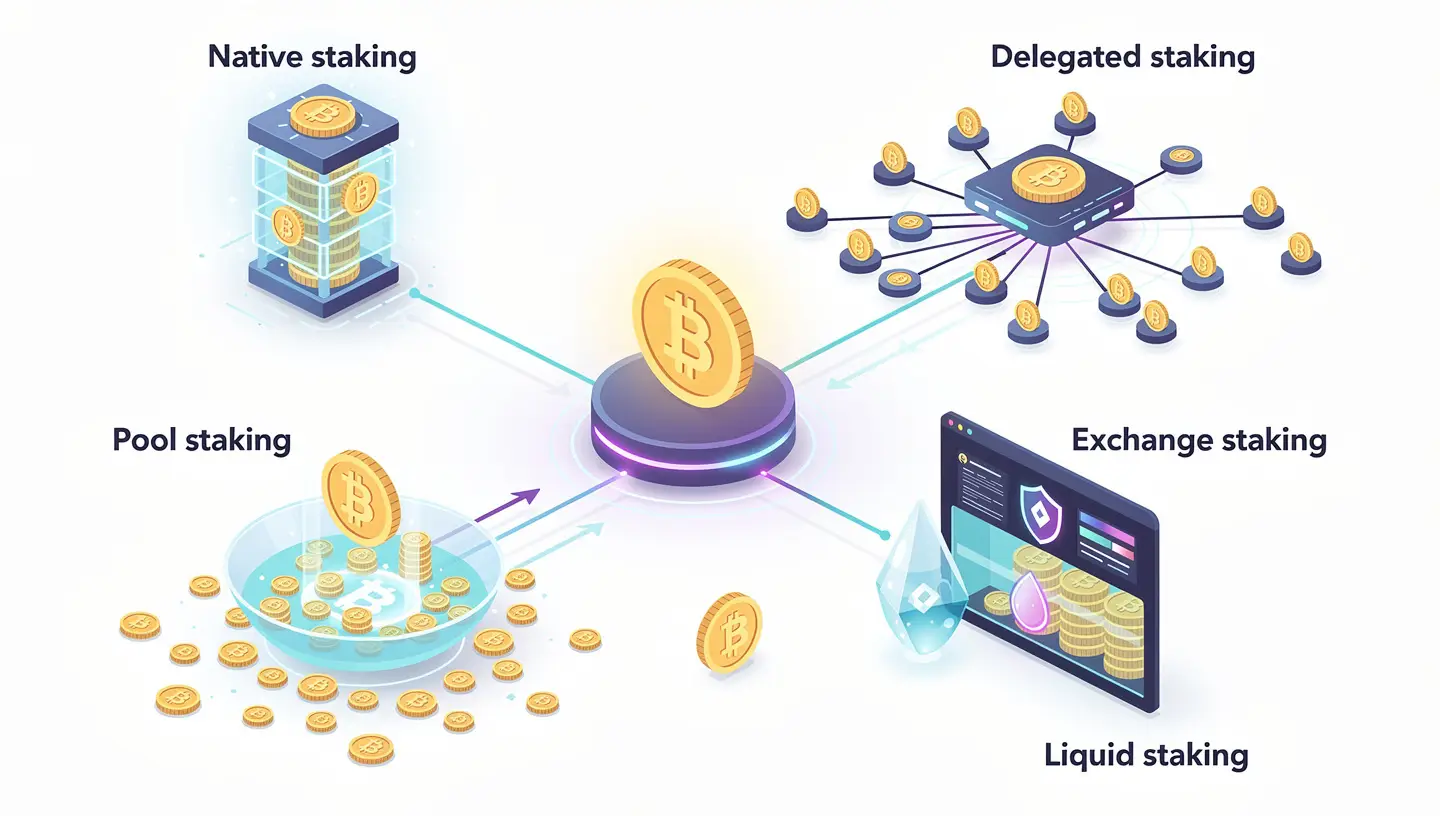
The method you choose affects how much control you keep, how much technical work you take on, and what percentage of the rewards reaches your wallet after fees.
Native Staking
Native staking means running your own validator node and staking directly with the network, without a third party in between. You maintain full custody of your coins, you control the validator software, and you receive the maximum possible share of block rewards because there is no platform taking a cut. The trade-off is that native staking requires a substantial minimum stake, a machine that stays online continuously, and the technical knowledge to configure and maintain a node. For Ethereum, the minimum is 32 ETH. This path suits experienced participants who are comfortable with the technical side of blockchain infrastructure.
Delegated Staking
Delegated staking lets you assign your staking power to an existing validator without running any software yourself. You keep your coins in your own wallet, choose a validator from the network’s list of active operators, and delegate your stake to them. The validator handles all the technical work. You receive a share of their rewards minus a commission fee that the validator sets, typically between 5 and 15 percent of your earnings. Delegated staking is the most common path for individual holders who want exposure to staking rewards without the complexity of running a node.
Pool Staking
A staking pool is a group of token holders who combine their coins to increase the group’s collective chances of being selected to validate a block. Any rewards earned by the pool are distributed among members in proportion to how much each person contributed. Pools are particularly useful on networks where solo staking requires a large minimum amount that most holders cannot meet on their own. The pool manager usually charges a small fee for organising the operation.
Exchange Staking
Exchange staking is the simplest option for beginners. You leave your coins on a centralised exchange, such as Coinbase, Kraken, or Binance, and opt into their staking programme. The exchange handles everything, including validator selection, technical setup, and reward distribution. You click a button and rewards start appearing in your account. The convenience comes at a cost: the exchange takes a significant fee, often 25 percent or more of your earnings, and you give up custody of your coins. If the exchange is hacked or faces regulatory problems, your staked assets could be at risk.
Liquid Staking
Liquid staking solves the biggest practical problem with standard staking, which is that your coins are frozen during the lock-up period. When you use a liquid staking protocol, such as Lido for Ethereum, you deposit your coins and receive a representative token in return, for example stETH for staked ETH. That representative token can be traded, used as collateral in other protocols, or sold while your original stake continues earning rewards in the background. Liquid staking gives you access to the yield of staking without the liquidity penalty, though it introduces additional smart contract risk because your position now depends on the security of the liquid staking protocol as well as the underlying network.
Custodial vs. Noncustodial Staking
Across all these methods runs one important distinction. Custodial staking means handing your coins over to a platform that holds them on your behalf, as with exchange staking. Noncustodial staking means your coins stay in a wallet that you control at all times, as with delegated or native staking. The crypto community phrase “not your keys, not your coins” captures the risk of custodial arrangements concisely.
How to Start Staking Crypto
Getting started with staking crypto requires a few decisions up front. The choices you make here, about which coin to stake, where to stake it, and through which method, determine your risk exposure, your reward rate, and how much flexibility you keep.
Choosing the Right Cryptocurrency
Your first decision is which coin to stake. Only cryptocurrencies running on proof-of-stake or a related consensus mechanism support staking, so that immediately narrows the list. Beyond eligibility, you want to look at several factors before committing. What is the project’s track record and development activity? Does the coin have a use case that justifies its long-term existence, or is it primarily kept alive by high staking yields? What is the minimum staking requirement, and does the tokenomics model dilute your rewards through high inflation?
The most common choices for staking are established networks with long histories: Ethereum, Solana, Cardano, Polkadot, and Cosmos. These networks have survived multiple market cycles, have active developer communities, and offer staking programmes with published reward structures. Chasing the highest advertised APY on an unknown network is one of the most reliable ways to lose money in this space.
If you want to understand the broader landscape of coins before choosing one to stake, the guide on what is an altcoin provides useful context on how different types of coins are categorised.
Selecting a Staking Platform or Wallet
Once you have chosen a coin, you need a place to stake it. Your options fall into three broad categories: a centralised exchange, a dedicated staking platform, or a self-custody wallet.
Centralised exchanges offer the most beginner-friendly experience but take the largest fees and hold your coins on your behalf. Dedicated staking platforms and decentralised protocols offer better rates and, in noncustodial cases, keep you in control of your keys. Self-custody wallets, such as Ledger or Trezor hardware wallets, let you delegate directly from a device you control, which combines security with competitive reward rates.
Whatever platform you choose, verify that it supports the specific coin you want to stake, check the fee structure carefully, and look for independent security audits before depositing anything significant.
Understanding Lock-Up Periods and Payout Schedules
Before you stake, read the rules around the lock-up period carefully. Some networks have no lock-up at all and allow flexible staking where you can withdraw at any time. Others lock your coins for a fixed duration ranging from a few days to several weeks. The bonding period at the start and the unbonding period at the end both affect how quickly you can respond to market movements. If the price of your staked coin drops sharply while you are in a long unbonding window, you cannot sell until the process completes.
Payout schedules also vary. Some networks distribute staking rewards every epoch, which on Ethereum is roughly 6.4 minutes. Others pay out daily, weekly, or at the end of a staking term. Know when to expect your rewards and factor that into any calculations about your expected return.
Crypto Staking Rewards: How Much Can You Earn?
The honest answer is that it depends on several variables that move independently of each other, and projections based on today’s rate may look very different in six months. That said, there are established frameworks for thinking about what staking pays and why the numbers change.
Staking rewards are most commonly expressed as APY (annual percentage yield), which accounts for compounding, or APR (annual percentage rate), which does not. When comparing rates across platforms, check which metric they are quoting. An APR of 5 percent with monthly compounding produces a higher effective return than an APY of 5 percent stated without compounding, so the numbers can be misleading if you do not check the underlying assumptions.
As a rough reference point for current rates, the table below shows approximate staking rewards for several major networks. These figures fluctuate with network conditions and are meant as orientation, not as guarantees.
| Cryptocurrency | Approximate APY | Minimum to Stake Solo | Lock-Up Period |
|---|---|---|---|
| Ethereum (ETH) | 3% – 5% | 32 ETH (solo validator) | Days to weeks (variable) |
| Solana (SOL) | 5% – 8% | No minimum to delegate | ~2-3 days (unbonding) |
| Cardano (ADA) | 3% – 5% | No minimum | No lock-up (flexible) |
| Polkadot (DOT) | 10% – 14% | ~502 DOT (nominator) | 28 days (unbonding) |
| Cosmos (ATOM) | 15% – 20% | No minimum to delegate | 21 days (unbonding) |
Factors That Affect Your Staking Rewards
The rate shown by a network or platform is not a fixed salary. Several factors push it up or down over time. The total amount of coins staked across the entire network is the most influential variable: when more coins are staked, rewards per staker decrease because the same pool of newly created coins is split among more participants. When fewer coins are staked, each participant’s share of the reward increases.
Token inflation is a second major factor. Some networks issue new coins at a high rate to fund staking rewards, which means the supply of that coin grows continuously. If the rate of new coins entering circulation outpaces demand, the price falls and your rewards are worth less in real terms even if the APY looks attractive on paper. Always check the inflation rate of a network alongside the stated reward rate.
Validator commission, network congestion, and protocol changes such as upgrades or governance votes can also shift your effective return in either direction. Staking rewards are best thought of as a variable rate that trends within a range rather than a fixed percentage you can count on.
Compounding Your Staking Rewards
Compounding means adding your earned rewards back into your staked position so that future rewards are calculated on the larger total. Over a long time horizon, compounding meaningfully increases the total return. Some networks and platforms handle compounding automatically. Solana, for instance, reinvests rewards on your behalf by default. Others, like Cosmos, require you to manually claim rewards and restake them, which involves a small transaction fee each time.
If you plan to stake for years rather than months, the choice between a network that auto-compounds and one that requires manual reinvestment is worth factoring in, especially if transaction fees on that network are high enough to eat into the compounding benefit.
Risks of Crypto Staking
Staking is not a risk-free way to earn passive income. The rewards are real, but so are the ways you can lose money. Understanding each risk clearly before committing capital is the difference between an informed decision and an unpleasant surprise.
Slashing Penalties
Slashing is the most dramatic risk specific to staking. When a validator behaves maliciously, approves double transactions, or goes significantly offline during a period when they are supposed to be active, the network destroys a portion of the coins staked by that validator. If you delegated your coins to a validator who gets slashed, you can lose part of your staked balance, not just your rewards. The severity of the slash depends on the network and the nature of the offence. On Ethereum, certain slashing offences result in a minimum penalty of 1 ETH, but coordinated attacks can trigger much larger penalties affecting the entire validator. Choosing established, well-reviewed validators with a long history of uptime significantly reduces this risk.
Market Volatility and Token Price Risk
This is the risk most people underestimate. Your staking rewards are paid in the same cryptocurrency you staked. If that coin loses 50 percent of its value while your coins are locked up in a lock-up period, the rewards you earned do not compensate for the capital loss. A 7 percent annual staking yield is irrelevant if the underlying asset falls 40 percent during the year. Staking makes the most sense when you already planned to hold a coin for the long term regardless of short-term price movements, because then the rewards represent a genuine bonus on top of your existing position rather than a false sense of security.
Liquidity Risk During the Lock-Up Period
When your coins are in a staking contract with a fixed lock-up period, you cannot access them regardless of what happens in the market. If the coin you staked drops sharply and you want to sell, you have to wait out the unbonding period before you can act. On networks with long unbonding windows, this can mean watching the price fall for weeks while you wait for your coins to be released. Liquid staking protocols partially address this by giving you a tradeable representative token, but they add their own smart contract risk in exchange for that flexibility.
Platform and Regulatory Risk
If you stake through a centralised exchange or custodial staking platform, you carry the risk of that platform itself. Exchanges have been hacked, gone bankrupt, had their assets frozen by regulators, and unilaterally changed their staking terms. When your coins are held by a third party, your ability to recover them depends entirely on that party’s solvency and goodwill. On the regulatory side, staking is still largely unregulated in most jurisdictions. Regulators in the United States and the European Union have both signalled interest in how staking should be classified and taxed. Changes in cryptocurrency regulation could affect how platforms are allowed to offer staking services and what tax treatment your rewards receive.
Best Cryptocurrencies for Staking
The best crypto for staking depends on your priorities. If you want security and liquidity, you accept a lower yield. If you want the highest possible return, you accept more risk and longer lock-up periods. Below are five networks with established track records and active staking programmes.
Ethereum (ETH)
Ethereum staking offers an approximate APY of 3 to 5 percent, with the exact figure shifting based on how many validators are active on the network. To run a solo validator you need 32 ETH and a machine that stays online. For holders without that amount, liquid staking protocols like Lido or pooled services on major exchanges allow participation with any amount. Ethereum is the largest proof-of-stake network in the world, with an established development roadmap and the deepest liquidity of any staking asset.
Solana (SOL)
Solana staking typically returns between 5 and 8 percent APY. There is no minimum amount required to delegate to a validator, which makes it accessible to holders of any size. The unbonding period is roughly two to three days, shorter than most other major networks. Solana processes transactions quickly and at low cost, and the network has grown substantially in developer activity and user adoption since 2021.
Cardano (ADA)
Cardano staking is one of the most flexible staking models available. There is no minimum amount and no lock-up period. You can stake directly from your wallet without giving up custody of your coins, and you can unstake or move your coins to a different pool at any time without penalty. The APY sits in the 3 to 5 percent range, which is modest but comes with essentially no liquidity risk.
Polkadot (DOT)
Polkadot offers among the highest reward rates of any major network, with APY typically running between 10 and 14 percent. The trade-off is a 28-day unbonding period, one of the longest in the industry, and a minimum delegation requirement of approximately 502 DOT to participate as a nominator. Polkadot’s network architecture, which connects multiple blockchains in a relay-chain structure, gives the DOT token a clear utility case that supports its long-term demand.
Cosmos (ATOM)
Cosmos frequently shows the highest APY figures of any established network, often between 15 and 20 percent, though this comes with a corresponding 21-day unbonding period and a relatively high token inflation rate that partially offsets the headline yield in real terms. ATOM is the native token of the Cosmos Hub, which serves as the coordination layer for a large network of interconnected blockchains. The project has a strong developer community and a long history of delivering on its technical roadmap.
For a clearer understanding of how Bitcoin’s separate model compares to these proof-of-stake networks, the article on how does Bitcoin work explains the proof-of-work mechanics in detail.
Staking vs. Mining: What Is the Difference?
Both staking and mining are ways to participate in blockchain validation and earn rewards, but the underlying mechanisms and the costs involved are completely different.

Mining, used by Bitcoin and other proof-of-work networks, requires specialised hardware called ASICs or high-performance GPUs. Miners compete against each other to solve a cryptographic puzzle, and only the winner adds the next block and collects the reward. All the other miners who burned electricity on that same puzzle get nothing. The cost of mining is therefore measured in hardware investment and ongoing electricity bills, and the barrier to entry for profitable mining has risen to the point where it is dominated by large industrial operations.
Staking, used by proof-of-stake networks like Ethereum and Solana, replaces the energy-burning competition with a financial commitment. You lock up coins, the network selects validators based partly on how much they have staked, and rewards are distributed to all participants who contributed, not just the one who won a race. The barrier to entry is lower, the energy cost is negligible by comparison, and the process does not require specialised hardware.
The summary is this: mining rewards you for compute power you spend. Staking rewards you for capital you commit. Both serve the same underlying purpose of keeping a blockchain honest, they just use different economic levers to do it.
To understand the origins of the proof-of-work model and why Bitcoin chose it, the history of Bitcoin covers that story from the beginning.
Common Mistakes Beginners Make When Staking Crypto
Most staking losses are avoidable. They tend to come from the same set of decisions made too quickly, without reading the rules first.
- Chasing the highest APY without checking the token’s inflation rate. A 40 percent annual yield on a coin that inflates the supply by 35 percent per year is not as attractive as it looks. Your rewards are being diluted as they are earned.
- Ignoring the lock-up period before a volatile period in the market. Staking your entire position without keeping some liquid reserve means you have no ability to react to major price movements until the unbonding period ends.
- Delegating to an unvetted validator. Picking a random validator from the bottom of the list because the commission is slightly lower is a false economy. A slashing event on that validator affects your balance, not just theirs.
- Confusing APR with APY. Platforms quote rates differently. An APR of 6 percent compounded monthly is higher than an APY of 6 percent stated without compounding. Read the fine print before calculating expected returns.
- Using custodial staking without understanding the platform risk. If the exchange holding your staked coins shuts down, freezes withdrawals, or gets hacked, your staking rewards are irrelevant. Only use custodial platforms you have researched thoroughly.
- Staking a coin you are not committed to holding long term. Staking rewards rarely outweigh significant price drops. If you are not confident in the underlying asset, the lock-up period exposes you to downside risk without a corresponding upside.
It is also worth understanding the difference between a coin and a token before choosing what to stake, as the distinction affects which networks and staking mechanisms are available. The guide on crypto token vs. coin explains that difference clearly.
Is Crypto Staking Worth It?
Crypto staking makes the most sense for people who already hold proof-of-stake coins and have no intention of selling them in the near term. For long-term holders, often called HODLers, staking converts a passive position into one that generates ongoing passive income without requiring any active management once the setup is complete.
Staking is harder to justify as a primary investment strategy built around the yield alone. The staking rewards are denominated in the same volatile asset you staked, which means the real-world value of those rewards swings with the market. A 6 percent yield on an asset that falls 30 percent in a year still results in a significant capital loss. Approaching staking as a yield-generating tool for coins you hold long term rather than as a way to profit from the staking rate itself is the framing that leads to fewer surprises.
If you are completely new to crypto and considering staking before you have a strong understanding of private keys, wallet security, and how blockchain transactions work, take the time to build that foundation first. Staking involves locking real money into contracts governed by code, and mistakes at the setup stage can be costly and sometimes irreversible. The guide on what is a private key is a good place to start before moving any coins.
The Bottom Line
Cryptocurrency staking is a legitimate mechanism built into proof-of-stake blockchains that rewards token holders for contributing to network security and transaction validation. Done with the right coin, the right method, and a clear understanding of the risks, it can generate meaningful passive income on holdings you already planned to keep for the long term. Done carelessly, with an eye only on the advertised yield and without reading the lock-up terms or vetting the validator, it introduces risks that are entirely avoidable.
The fundamentals of what is crypto staking come down to this: you commit capital to a blockchain, the blockchain uses that commitment to stay secure and honest, and it pays you for the service. The rate changes, the lock-up periods vary, the risks are real, and the best outcomes come to those who treat staking as a long-term strategy rather than a shortcut.
Frequently Asked Questions
What is crypto staking in simple terms?
Staking means locking your cryptocurrency in a blockchain network for a period of time in exchange for rewards. The network uses your locked coins as part of its transaction validation process, and it pays you a percentage of the coins you staked as compensation for contributing to that process.
Is crypto staking safe?
Staking carries real risks including slashing penalties, price volatility, liquidity restrictions during the lock-up period, and platform risk if you stake through a custodial service. It is not risk-free. The risks are manageable if you choose established networks, well-reviewed validators, and understand the lock-up terms before you commit. Staking through noncustodial wallets reduces platform risk considerably compared to leaving coins on an exchange.
Can I lose money staking crypto?
Yes. If the price of your staked coin falls significantly during the lock-up period, your position loses value regardless of the rewards you earn. Additionally, delegating to a validator that gets slashed can reduce your staked balance directly. The rewards from staking do not protect against losses in the underlying asset’s price.
How much can you earn from crypto staking?
Rates vary widely by network and change over time. Major networks currently offer roughly 3 to 5 percent APY for Ethereum and Cardano, 5 to 8 percent for Solana, 10 to 14 percent for Polkadot, and 15 to 20 percent for Cosmos. Higher yields typically come with longer unbonding periods, higher token inflation, or greater network risk. Always compare the stated APY against the coin’s inflation rate to understand the real return.
Do you need a lot of money to start staking?
Not necessarily. Some networks like Cardano and Solana have no minimum amount for delegation. Others like Ethereum require 32 ETH to run a solo validator, though liquid staking protocols and pooled services allow Ethereum staking with much smaller amounts. The method you choose, whether native, delegated, pooled, or exchange staking, largely determines the minimum you need to get started.
What is the difference between staking and yield farming?
Staking involves locking coins directly with a proof-of-stake blockchain to support transaction validation, and rewards come from the network’s own block reward mechanism. Yield farming involves depositing assets into decentralised finance (DeFi) protocols, such as liquidity pools, to earn fees and incentive tokens from that protocol. Yield farming generally carries higher potential returns and significantly higher smart contract risk than straightforward staking.
How are staking rewards taxed?
Tax treatment varies by country. In many jurisdictions, including the United States, staking rewards are treated as ordinary income at the time you receive them, valued at the market price on the day of receipt. When you later sell the coins you received as rewards, any gain or loss from that sale is treated as a capital gain or loss. Tax rules in this area are still evolving and differ significantly between countries. Consulting a tax professional familiar with cryptocurrency regulation in your jurisdiction is strongly advised before you start staking significant amounts.