There are two honest answers to this question, and they lead to very different places. The minimum possible time to mine 1 Bitcoin is 10 minutes, the length of a single Bitcoin block. If your miner wins the next block, you receive 3.125 BTC immediately. The realistic answer for a single machine is closer to 9 years, and for most home setups, the math never turns profitable at all.
Bitcoin mining is not a construction project where consistent effort produces consistent output. It is closer to a lottery. Every 10 minutes, one miner out of millions wins the entire block reward. Your share of that reward tracks your share of the total network computing power. One machine holds a tiny slice of that power. The table below shows what that means in practice.
| Mining setup | Approximate hashrate | Time to mine 1 BTC |
|---|---|---|
| 1 top-tier ASIC (S23 Hydro) | ~580 TH/s | ~9 years |
| 1 mid-tier ASIC (S21 XP) | ~270 TH/s | ~20 years |
| 1 older ASIC (S19 XP) | ~141 TH/s | ~38 years |
| 10 top-tier ASICs | ~5,800 TH/s | ~11 months |
| 50 ASICs | ~29,000 TH/s | ~2 months |
| 1,000+ ASICs (commercial farm) | 580,000+ TH/s | A few days |
These figures show gross BTC accumulation at flat difficulty. In reality, difficulty has trended upward for most of Bitcoin’s history, so actual timelines run longer than a static calculation suggests.
What is Bitcoin mining?
Bitcoin mining is the process by which new transactions are verified and added to the Bitcoin blockchain. Specialized computers called ASIC miners (Application-Specific Integrated Circuits) compete to solve a cryptographic puzzle based on the SHA-256 algorithm. The first miner to find a valid solution earns the right to add the next block of transactions and receives a reward of newly issued Bitcoin.
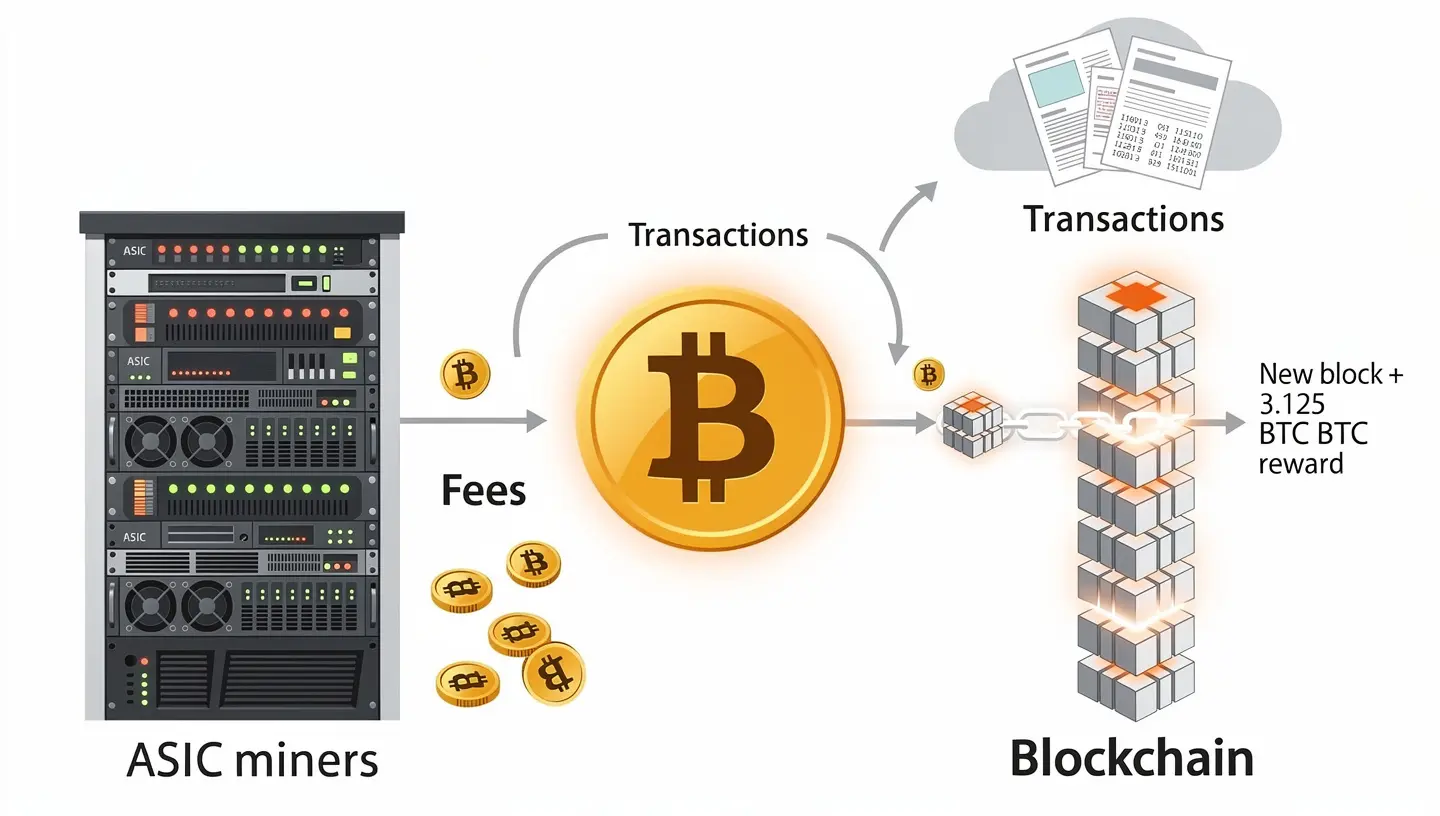
That reward currently stands at 3.125 BTC per block, reduced from 6.25 BTC after the Bitcoin halving in April 2024. Miners also collect the transaction fees included in each block, though these are typically small relative to the block subsidy at current fee levels.
Only ASIC miners can compete meaningfully in this market. A gaming GPU produces a fraction of the hashrate of a modern ASIC at several times the energy cost per hash. A laptop, desktop CPU, or smartphone is so far below the competitive threshold that any mining attempt amounts to paying for electricity with no return. The Bitcoin mining industry has consolidated almost entirely around industrial-scale operations running thousands of purpose-built machines.
For a full breakdown of how the Bitcoin blockchain processes and records transactions at the base layer, see our guide on how Bitcoin works.
Key factors that determine how long it takes
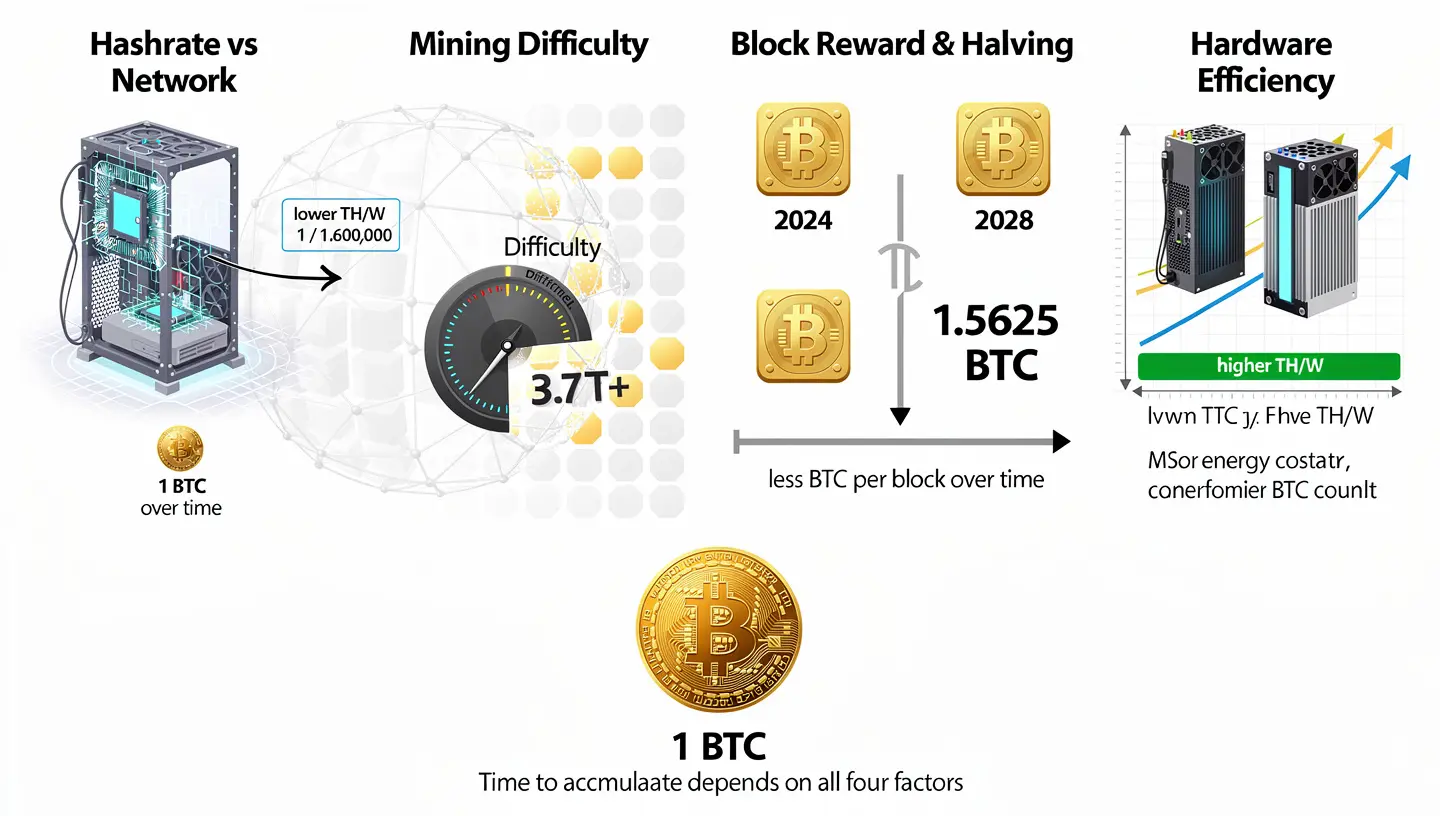
Four variables control how long any given setup needs to accumulate 1 Bitcoin. Understanding each one makes it possible to evaluate whether mining makes sense for a particular situation.
Your hashrate vs. the network
Your expected share of mining rewards equals your hashrate divided by the total network hashrate. As of mid-2026, the Bitcoin network runs at approximately 940 EH/s (exahashes per second). One top-tier ASIC at 580 TH/s holds roughly 1/1,600,000 of total network power.
A concrete example from River: a miner with 100 TH/s against a network of 150 EH/s holds 1/1,500,000 of total power. That miner would statistically mine one block every 1,500,000 blocks, which works out to roughly 28.5 years, yielding about 0.219 BTC per year given the current block reward. At that rate, accumulating 1 BTC takes approximately 4.5 years in a mining pool, where small consistent payouts replace the long wait for a full block.
Mining difficulty and the adjustment
Bitcoin’s protocol adjusts the mining difficulty every 2,016 blocks, roughly every two weeks. If blocks have been arriving faster than 10 minutes on average, difficulty increases. If slower, it decreases. This keeps the average block time near 10 minutes regardless of how many miners are active.
Each 2,016-block period is called a difficulty epoch. Within each epoch, difficulty is fixed. At the next adjustment, it resets based on the actual time the previous epoch took. The difficulty in 2025 reached 127 trillion, meaning miners must make an enormous number of attempts per second to have a realistic chance of finding a valid block. As more mining hardware comes online globally, difficulty rises and the same machine earns less BTC over time.
Block reward and the halving
Each block pays 3.125 BTC to the winning miner as of April 2024. Every 210,000 blocks, roughly every four years, the Bitcoin halving cuts that reward in half. The next halving is expected around 2028 and will reduce the reward to 1.5625 BTC per block.
A smaller block reward directly extends the time needed to accumulate 1 Bitcoin. A farm earning 3.125 BTC per block today will need twice as long to accumulate the same BTC total once the 2028 halving takes effect, at the same hashrate, assuming difficulty does not change. In practice, difficulty adjusts to reflect available hashrate, but the long-term direction after each halving is more time needed per BTC for a fixed setup.
For a full explanation of how halvings work and the history of each one, see our guide on what is the Bitcoin halving.
Hardware efficiency
Different ASIC models produce different hashrates at different energy costs. The key metric is terahashes per watt: how much computing power you get per unit of electricity consumed. A more efficient machine earns the same BTC at lower operating cost, which matters more than raw hashrate for profitability. Hardware generations improve significantly every two to three years, which means older machines become uncompetitive as new models enter the market and difficulty rises.
How long does it take with specific hardware?
The table below shows mining timelines based on May 2025 difficulty, using the Antminer S21E XP Hyd 3U at 860 TH/s per unit as the reference hardware. Hardware and electricity costs are not included.
| Number of ASICs | Total hashrate | Hardware investment | Time to mine 1 BTC |
|---|---|---|---|
| 5 | 4,300 TH/s | ~$66,000 | ~442 days |
| 10 | 8,600 TH/s | ~$132,000 | ~221 days |
| 20 | 17,200 TH/s | ~$264,000 | ~110 days |
| 50 | 43,000 TH/s | ~$660,000 | ~44 days |
| 100 | 86,000 TH/s | ~$1.32 million | ~22 days |
| 1,000 | 860,000 TH/s | ~$13.2 million | ~2.2 days |
| 2,209 (to mine 1 BTC per day) | ~1.9 EH/s | ~$29.2 million | 1 day |
These numbers assume flat difficulty and constant uptime. Difficulty has risen significantly over the past several years, so real timelines for setups deployed today will likely be longer than these figures suggest.
For context on how Bitcoin’s supply mechanics work and why the block reward matters for mining economics, see our guide on what is Bitcoin.
Solo mining vs. pool mining: which reaches 1 Bitcoin faster?
Neither. Solo mining and pool mining reach 1 Bitcoin in the same expected time at the same hashrate. The choice affects the shape and variance of your payouts, not the long-run average.
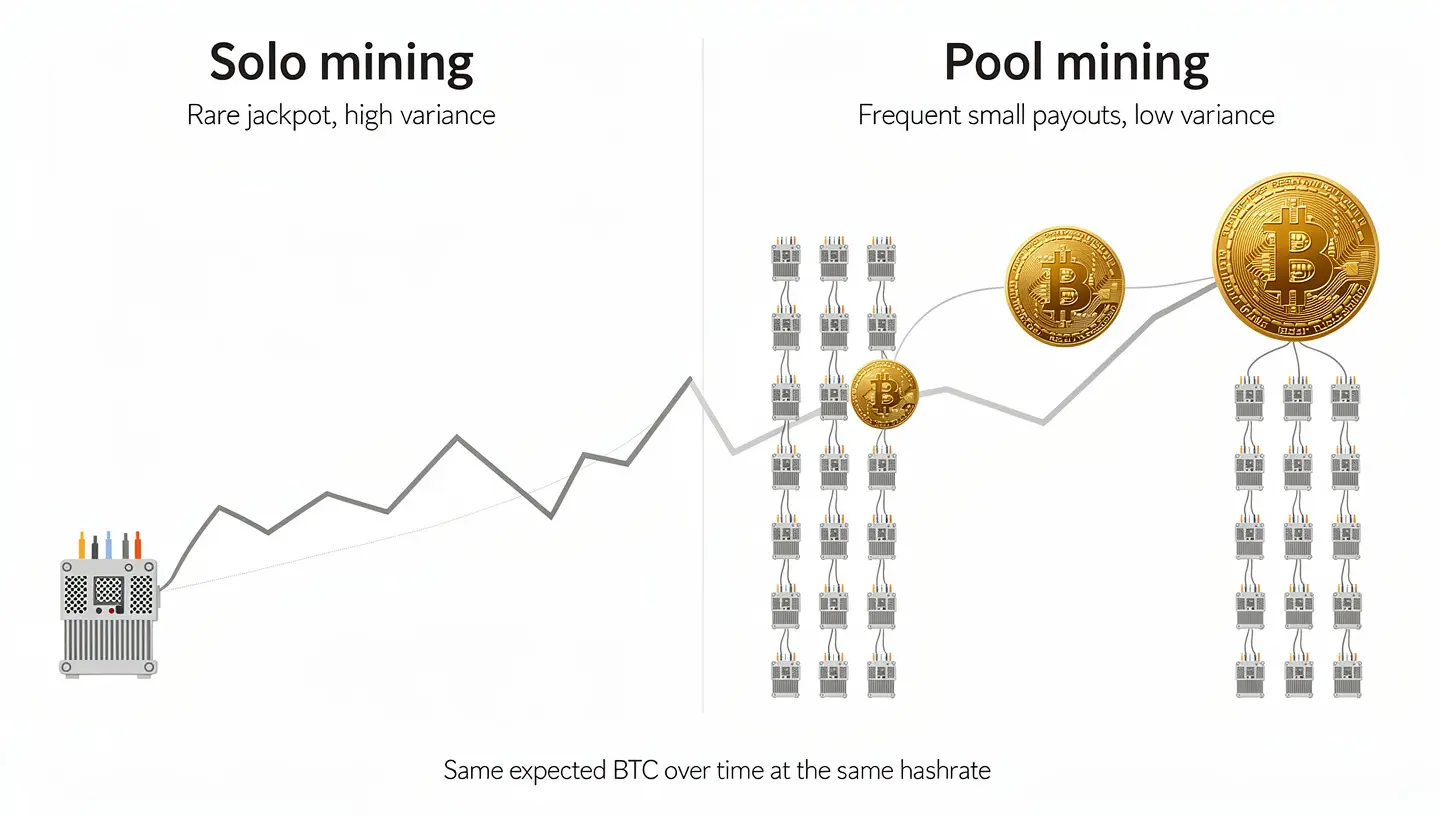
Solo mining is a pure lottery. A single top-tier ASIC at 580 TH/s averages one block every 29 years. Solve that block and you receive 3.125 BTC at once. Most solo miners wait far longer than the average and many never solve a block at all. The math works out to roughly 9 years per Bitcoin when you divide the 3.125 BTC block reward by the expected wait time, but that 9-year average hides enormous variance. You might get lucky in month one or wait 30 years.
Pool mining takes the same expected output and distributes it in small, regular fractions. Every time the pool wins a block, all contributing miners receive a proportional payout. Your balance climbs toward 1 Bitcoin in a steady line instead of a rare jackpot. This is why nearly every active miner today mines in a pool. The three largest pools by hashrate, Foundry USA, AntPool, and ViaBTC, together account for a majority of all blocks mined.
The only way to shorten the time to 1 Bitcoin is more hashrate. Double your hashrate and you halve the expected time. This is why the timeline scales linearly with fleet size in the tables above, and why commercial farms reach 1 BTC in days while a single home machine measures progress in years.
Can you mine 1 Bitcoin in a day?
Yes, but the scale required puts it beyond almost any individual investor. To mine 1 BTC in a single day, you need approximately 0.2% of the entire Bitcoin network’s hashrate, around 1.9 EH/s at mid-2026 conditions.
Based on CoinCodex’s 2025 analysis, achieving that level requires approximately 2,209 Antminer S21E XP Hyd 3U miners, each priced at roughly $13,200, for a total hardware investment of about $29.2 million. That figure excludes electricity, cooling infrastructure, facility costs, and operational expenses. Mining 1 Bitcoin per day is an industrial operation, not a home project.
Can you mine 1 Bitcoin at home?
Technically yes, practically difficult. A single ASIC can mine at home, but several factors push the economics against it in most countries.
- Electricity cost: A modern ASIC consumes 3,000-3,500 watts continuously. At $0.15/kWh, common in many countries, that is $324-$378 per month per machine. Mining profit at typical Bitcoin prices and difficulty barely covers that cost, if at all.
- Noise: ASICs run at 70-80 decibels, comparable to a running vacuum cleaner. Running one in a living space 24 hours a day is impractical for most households.
- Heat: Each ASIC dissipates 3-4 kilowatts of heat. Without proper ventilation or cooling, this damages hardware and creates a fire risk.
- Uptime: Industrial mining operations achieve 95%+ uptime through redundant power, dedicated internet connections, and on-site maintenance. Home setups suffer from outages and internet interruptions that directly extend the time to 1 Bitcoin.
An alternative is hosted mining or colocation: you purchase the ASIC and send it to a professional data center that manages cooling, power, and maintenance. Hosted rates typically run $0.07-0.08/kWh bundled, significantly below residential electricity prices in most markets. You retain ownership of the machine and the mined Bitcoin while the facility handles the operational side.
For a comparison of proof-of-work mining with proof-of-stake validation, which some investors use as an alternative source of crypto income, see our guide on proof of work vs proof of stake.
The real costs of mining 1 Bitcoin
Time to 1 Bitcoin is only part of the picture. The financial cost per Bitcoin determines whether mining makes any sense at all.
Hardware costs
Top-tier ASICs in 2025 and 2026 range from roughly $3,000 for mid-range units to over $13,000 for the most efficient models. Hardware depreciates over 14-36 months as newer, more efficient machines push difficulty higher and make older equipment unprofitable. The total hardware cost to mine 1 Bitcoin, at efficient scale, has been estimated at $15,000-$25,000 in early 2025, excluding electricity.
Electricity costs
Electricity is the largest ongoing cost in mining. An Antminer S21 consuming 3,500W at $0.10/kWh costs approximately $252 per month to run. At $0.15/kWh, that rises to $378. Industrial mining operations in regions with cheap power, such as Kazakhstan, Paraguay, Texas, Montana, and Ethiopia, run at $0.04-0.07/kWh, which is what makes large-scale mining economically viable. At residential rates in most European countries and many parts of North America, the electricity cost alone approaches or exceeds the value of the Bitcoin produced.
Other costs
Beyond hardware and electricity: cooling infrastructure (air conditioning or immersion cooling for larger setups), internet connectivity, hardware replacement as machines fail, and facility costs if not using hosted mining. For solo operators managing their own setup, there are also software and maintenance time considerations. At commercial scale, staff costs and colocation fees add further to the total cost per Bitcoin.
For a broader look at Bitcoin’s price history and how mining economics have changed through multiple market cycles, see our Bitcoin history guide.
Is Bitcoin mining still worth it in 2026?
The honest answer depends on who is asking. Three variables determine profitability: Bitcoin’s market price, electricity cost, and hardware efficiency.
For home miners in countries with standard electricity rates, mining is typically unprofitable after accounting for hardware depreciation and power costs. The Bitcoin produced rarely covers the total cost of production at $0.12/kWh or above, particularly after the 2024 halving cut the block reward in half.
For industrial operations with access to electricity below $0.07/kWh and current-generation ASICs, mining remains profitable with thin margins. These operations depend on Bitcoin’s price rising over time to maintain those margins as difficulty increases and future halvings reduce the block reward.
For most individual investors, simply buying Bitcoin on an exchange is a more cost-effective way to gain exposure. There are no hardware purchases, no electricity costs, no downtime risk, and no depreciation of equipment. If the goal is to own Bitcoin rather than to participate in the mining industry specifically, direct purchase is almost always more efficient.
If you are new to Bitcoin and trying to understand what mining produces and why, see our guide on what is cryptocurrency for the broader context.
Mining tools and calculators
Before investing in mining hardware, running the numbers through a dedicated calculator is essential. These tools account for current difficulty, hashprice, and energy costs to give a realistic projection.
Minerstat
Minerstat’s ASIC profitability tool provides professional-level analysis with detailed profitability graphs and difficulty forecasts. Supports over 50 mining algorithms and 100+ wallets. Useful for anyone comparing multiple ASIC models or evaluating whether a purchase makes sense at current conditions.
Braiins Insights
Built by the developers of Braiins OS, one of the major mining firmware providers. Provides detailed hashrate, difficulty, and profitability data, including historical trends and forward projections. Strong choice for detailed hardware analysis before deployment.
Hashrate Index
Industry-level analytics including hashprice per day, ASIC model comparisons, and profitability by hardware type. Used by professional mining operations and analysts tracking the broader mining market.
CryptoCompare Mining Calculator
A straightforward calculator for quick profit estimates. Enter hashrate, power consumption, and electricity price to get daily, weekly, and monthly projections. Suitable for beginners who need a fast answer without navigating complex dashboards.
NiceHash profitability calculator
NiceHash’s calculator lets you input any ASIC model from a database of current hardware and shows expected earnings at live network conditions. Also allows selling hashrate directly if you want income in Bitcoin without committing to a specific mining pool.
Bitcoin mining scams to avoid
The gap between what people hope mining can do and what it actually produces has made Bitcoin mining a persistent target for fraud. These are the most common formats.
- Fake cloud mining platforms: These services claim you can rent hashrate and earn guaranteed daily returns, often 5-10% per day or more. No legitimate mining operation can offer guaranteed returns at those levels. Most take your deposit and either pay out briefly from new investor funds before collapsing, or never pay at all.
- Free Bitcoin mining apps: Apps that claim to mine Bitcoin on your phone or with small monthly fees. Phones produce negligible hashrate compared to ASICs and generate essentially no mining income. These apps either serve ads, collect data, or ask for small fees while providing no actual mining.
- Pyramid recruiting schemes: Presented as mining operations where you earn by recruiting new members rather than through actual mining. The underlying mining, if it exists at all, is incidental to the recruitment model.
- Fake hardware presales: You pay for ASIC miners that never arrive. Only purchase hardware from verified manufacturers and authorized distributors: Bitmain, MicroBT, Jasminer, and their official resellers.
The reliable test: if a platform promises guaranteed returns from Bitcoin mining, it is a scam. Mining revenue depends on Bitcoin’s price, network difficulty, and electricity costs, all of which are variable. No honest operator can guarantee returns.
Alternatives to mining Bitcoin
For most people researching this topic, the conclusion they reach is that mining is not the right route. These are the main alternatives for gaining Bitcoin exposure or earning crypto income without running mining hardware.
- Buying Bitcoin directly: Purchasing BTC on a regulated exchange is cheaper, simpler, and has no ongoing costs. If your goal is to own Bitcoin rather than participate in the mining industry, this is almost always the more efficient path. See our guide on what is a crypto exchange for a starting point.
- Bitcoin ETFs: Spot Bitcoin ETFs such as iShares IBIT and Fidelity FBTC provide Bitcoin price exposure through a standard brokerage account with no custody or hardware requirements.
- Proof-of-stake staking: Networks like Ethereum, Solana, and Cardano offer staking income without hardware investment. The returns come from network participation fees rather than block competition. See our guide on what is crypto staking for details.
- Mining company stocks: Public companies like Marathon Digital Holdings (MARA), Riot Platforms (RIOT), and CleanSpark give indirect exposure to Bitcoin mining economics through standard equity markets.
- Legitimate cloud mining: Platforms like NiceHash let you purchase hashrate for a fixed period without managing hardware. This carries platform risk and is not guaranteed to be profitable, but avoids the hardware overhead of running your own machines.
Frequently asked questions
What is the minimum time to mine 1 Bitcoin?
The minimum possible time is about 10 minutes. That is the length of one Bitcoin block. If a miner wins the very next block after starting, they receive 3.125 BTC immediately. In practice, a single ASIC winning a block within minutes would be extraordinarily lucky, statistically equivalent to winning a large lottery. For a single top-tier machine, the expected wait for a full block is around 29 years.
Can you randomly mine 1 Bitcoin?
Yes, with very low probability. Any miner connected to the Bitcoin network has a theoretical chance of winning the next block, regardless of how small their hashrate. With one ASIC at 580 TH/s against a network of 940 EH/s, the odds of winning a specific block are about 1 in 1.6 million. Solo mining on low-power hardware is sometimes called “lottery mining” for this reason. The expected value is the same as pool mining at the same hashrate, but the variance is extreme: most solo miners with a single machine wait decades or never win a block at all.
Can you mine 1 Bitcoin a day?
Yes, but it requires approximately $29 million worth of the latest ASIC hardware, around 2,209 Antminer S21E XP Hyd 3U units contributing roughly 1.9 EH/s of hashrate. That is about 0.2% of the entire Bitcoin network. Mining 1 BTC per day is an industrial operation. For most investors, this level of capital is better deployed by purchasing Bitcoin directly.
Can you mine Bitcoin on your phone?
Not in any practical sense. The computing power of a smartphone is so far below the performance of ASIC miners that any Bitcoin earned would be immeasurably small. Running mining software on a phone primarily drains the battery, generates heat, and shortens the device’s lifespan. Apps marketed as “crypto mining apps” typically do not mine Bitcoin at all; they earn small amounts through other mechanisms or are outright scams.
Can you mine Bitcoin on your GPU?
Technically possible, not practically viable. Modern graphics cards produce a fraction of the hashrate of a dedicated Bitcoin ASIC at significantly higher energy cost per hash. The electricity bills from GPU mining Bitcoin would outweigh any BTC earned by a wide margin. GPUs are still used for mining other cryptocurrencies that use different algorithms, but Bitcoin’s SHA-256 algorithm is fully dominated by purpose-built ASICs.
How many Bitcoins are left to mine?
As of mid-2026, approximately 19.9 million Bitcoin have been mined out of a maximum supply of 21 million. That leaves roughly 1.1 million Bitcoin remaining. These will be released gradually through the block reward over the next century, with the last Bitcoin expected to be mined around 2140 as successive halvings reduce the reward to near zero.
Does pool mining get you to 1 Bitcoin faster than solo mining?
No. Pool mining and solo mining produce the same expected BTC total at the same hashrate over time. The difference is payout frequency and variance, not speed. In a pool, you receive small regular payments proportional to your hashrate contribution. With solo mining, you wait for a full block win. The long-run average is identical; pool mining simply smooths that average into a steady income stream rather than rare lump sums.
What happens to mining when all Bitcoin is mined?
Around 2140, the last Bitcoin will be mined and the block reward will reach zero. After that point, miners will earn only from transaction fees included in each block. Whether those fees will be sufficient to sustain the mining industry and keep the network secure is one of the central open questions about Bitcoin’s long-term economics. Growing transaction volume from Bitcoin’s second-layer networks and other on-chain activity is expected to increase fee revenue over time, but 2140 is far enough away that confident predictions are difficult.