Every four years, something unusual happens to Bitcoin: the reward for mining a new block gets cut in half automatically. No board meeting decides it. No central bank votes on it. No government approves it. The cut happens because Satoshi Nakamoto wrote it into the protocol in 2009, and it has been running on schedule ever since. This event is called the Bitcoin halving, and it is one of the most closely watched recurring events in the crypto market.
The halving is the mechanism that ensures Bitcoin can never have more than 21 million coins in existence. It controls the pace at which new Bitcoin enters circulation, and it directly affects the economics of mining, the scarcity of the asset, and historically, the price. Understanding what it is and how it works is essential context for anyone trying to make sense of Bitcoin’s price cycles and long-term design.
What is the Bitcoin halving?
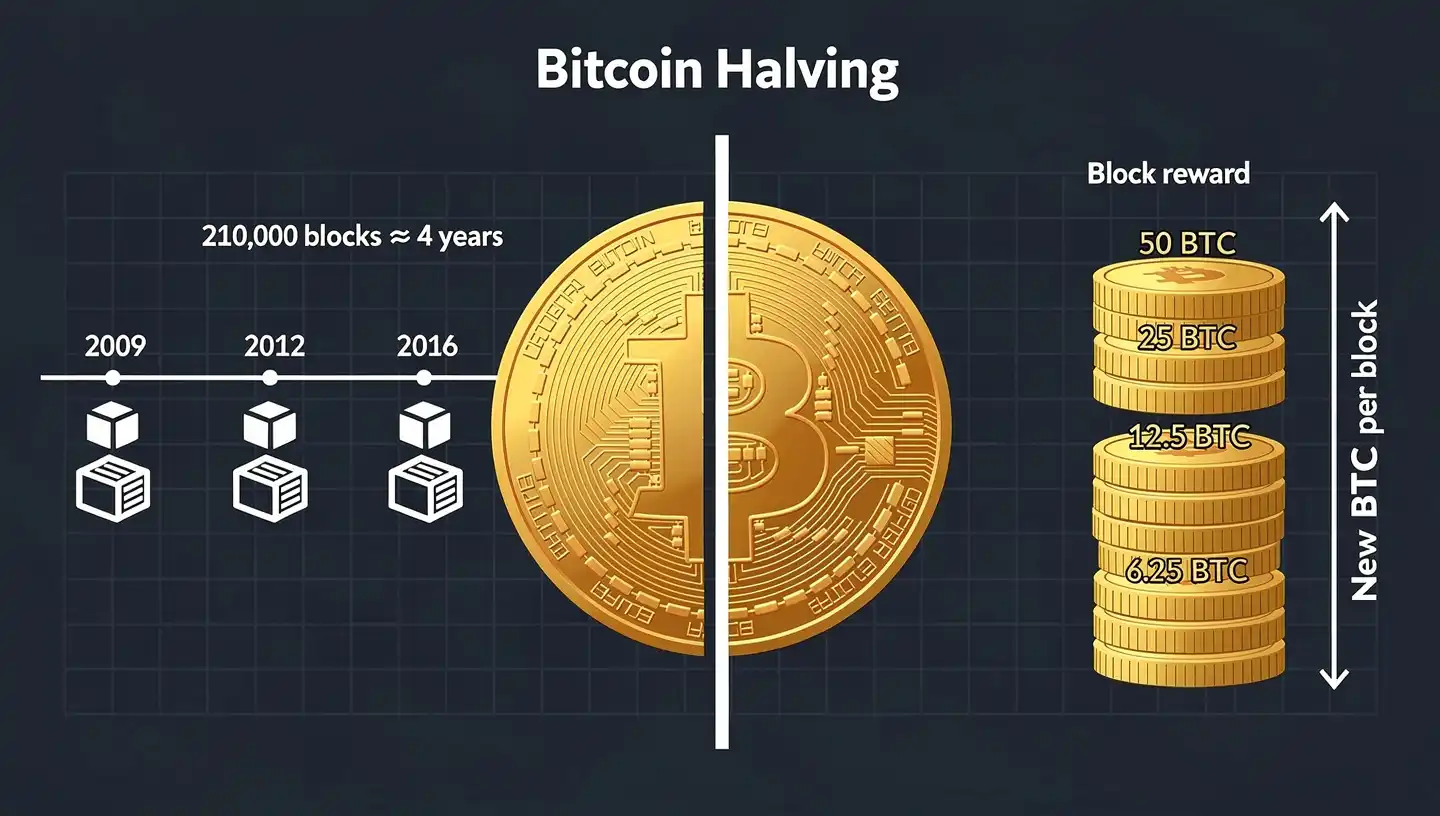
A Bitcoin halving is an event programmed into the Bitcoin protocol that cuts the block reward paid to miners by 50%. It occurs every 210,000 blocks mined, which at Bitcoin’s average block time of approximately 10 minutes works out to roughly once every four years.
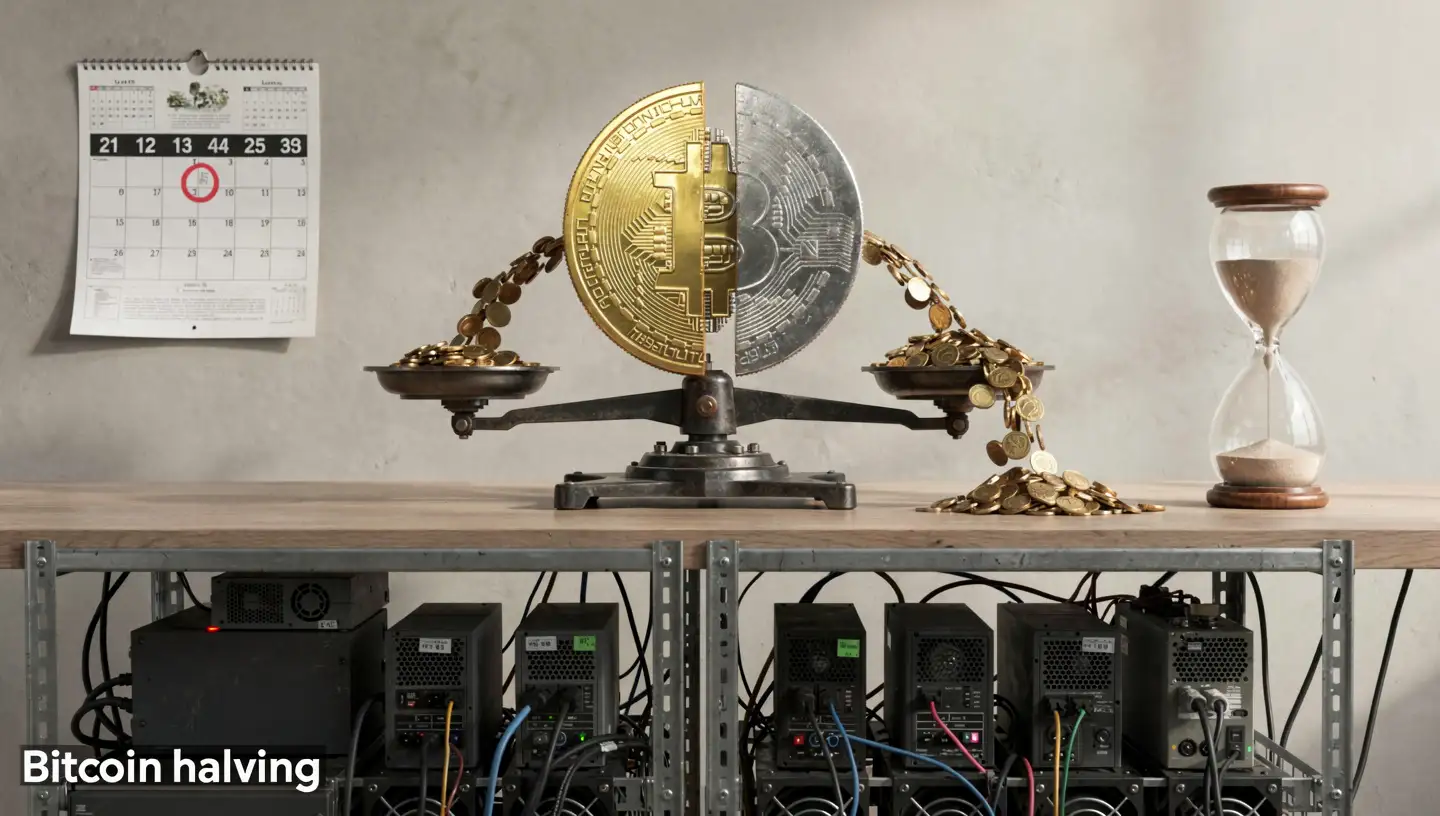
When Bitcoin launched in January 2009, miners received 50 BTC for every block they successfully added to the blockchain. After the first halving in November 2012, that reward dropped to 25 BTC. It halved again in July 2016 to 12.5 BTC, again in May 2020 to 6.25 BTC, and most recently in April 2024 to 3.125 BTC. This process continues until around the year 2140, when the last fraction of a Bitcoin will be mined and no new supply enters circulation.
The halving is not a policy decision. It is a line of code that runs automatically when the block count hits a multiple of 210,000. Nobody can override it, delay it, or change the amount without the consensus of the entire Bitcoin network, and given Bitcoin’s history, that is effectively impossible for a change this fundamental.
What is Bitcoin mining?
To understand why the halving matters, you first need to understand what miners do and why they are compensated at all.

Bitcoin mining is the process by which transactions on the Bitcoin network are verified and added to the blockchain. Networks of specialized computers, called miners, compete to solve a cryptographic puzzle. The first miner to find the solution earns the right to add the next batch of transactions as a new block, and receives newly issued Bitcoin as a reward.
The puzzle cannot be solved through clever reasoning or shortcuts. It requires raw computing power, with miners making billions of guesses per second until one of them hits the target. The total computing power committed to this process is called the hashrate. A higher hashrate means more computers are mining, which means the network is more expensive to attack and therefore more secure.
Without the block reward, miners have little financial reason to run the hardware, pay the electricity bills, and keep the network running. The block reward is the economic engine that keeps Bitcoin’s infrastructure online. The halving cuts that engine’s fuel in half every four years, which is why it creates such significant ripple effects through the mining industry and the broader market.
For a full technical breakdown of how the Bitcoin blockchain processes and verifies transactions, see our guide on how Bitcoin works.
How does the Bitcoin halving work?
The mechanics behind the halving are precise and leave nothing to interpretation.
The 210,000-block rule
The halving is triggered automatically at every 210,000th block. Bitcoin’s protocol is designed to produce a new block approximately every 10 minutes. The math that produces the roughly four-year halving cycle:
210,000 blocks × 10 minutes = 2,100,000 minutes = 3.99 years
That is where “every four years” comes from. It is not a calendar date that was chosen; it is the inevitable output of the block count and the target block time. If miners collectively produce blocks slightly faster than 10 minutes on average (which they often do when hashrate is high), the halving arrives a few weeks earlier than predicted.
Mining rewards and Bitcoin’s inflation rate
Bitcoin’s inflation rate, meaning the rate at which new coins are added to the total supply, falls with each halving. Here is how the numbers have moved:
- 2009 launch: 50 BTC per block, approximately 7,200 BTC issued per day, high annual inflation
- After 2012 halving: 25 BTC per block, annual inflation rate approximately 12%
- After 2016 halving: 12.5 BTC per block, annual inflation rate approximately 4%
- After 2020 halving: 6.25 BTC per block, annual inflation rate approximately 1.8%
- After 2024 halving: 3.125 BTC per block, approximately 450 BTC issued daily, annual inflation rate approximately 0.85%
For context, the US Federal Reserve targets around 2% annual inflation for the dollar. After the fourth halving, Bitcoin’s issuance rate is lower than that. Bitcoin is now described as disinflationary: it still creates new coins, but at a declining rate that approaches zero over time.
How block time stays nearly constant
One technical detail worth understanding: if more miners join the network, why does the block time not speed up and cause halvings to happen sooner than expected?
Because Bitcoin has a built-in difficulty adjustment. Every 2,016 blocks, approximately every two weeks, the protocol automatically recalibrates how hard the mining puzzle is. If blocks have been produced faster than 10 minutes on average, the difficulty increases to slow things down. If blocks have been coming too slowly, the difficulty drops. This self-correcting mechanism keeps the average block time near 10 minutes regardless of whether there are 100 miners or 10 million miners working simultaneously.
The halving does not disrupt this. It reduces the reward per block without changing the speed at which blocks are produced.
For more on how proof-of-work mining compares to proof-of-stake validation, which is used by other major cryptocurrencies, see our guide on proof of work vs proof of stake.
Bitcoin halving dates: full history
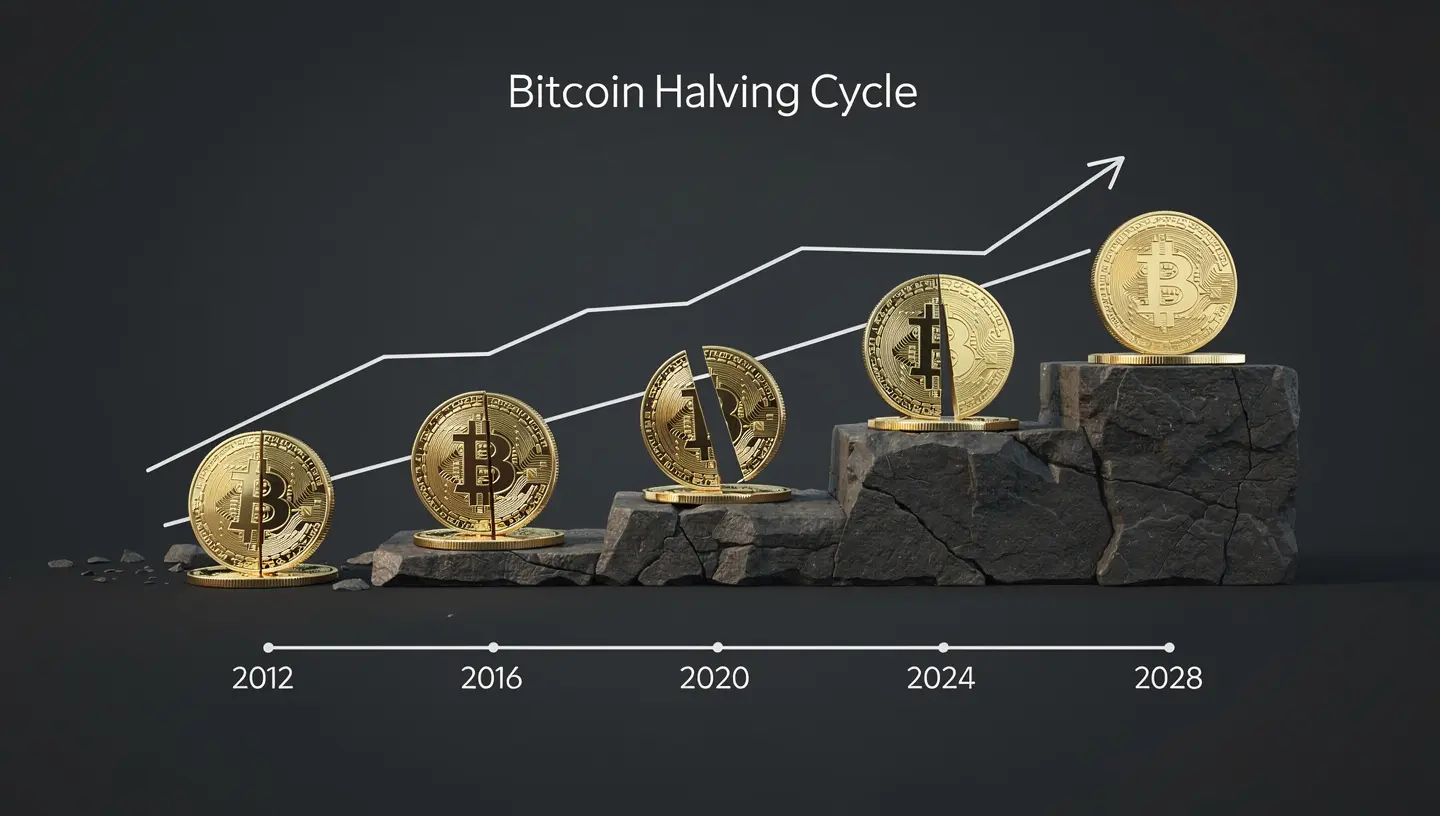
Four halvings have occurred since Bitcoin launched. Each one reduced the block reward and changed the economics of mining and the supply of new Bitcoin entering the market.
| Halving | Date | Reward before | Reward after | BTC price on halving day |
|---|---|---|---|---|
| 1st | November 28, 2012 | 50 BTC | 25 BTC | ~$12 |
| 2nd | July 9, 2016 | 25 BTC | 12.5 BTC | ~$650 |
| 3rd | May 11, 2020 | 12.5 BTC | 6.25 BTC | ~$8,500 |
| 4th | April 19, 2024 | 6.25 BTC | 3.125 BTC | ~$63,800 |
| 5th (expected) | ~2028 | 3.125 BTC | 1.5625 BTC | unknown |
First halving, 2012: Bitcoin was still largely unknown outside early crypto circles. The halving attracted minimal mainstream attention. In the months that followed, the price climbed from around $12 to over $1,000 by late 2013.
Second halving, 2016: More media coverage and a larger community. Price on halving day was around $650. Bitcoin went on to reach nearly $20,000 by December 2017, roughly 18 months later.
Third halving, 2020: Took place during the COVID-19 pandemic in May, just weeks after Bitcoin had crashed to $3,800 in the March market selloff. The recovery was sharp. Bitcoin reached $68,789 by November 2021.
Fourth halving, 2024: The most anticipated halving to date, coming just months after the approval of spot Bitcoin ETFs in the US. Daily issuance dropped from approximately 900 BTC to 450 BTC. Bitcoin crossed $100,000 for the first time by December 2024 and set a new all-time high above $126,000 in October 2025.
For the full price history of Bitcoin across all four halving cycles, see our Bitcoin history guide.
Why does the Bitcoin halving happen?
The halving exists because of a design choice Satoshi Nakamoto made before Bitcoin launched. The goal was to create a currency with a predictable, fixed total supply that no authority could change.
Bitcoin’s maximum supply is 21 million coins. That number is hard-coded into the protocol. The halving is the mechanism that enforces it, by steadily reducing how many new coins enter circulation each block,, it ensures that the approach to 21 million is gradual rather than sudden.
Without the halving, all 21 million bitcoins could theoretically have been mined in the early years, leaving miners no reward to sustain the network afterwards. The halving schedule distributes mining rewards across more than a century, giving the network time to grow a transaction fee economy that can eventually replace block rewards as the primary miner incentive.
As of 2025, approximately 94% of all bitcoins that will ever exist have already been mined. The remaining 6% will take until approximately 2140 to reach the total cap. The halvings get the credit for that extended timeline.
For more on who created Bitcoin and what problems it was designed to solve, see our piece on who created Bitcoin.
How the Bitcoin halving affects the price
The halving does not change demand for Bitcoin. It changes the supply of new Bitcoin entering the market. If demand stays the same or grows while new supply is cut in half, basic economics suggests upward pressure on price. The historical record supports this, though with significant caveats.
Supply reduction and scarcity
Before the 2024 halving, approximately 900 new bitcoins entered the market every day from mining rewards. After the halving, that number dropped to approximately 450. This supply reduction means less selling pressure from miners who must regularly sell some of their earnings to cover operating costs like electricity and hardware.
Miners are structural sellers. They produce Bitcoin at a cost and must convert some of it to fiat to pay bills. When the daily output is halved, the amount they need to sell is also roughly halved, assuming operating costs stay constant. This reduction in consistent daily selling pressure is one mechanism through which the halving influences price.
Historical price performance after each halving
Every halving to date has eventually been followed by a new all-time high. The gains and timing have varied:
- After 2012 halving: Bitcoin reached ~$1,150 approximately one year later, a gain of roughly 9,500% from halving-day price
- After 2016 halving: Bitcoin reached ~$19,783 approximately 17 months later, a gain of roughly 2,975%
- After 2020 halving: Bitcoin reached ~$68,789 approximately 18 months later, a gain of roughly 688%
- After 2024 halving: Bitcoin crossed $100,000 within eight months and reached ~$126,000 by October 2025
The percentage gains are declining with each cycle. This is expected. It is much easier to double a $100 million market cap than a $1 trillion one. The absolute dollar gains, however, have grown with each cycle. Both observations matter for anyone trying to use halving history as an investment framework.
Importantly, the halvings have not been the only driver of these price moves. Spot Bitcoin ETF approval in January 2024, growing institutional adoption, and macroeconomic factors contributed significantly to the 2024-2025 cycle. Attributing all price appreciation to the halving alone oversimplifies a complex market.
The stock-to-flow model
One widely discussed framework for analyzing Bitcoin’s scarcity relative to its price is the stock-to-flow (S2F) model. It compares the existing supply (stock) of an asset to the annual rate at which new supply is produced (flow). Gold has a stock-to-flow ratio of approximately 62, meaning it would take 62 years of current production to double the existing supply.
After the 2024 halving, Bitcoin’s stock-to-flow ratio increased to approximately 112, making it theoretically scarcer than gold by this measure. The model, popularized by pseudonymous analyst PlanB, predicted that higher stock-to-flow ratios would correlate with higher prices. Historical correlations have been strong, but the model has also missed significantly at specific price targets. It should be treated as one analytical lens among many, not a reliable prediction tool.
Does the Bitcoin halving affect altcoins?
Historically, Bitcoin rallies following halvings have eventually triggered broader market gains, including for altcoins. The pattern has been: Bitcoin reaches a new all-time high, Bitcoin dominance peaks, and then capital rotates from Bitcoin into altcoins as investors seek higher percentage returns. This is called altcoin season.
The 2017 altseason followed Bitcoin’s December 2017 ATH. The 2021 altseason followed Bitcoin’s April 2021 ATH, with a second wave after Bitcoin’s November 2021 peak. Neither happened immediately after the halving; there was always a delay as Bitcoin led the rally first.
This pattern is not guaranteed to repeat. Each cycle has its own character, and the growth of institutional Bitcoin holders who do not rotate into altcoins may change the dynamic in future cycles.
For more on how Bitcoin dominance shifts during and after halving cycles, see our guide on Bitcoin dominance.
How the Bitcoin halving affects miners
Miners feel the effects of every halving most directly. Their revenue is cut in half overnight, while their operating costs remain the same.
Miner profitability and the shutdown price
Every mining operation has a shutdown price: the Bitcoin price below which the cost of electricity exceeds the value of the coins produced. When the block reward is halved, that shutdown price effectively doubles for miners whose costs do not change. A miner that was profitable at $25,000 per Bitcoin may become unprofitable at the same price after the halving cuts their reward in half.
The miners who survive halvings are those with access to cheap electricity, the most efficient hardware, and the financial reserves to weather a period where the market has not yet adjusted the price upward to compensate for the lower reward. Industrial-scale miners in regions with low electricity costs have a structural advantage over smaller operations every time a halving occurs.
Hashrate and difficulty adjustment after halving
Immediately after a halving, some less efficient miners shut down because the economics no longer work for them. This reduces the total network hashrate, which is the combined computing power of all active miners. When hashrate drops, the difficulty adjustment responds automatically within approximately two weeks, lowering the puzzle difficulty so that remaining miners can still produce blocks at the target rate of one every 10 minutes.
After the 2020 halving, the hashrate dropped briefly before recovering as Bitcoin’s price increased and made mining profitable again for more participants. The network has never experienced a long-term security problem from post-halving hashrate drops. The difficulty adjustment has been effective in keeping the network running stably through all four halvings.
The long-term transition to transaction fees
As block rewards shrink with each successive halving, miners will eventually rely almost entirely on transaction fees paid by users to include their transactions in a block. This transition is already underway: transaction fees have represented a growing percentage of total miner revenue over time, particularly during periods of high network congestion.
Whether transaction fees will be sufficient to sustain a large, secure mining industry once block rewards become negligible is one of the most significant open questions about Bitcoin’s long-term economic model. Newer developments on Bitcoin, including the Runes protocol and second-layer networks, are attempts to drive more transaction activity and fee revenue on the base chain.
For more on how staking works on proof-of-stake networks as a comparison to Bitcoin’s mining model, see our guide on what is crypto staking.
Benefits and drawbacks of the Bitcoin halving
Benefits of the Bitcoin halving
- Predictable monetary policy. Every participant in the Bitcoin network knows exactly how many new coins will be created and when the next reduction will occur. This transparency has no equivalent in fiat monetary systems where central bank decisions can change without notice.
- Built-in scarcity. The fixed 21 million supply cap, enforced by the halving schedule, is the foundation of Bitcoin’s value proposition as a scarce digital asset.
- Declining inflation rate. Each halving pushes Bitcoin’s annual inflation rate lower, eventually reaching zero. For holders, this means their share of the total supply is not diluted at an accelerating rate.
- Network security incentive. During the early years when Bitcoin’s price was low, the generous block reward attracted enough miners to keep the network secure. As the price rose, the economic value of the reward remained meaningful even as the coin quantity decreased.
- Historical price appreciation. Every halving to date has been followed by a new all-time high, drawing new participants and increasing awareness of Bitcoin with each cycle.
Drawbacks of the Bitcoin halving
- Miner revenue shock. Every halving cuts miner income in half immediately. Less efficient miners are pushed out of the market, at least temporarily, until the price adjusts or they upgrade their equipment.
- Mining centralization risk. As small miners are squeezed out by each successive halving, the mining industry tends to consolidate around well-funded industrial operators. This reduces decentralization at the hardware level.
- Speculative excess around halvings. The predictability of halvings creates speculative buying in the months before the event. This FOMO-driven demand can push prices above what fundamentals support, leading to sharp corrections after the halving passes.
- Unresolved long-term fee economics. The biggest unanswered question is whether transaction fees alone will sustain sufficient mining activity once block rewards become negligible after future halvings.
- Past performance is not predictive. Four halvings is a small sample. The consistent post-halving price increases could reflect the halving mechanism, broader adoption growth, macro conditions, or all three simultaneously. There is no guarantee the pattern continues.
Should you buy Bitcoin before or after the halving?
This is the question that generates the most interest in the months surrounding each halving, and it deserves a direct answer.
The case for buying before the halving is based on historical pre-halving price appreciation. Bitcoin tends to rise in the year leading up to a halving as the event draws media attention and new buyers. In 2023, Bitcoin gained approximately 160% in the twelve months before the April 2024 halving.
The case for caution is the “buy the rumour, sell the news” dynamic. When a widely anticipated event finally arrives, traders who bought in anticipation often sell on the day itself. Bitcoin has sometimes experienced short-term price drops immediately after halvings as this sell pressure hits. The actual sustained bull run that follows the halving typically takes months to develop, not days.
Dollar-cost averaging (DCA), which means buying a fixed amount of Bitcoin at regular intervals regardless of price, is consistently referenced by analysts and experienced holders as a more reliable approach than trying to time entries around the halving. DCA removes the need to predict whether the halving is “priced in” or not. Over the long timeframes that Bitcoin has historically rewarded, consistent accumulation has outperformed most attempts at precise market timing.
No investment approach eliminates risk. Bitcoin has lost more than 80% of its value from peak to trough in past cycles. Investing only amounts you can afford to lose completely is the only consistently sound guideline in a market this volatile.
For context on what all-time highs mean for Bitcoin and how ATH levels relate to halving cycles, see our guide on ATH meaning in crypto.
When is the next Bitcoin halving?
The fifth Bitcoin halving is expected in approximately 2028. At that point, the block reward will drop from 3.125 BTC to 1.5625 BTC per block.
The exact date cannot be known in advance because it depends on how quickly blocks are mined, which is influenced by the total hashrate on the network. If more miners join and blocks come slightly faster than 10 minutes on average, the halving arrives earlier. Several websites offer live countdown timers based on current block production rates, including Nicehash and CoinWarz.
By the time the fifth halving occurs, approximately 97% of all Bitcoin that will ever exist will already have been mined. The remaining 3% will take another 112 years to produce, slowly distributed across the final halvings that stretch through to 2140.
What happens when the last Bitcoin is mined?
Around the year 2140, the block reward will have been halved so many times that it effectively reaches zero. The last fraction of a Bitcoin will be mined, and the total supply will be locked at just under 21 million coins. No new Bitcoin can ever be created after that point.
From that moment, miners will have no block reward to earn. Their only compensation will be the transaction fees users pay to have their transactions included in the next block. For this economic model to sustain a large enough mining industry to keep the network secure, the volume and value of Bitcoin transactions must generate sufficient fee revenue.
Optimists point to Bitcoin’s growing use in payments, second-layer networks like the Lightning Network, and newer protocols built on top of Bitcoin as sources of fee revenue that will grow over time. Skeptics note that 2140 is too far away to model with confidence and that the network may look completely different by then. Both positions are reasonable given the uncertainty involved.
What is not in question is the design itself: Bitcoin’s supply is fixed, the halving is the mechanism that enforces it, and the timeline to 2140 is built into the same code that has run without interruption since January 2009.
For a broader introduction to Bitcoin and the full context of how it was designed, see our guide on what is Bitcoin.
Live halving countdown data and block reward tracking is available at NiceHash Bitcoin Halving and CoinWarz Halving Countdown.
Frequently asked questions
What is a Bitcoin halving in simple terms?
A Bitcoin halving is a scheduled event that cuts the reward miners receive for adding a new block to the blockchain by 50%. It happens every 210,000 blocks, which works out to roughly every four years. The halving is Satoshi Nakamoto’s mechanism for controlling how quickly new Bitcoin enters circulation and ensuring the total supply never exceeds 21 million coins.
How often does the Bitcoin halving occur?
Every 210,000 blocks. At Bitcoin’s target block time of 10 minutes, that works out to approximately every 3.99 years, which is why it is commonly described as every four years. The exact calendar date shifts slightly depending on how fast blocks are mined. Four halvings have occurred: November 2012, July 2016, May 2020, and April 2024.
Does the Bitcoin halving always lead to a price increase?
Every halving so far has eventually been followed by a new all-time high, but the timing and magnitude have varied significantly. The price gains have decreased percentage-wise with each cycle as Bitcoin’s market cap grows larger. Halvings are not the only factor behind price moves: institutional adoption, macro conditions, and regulatory developments all contribute. There is no guarantee that the historical pattern continues.
What happens to Bitcoin miners after the halving?
Their block reward is cut in half immediately. Miners with higher operating costs relative to their output may become unprofitable and shut down temporarily, which reduces the total network hashrate. The difficulty adjustment mechanism responds within approximately two weeks, lowering the mining difficulty so remaining miners can still produce blocks on schedule. As Bitcoin’s price typically rises in the months and years following a halving, profitability tends to recover for those who remain active.
Does the Bitcoin halving affect altcoins?
Not directly, but historically yes. Bitcoin rallies following halvings have eventually triggered broader market gains including for altcoins. The typical pattern has been Bitcoin reaching a new all-time high, then capital rotating into altcoins. This rotation is called altcoin season. It has followed the 2016, 2020, and 2024 halvings but has not been immediate; Bitcoin has led the rally first, with altcoins following months later.
What is the current Bitcoin block reward?
As of April 2024, the current block reward is 3.125 BTC per block. At the target block time of 10 minutes, this means approximately 450 new Bitcoin are created per day. The next halving, expected around 2028, will reduce this to 1.5625 BTC per block.
What is the shutdown price for Bitcoin miners?
The shutdown price is the Bitcoin price below which a miner’s electricity costs exceed the value of the coins they produce. It varies significantly between mining operations depending on electricity costs and hardware efficiency. After a halving cuts the block reward in half, the shutdown price for each miner effectively doubles, assuming energy costs stay constant. Miners with access to cheap electricity and the most efficient hardware have the lowest shutdown prices and are best positioned to survive halvings.
How do I track when the next Bitcoin halving is?
Several websites provide live countdown timers based on current block production. NiceHash and CoinWarz both offer halving countdowns that update in real time based on actual block times rather than fixed calendar estimates. Because the exact date depends on mining speed, these estimates shift slightly over time. The countdown is always measured in blocks remaining, not calendar days.