If you spend any time in crypto communities, three letters come up constantly: ATH. Sometimes paired with rocket emojis during a price surge, sometimes in wistful comparisons to better days. An all-time high (ATH) is the highest price a cryptocurrency has ever reached since it first became available to trade. That is the short answer. The longer one covers why it matters, what typically happens when a coin breaks its ATH, and how to use this data without falling into the traps that catch most new market participants.
ATH is not limited to price alone. A token’s market capitalization can reach an ATH, its trading volume can hit an ATH, or the total crypto market cap can set an all-time high. But when the term appears without further context, it almost always refers to price.
What does ATH mean in crypto?
ATH stands for all-time high. In crypto, it refers to the highest price a cryptocurrency has ever traded at across its entire history, from the very first transaction to the present moment. There is no expiration. An ATH set three years ago remains the ATH until a higher price replaces it.
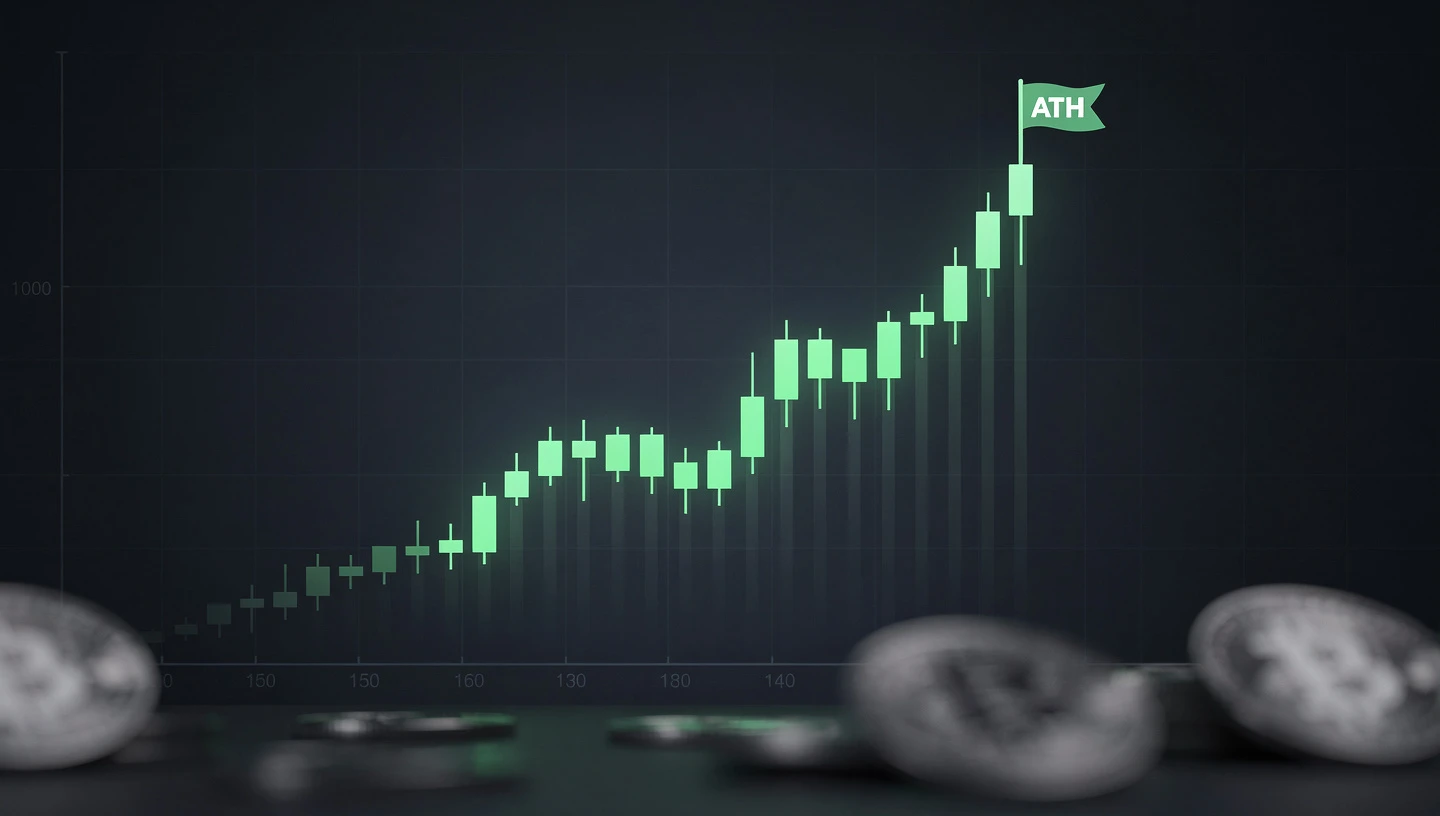
The concept is not unique to crypto. In stock markets, you will regularly hear about the S&P 500 or an individual company’s shares hitting an all-time high. The meaning is identical: the highest recorded value to date. What makes crypto ATHs distinct is how they form, how quickly they can reverse, and how they fit into the broader market cycles that crypto follows.
When a coin breaks through its previous ATH, it enters what traders call price discovery. Above that level, there is no prior price history, no established resistance, and no reference point from holders who bought at the top and are waiting to sell at breakeven. Price action above ATH is inherently less predictable and often more volatile than trading within a previously established range.
What does ATL mean in crypto?
ATL stands for all-time low. It is the lowest price a cryptocurrency has ever reached since it began trading. Where ATH marks the ceiling of an asset’s price history, ATL marks the floor.
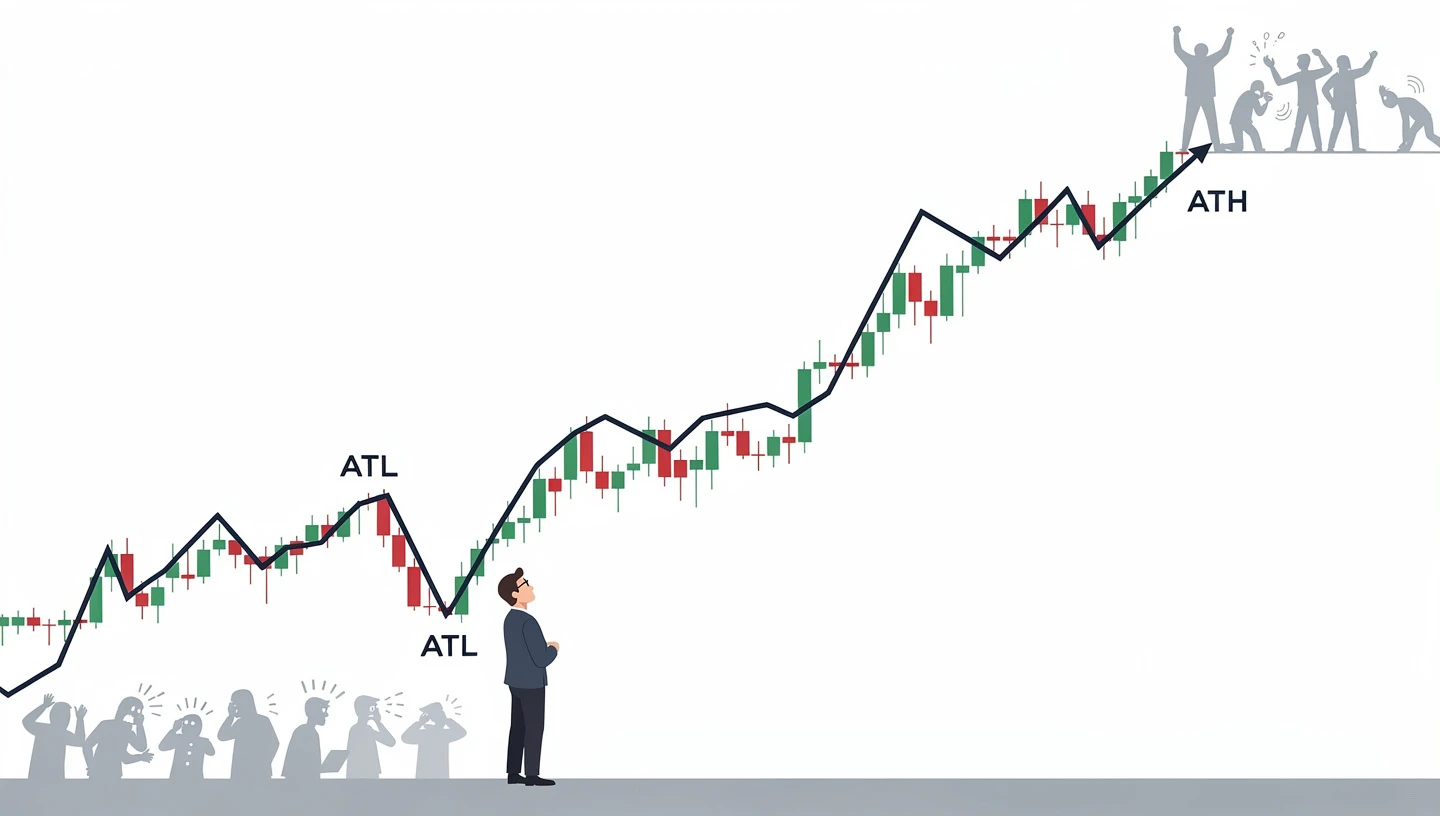
For most established cryptocurrencies, ATLs were set very early in their life cycle, when liquidity was thin and few people were trading. Bitcoin’s ATL dates back to 2010 when it traded for fractions of a cent. For newer or struggling projects, an ATL can be a recent and painful marker, sometimes signaling a collapse of confidence in the project itself.
A new ATL almost always triggers negative sentiment. It means the asset has fallen below every price point in its history, which can lead to panic selling, negative coverage, and further price drops. That said, ATLs have historically represented buying opportunities for those with conviction in the underlying project, provided the fundamentals have not changed. Panic selling at an ATL locks in losses at the worst possible moment.
ATH vs. ATL: key differences
| ATH (all-time high) | ATL (all-time low) | |
|---|---|---|
| What it marks | Highest price ever recorded | Lowest price ever recorded |
| When it typically forms | Bull markets, strong catalysts, FOMO-driven buying | Bear markets, project failures, panic selling |
| Psychological effect | Euphoria, FOMO, increased media attention | Fear, negative headlines, possible capitulation |
| For traders | Resistance zone, potential profit-taking point | Potential support zone, possible buying opportunity |
| Timeframe | Full trading history, no expiration | Full trading history, no expiration |
How ATH is determined
ATH is simply the single highest price ever recorded for an asset. A few technical details shape how that number is reported.
Exchange variation
Different exchanges can show slightly different ATH figures because each platform has its own order book and liquidity profile. A large buy order on one exchange might push the price briefly higher than the same moment on another. Data aggregators like CoinMarketCap and CoinGecko typically report a composite or averaged ATH figure drawn from multiple exchanges, which is why their ATH numbers are the most widely cited.
Intraday vs. closing price
In crypto’s 24-hour markets, ATH almost always refers to the highest price reached at any point during a trading session, not a daily closing price. A token might spike to its ATH during a volatile hour and pull back sharply within the same day. That intraday peak still counts as the official ATH. This is different from some traditional finance metrics that track closing prices only.
No expiration
An ATH set in 2021 remains the ATH in 2026 unless a higher price replaces it. This is different from the “52-week high” metric used in stock market analysis, which resets every year. In crypto, ATH is a lifetime record with no reset date. This is why some altcoins from the 2017 era still carry ATHs from that period, more than seven years later, without having come close since.
For a broader look at how different cryptocurrencies have developed their own price histories and records, see our guide on what is an altcoin.
What happens when a cryptocurrency hits ATH
Breaking a previous ATH sets off a predictable sequence of market activity. Understanding that sequence makes it easier to act without reacting emotionally.
Media coverage picks up. Social media fills with price screenshots and predictions of further gains. New participants who have been watching from the sidelines feel the pull of FOMO and enter the market. Simultaneously, some holders who bought earlier see the ATH as the right moment to take profits. That combination of fresh buying and established profit-taking creates the volatility that typically follows an ATH break.
A concrete example: when Bitcoin broke through $69,000 in November 2021, headlines appeared across mainstream financial and technology publications. New retail investors entered at or near the top. Within weeks, the price began a correction that took Bitcoin to under $16,000 by November 2022. The same pattern repeated when Bitcoin crossed $100,000 for the first time in December 2024 and again when it set a new record above $126,000 in October 2025.
This does not mean that buying when a coin breaks ATH always leads to losses. Some assets continue climbing for months after breaking ATH. What it does mean is that ATH breaks are moments of elevated risk, not confirmed entry signals. The price is in uncharted territory and the direction is genuinely unknown.
For context on how Bitcoin’s price history has developed through multiple ATH cycles, see our Bitcoin history guide.
Why ATH matters for traders and investors
ATH data serves practical functions beyond simply knowing what a coin’s record price was.

ATH as a resistance level
Previous ATHs act as psychological resistance levels. When a coin approaches its former ATH after a period of decline, there are typically holders who bought near that level and have been underwater since. As the price returns to their entry point, some will sell to break even rather than risk another downturn. This accumulated selling pressure can slow down or temporarily block a coin from breaking through its previous ATH.
When the price does eventually break through, the former resistance level often flips and becomes a new support zone. This is one of the most consistent patterns in technical analysis and it applies to crypto just as it does to stocks and other traded assets.
Benchmarking performance
Distance from ATH is a useful measure for understanding where a coin sits in its historical context. If Ethereum’s ATH was approximately $4,800 and it currently trades at $2,400, it is about 50% below ATH. That figure does not tell you whether the price will recover. It does tell you how far the asset has declined from its peak and gives a reference point for evaluating whether the current price looks historically high or low.
This metric is especially useful when comparing assets: some coins trade 20% below ATH while others trade 90% below. That gap reflects very different market stories.
Gauging market sentiment
An asset approaching its ATH signals growing confidence and bullish momentum. An asset that has been declining from its ATH for an extended period often reflects deteriorating sentiment or external pressures. When Bitcoin reaches new ATHs, it frequently generates positive sentiment across the broader crypto market and tends to shift Bitcoin dominance in ways that influence how capital moves into altcoins.
Informing entry and exit decisions
Some investors use ATH data to frame their entry and exit decisions. Buying significantly below ATH may represent a value opportunity if the project’s fundamentals remain strong. Selling near ATH may lock in gains before a potential correction. Neither approach is reliable on its own. A disciplined strategy like dollar-cost averaging (DCA) avoids the need to time entries around ATH at all, spreading purchases across different price levels regardless of where the market is in its cycle.
For more on how market cap works alongside ATH data when evaluating any cryptocurrency, see our guide on what is market cap in crypto.
Notable cryptocurrency all-time highs
ATH figures shift as markets move. The table below reflects approximate ATH prices based on data available at the time of writing. For live figures, platforms like CoinMarketCap and CoinGecko update in real time.
| Cryptocurrency | Ticker | Approximate ATH price | Date reached |
|---|---|---|---|
| Bitcoin | BTC | ~$126,000 | October 2025 |
| Ethereum | ETH | ~$4,878 | November 2021 |
| Solana | SOL | ~$295 | January 2025 |
| XRP | XRP | ~$3.84 | January 2018 |
| Cardano | ADA | ~$3.09 | September 2021 |
| Dogecoin | DOGE | ~$0.74 | May 2021 |
| Binance Coin | BNB | ~$793 | June 2024 |
| Polkadot | DOT | ~$55 | November 2021 |
One detail worth noting: most altcoin ATHs from the 2017-2018 cycle have never been retested, let alone broken. XRP’s 2018 ATH of $3.84 remained its record for years. Bitcoin, by contrast, has broken its previous ATH in every major bull cycle. That distinction reflects an important difference in how capital moves through the market during different cycle phases.
Bitcoin ATH history
Bitcoin has a track record of breaking its previous ATH in each major bull market cycle. It first crossed $1,000 in late 2013. It crossed $20,000 in December 2017. It crossed $69,000 in November 2021. And it crossed $100,000 for the first time in December 2024 before setting a new record above $126,000 in October 2025.
Each of those ATHs was followed by a significant correction. The 2013 ATH was followed by an 85% drawdown. The 2017 ATH was followed by an 84% drawdown. The 2021 ATH was followed by a 77% drawdown. The pattern of new ATHs followed by sharp corrections is consistent throughout Bitcoin’s history, which is why long-term investors treat individual ATH breaks as data points rather than signals to buy immediately.
For the full timeline of Bitcoin’s price development, see our guide on what is Bitcoin.
ATH and the crypto market cycle
Bitcoin ATHs do not occur randomly. They follow a pattern closely tied to the four-year halving cycle, and they tend to precede a broader altcoin rally that comes slightly later in the same cycle.
The Bitcoin halving cuts the block reward for miners in half roughly every four years. Historically, each halving has been followed by a significant Bitcoin price increase within 12 to 18 months. The halvings of 2012, 2016, 2020, and 2024 have each preceded a new Bitcoin ATH in the following cycle. This does not guarantee future outcomes, but it gives context for why ATH watches tend to cluster around the one to two-year period following each halving.
Capital rotation from Bitcoin into altcoins has also followed a consistent pattern. In 2017, Bitcoin hit its ATH in December, and altcoins reached their ATHs in January and February 2018. In 2021, Bitcoin hit an ATH in April, and many altcoins hit their ATHs in May. Bitcoin then hit a second ATH in November 2021 and altcoins followed in November and December. Understanding this sequence makes it easier to interpret where specific assets sit relative to their likely ATH timing in any given cycle.
For more on how proof-of-stake and proof-of-work networks participate in these cycles differently, see our guide on proof of work vs proof of stake.
The psychology of ATH: traps to avoid
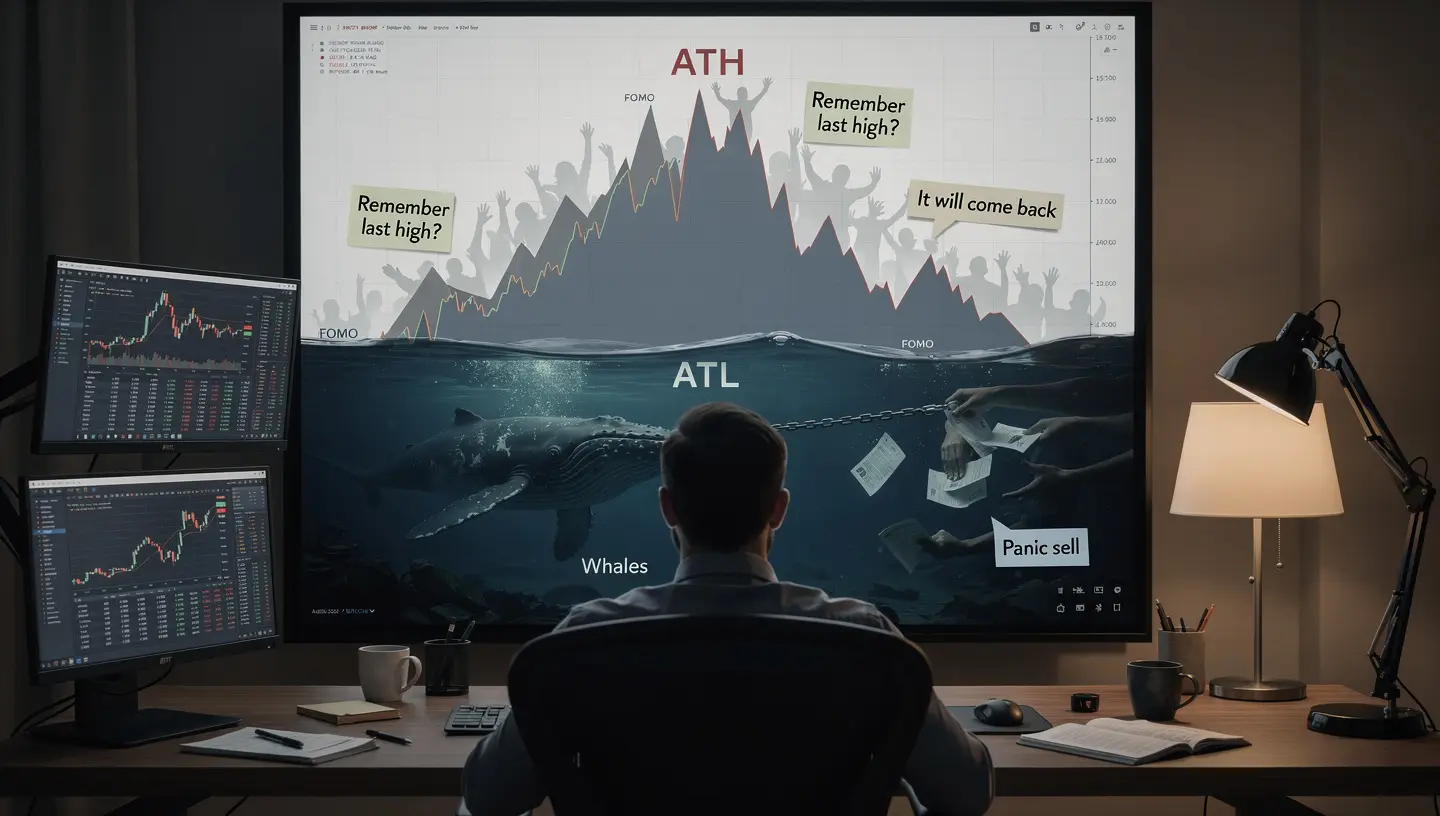
ATH and ATL are data points, but they are wrapped in powerful emotions. Understanding the psychological traps they create makes it easier to act on evidence rather than feeling.
FOMO at ATH
When an asset breaks ATH, the environment is almost designed to provoke impulsive decisions. Headlines announce new records. Social media fills with profit screenshots. People who have been on the sidelines feel like they are missing out on something that may never come back. This is FOMO (fear of missing out) and it is one of the most reliable engines of bad investment timing.
Buying at or near ATH is not automatically wrong. Some assets continue climbing for months after a new record. But buying because everyone else seems to be making money, without evaluating the asset’s fundamentals, is how most retail losses happen. Many beginners enter at ATH and watch the price correct significantly within weeks.
Anchoring to a past ATH
If you bought a token near its ATH and the price has since fallen significantly, it is natural to wait for it to return to that level before selling. This is called anchoring bias: treating the past ATH as the “true” value of the asset and expecting prices to return there. The problem is that some assets never recover their ATH. The fundamentals may have changed, competition may have increased, or the original rally may have been driven by speculation rather than genuine adoption. Evaluating the project as it is today matters more than where the price once was.
Panic selling at ATL
The counterpart to FOMO at ATH is panic selling when prices fall to new lows. Selling at ATL locks in losses at the worst possible moment and removes the possibility of participating in any subsequent recovery. If your reason for holding an asset was based on research and a long-term view, a price reaching ATL should trigger a reassessment of the thesis, not an emotional exit. The two questions worth asking are: has anything fundamentally changed about this project, and can I afford to continue holding while waiting for a recovery?
Whale influence at extremes
Large holders, called whales, can significantly influence price action around ATH and ATL levels. A single large sell order near ATH can trigger cascading liquidations among traders using borrowed capital, amplifying the price drop beyond what fundamentals would suggest. A large buy at ATL can spark a rapid reversal. Price extremes are particularly susceptible to this kind of outsized impact from single large positions. Interpreting sudden moves at these levels with skepticism rather than reacting to them immediately is a useful habit.
For anyone just getting started with crypto and trying to understand these market dynamics from the beginning, our crypto for beginners guide covers the foundational concepts.
ATH in stocks and traditional markets
ATH and ATL are universal financial terms used in stock markets, commodities, indices, and any other traded asset class. The mechanics are identical: ATH is the highest recorded price, ATL is the lowest. The psychological effects are the same: euphoria at ATH, despair at ATL.
There are practical differences in how ATH behaves across asset classes:
- Trading hours: Stock markets operate during set hours with circuit breakers that halt trading during extreme moves. Crypto trades continuously, 24 hours a day, seven days a week. ATH breaks in crypto can happen at any hour and the absence of circuit breakers means price moves can be more immediate and more dramatic.
- Frequency of new ATHs: Major stock indices like the S&P 500 set new ATHs relatively frequently during extended bull markets because the underlying companies keep growing. Crypto ATHs are more cyclical and cluster around specific catalysts, particularly Bitcoin halving events.
- 52-week high vs. ATH: Stock analysis often uses the 52-week high as a reference point because it resets annually. In crypto, the relevant benchmark is always ATH, which covers the full lifetime of the asset with no annual reset.
How to track ATH and ATL data
Finding ATH and ATL figures for any cryptocurrency is straightforward with standard tools.
- CoinMarketCap: Every asset page displays the ATH and ATL with the date each was reached, the current price, and the percentage change from ATH. This is the most widely referenced source in the market.
- CoinGecko: Same data as CoinMarketCap with slightly different coverage. Both display historical ATH/ATL with timestamps.
- TradingView: Useful for viewing the full price chart and marking ATH levels visually. Supports technical indicators and lets you overlay multiple assets for comparison.
- CoinStats and Delta: Portfolio tracking apps that show your holdings relative to each asset’s ATH in real time, so you can see your “distance from peak” across your entire portfolio.
Live ATH data for Bitcoin and other major cryptocurrencies is available at CoinMarketCap and CoinGecko, both of which update continuously.
Frequently asked questions
What does ATH stand for in crypto?
ATH stands for all-time high. In crypto, it refers to the highest price a cryptocurrency has ever traded at since it was first listed on a market. There is no expiration date: an ATH set years ago remains the ATH until a higher price is reached.
Is buying at ATH a good idea?
Not automatically. When a coin breaks ATH, it enters price discovery with no historical resistance above that level. The price may continue rising, but it may also correct sharply as early holders take profits. Buying at ATH based on excitement or FOMO rather than a clear thesis about the asset’s value is how most beginners end up holding at a loss. That said, some assets do continue climbing well past previous ATHs, so the answer depends on the specific asset and the reasoning behind the decision.
What was Bitcoin’s all-time high?
As of October 2025, Bitcoin’s all-time high was approximately $126,000, set on October 6, 2025. Bitcoin has broken its previous ATH in every major bull market cycle since its launch in 2009. Each new ATH has been followed by a significant correction before the next cycle began.
What is the difference between ATH and 52-week high?
A 52-week high is the highest price an asset has reached over the past year and resets annually. ATH covers the entire trading history of the asset with no reset. A coin might be near its 52-week high but still 70% below its ATH if the ATH was set several years ago.
Can a crypto ATH be different on different exchanges?
Yes. Each exchange has its own order book and liquidity. A large buy on one platform might briefly push the price higher than the same moment on another. Data aggregators like CoinMarketCap and CoinGecko report a composite ATH drawn from multiple exchanges, which is why their figures are the most commonly cited.
Does breaking ATH guarantee further gains?
No. Breaking ATH means the asset has entered price discovery with no prior resistance above that level. The price may keep rising, but it may also reverse quickly. Some of the sharpest corrections in crypto history have started within days of a new ATH. Breaking ATH is a signal that the market has assigned the asset its highest ever valuation, not a guarantee of what comes next.
What is the relationship between Bitcoin ATH and altcoin season?
Historically, Bitcoin tends to set its ATH first in a given cycle, and altcoins follow with their own ATHs weeks to months later. In 2021, Bitcoin’s November ATH was followed by a broad altcoin rally in the same month. In 2017, Bitcoin’s December ATH preceded altcoin ATHs in January 2018. This pattern reflects how capital typically enters crypto through Bitcoin first and then rotates into altcoins as confidence builds and risk appetite increases.
How do I find the ATH of any cryptocurrency?
Open the asset’s page on CoinMarketCap or CoinGecko. Both display the ATH and ATL with the date each was reached and the percentage change from those levels to the current price. Most major exchange platforms also display this data on individual asset pages.