Bitcoin mining is the process by which new bitcoins enter circulation and by which every transaction on the network gets verified and permanently recorded. Miners use specialized computers to compete in solving a cryptographic puzzle. The first one to solve it adds a new block of transactions to the blockchain and collects a reward, currently 3.125 BTC plus any transaction fees included in that block.
The term mining comes from the analogy with gold. Just as gold miners expend energy and equipment to extract a scarce physical resource, bitcoin miners expend electricity and computing power to produce a scarce digital one. The protocol controls how much new bitcoin gets issued and at what rate, with no company or government involved in that decision.
This guide covers how the process actually works from the moment a transaction is broadcast to the network, through the cryptographic competition miners run, to what happens when a winning block is found. It also covers the hardware, the economics, the environmental questions, and the alternatives for people who want bitcoin exposure without running their own mining operation.
What Is Bitcoin Mining
Bitcoin mining is a decentralized Proof of Work (PoW) mechanism. It is how the Bitcoin network reaches agreement on the current state of the ledger without relying on any central authority, like a bank or government, to validate transactions. Thousands of independent computers around the world run the same validation process simultaneously, and the rules of the protocol determine which version of the ledger is the correct one.
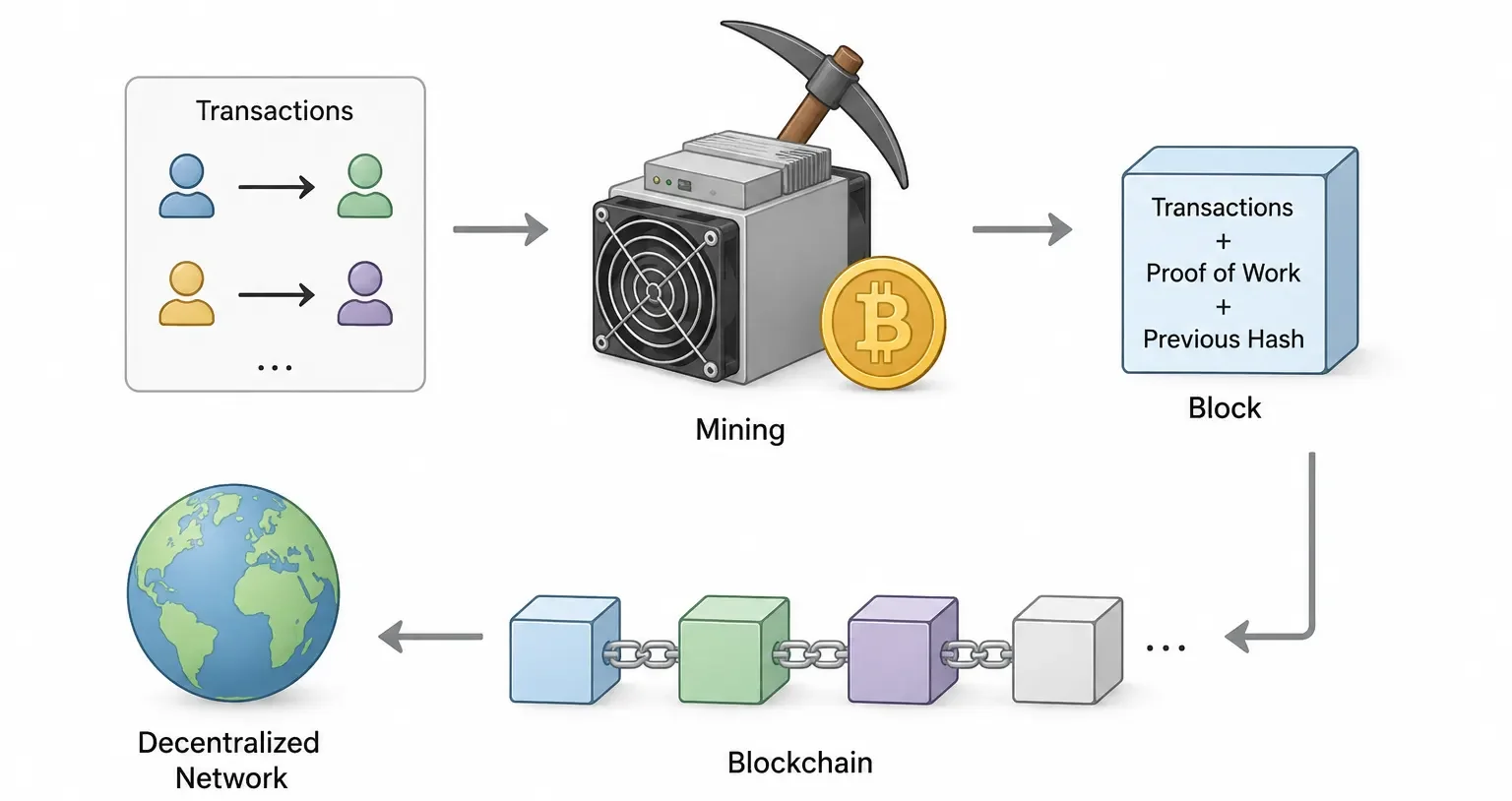
Mining does three things at once. It verifies that transactions are legitimate, prevents fraud by making it computationally expensive to rewrite transaction history, and issues new bitcoins into circulation at a predictable and declining rate. Without mining, the Bitcoin network would have no mechanism for reaching consensus and no way to prevent the same coins from being spent twice.
The Three Things Mining Does at Once
Transaction verification: when someone sends bitcoin, miners check that the sender holds the coins being spent and that the transaction follows the rules of the protocol. Valid transactions get included in the next block. Invalid ones are rejected by the network.
Fraud prevention: mining makes it so expensive to alter transaction history that doing so is practically impossible. Changing one block would require redoing all the computational work for that block and every block added since. At the current network size, no realistic attacker could sustain that effort.
New coin issuance: mining is the only mechanism through which new bitcoins are created. The protocol sets a fixed schedule for issuance, halving the block reward approximately every four years, until the total supply reaches 21 million bitcoins.
Why Bitcoin Needs Mining
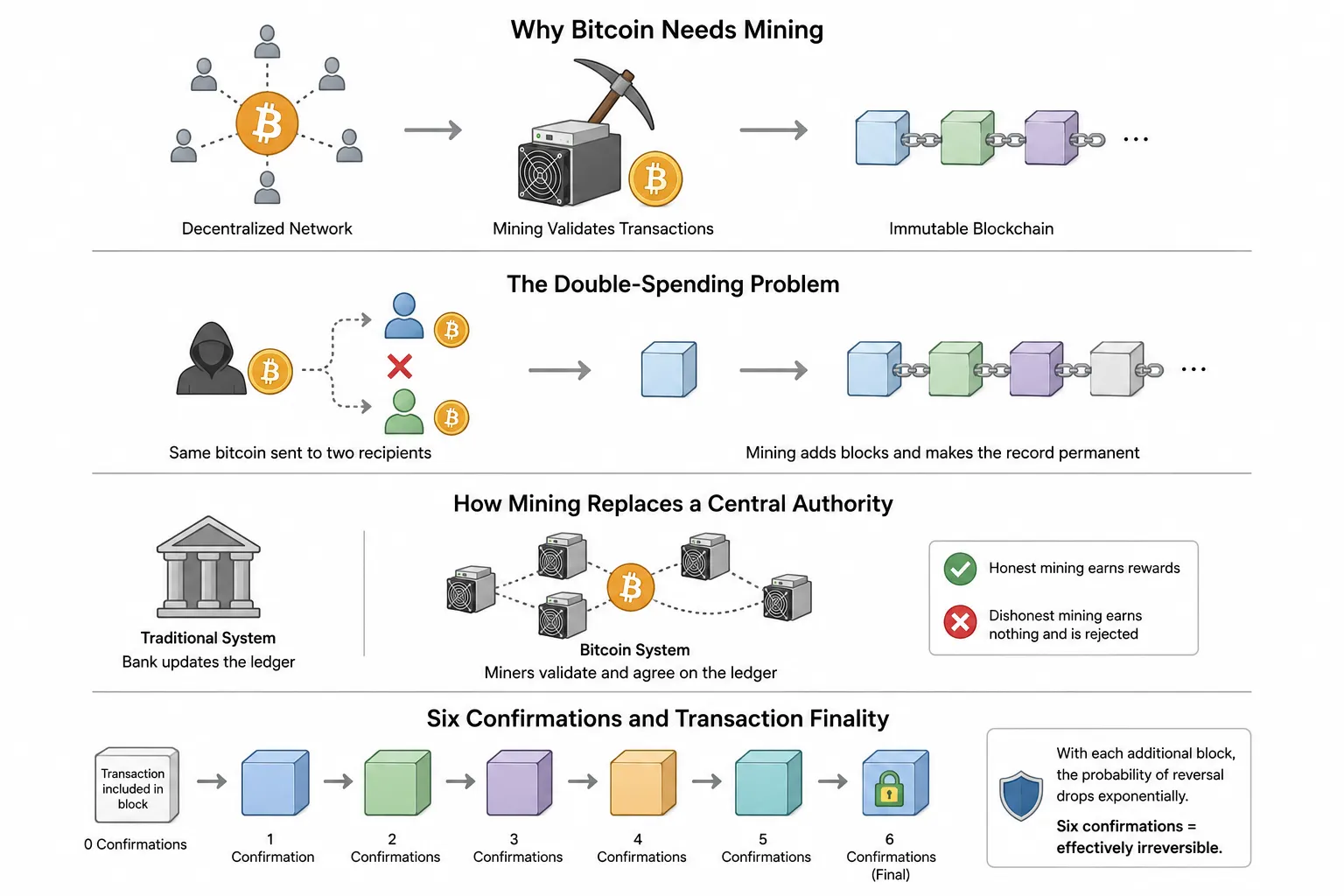
Bitcoin was designed to work without any central party controlling it. No bank approves transactions. No government issues the currency. For that design to function, the network needs a way for thousands of independent participants to agree on the same transaction history without trusting each other. Mining is that mechanism.
The Double-Spending Problem
Digital information can be copied. In theory, someone could broadcast two transactions simultaneously, each spending the same bitcoin in different directions, hoping to trick two recipients into thinking they both received funds. This is called the double-spending problem, and it is the core issue that any digital currency system must solve.
Bitcoin solves it through mining. Once a transaction is included in a block and that block is added to the chain, the record is permanent. Miners working on the next block build on top of the most recent confirmed block, adding confirmations on top of confirmations until the transaction is effectively irreversible.
How Mining Replaces a Central Authority
In a traditional payment system, a bank keeps the authoritative record of who owns what. When you send money, the bank updates its database. You trust the bank to record the transaction accurately and not manipulate the ledger. Bitcoin replaces that trusted third party with a competitive mathematical process. Any miner who validates a fraudulent transaction would have their block rejected by the rest of the network. The incentive to follow the rules is built directly into the economics: honest mining earns rewards, dishonest mining earns nothing and wastes real resources.
For a broader explanation of how the Bitcoin protocol handles ownership and value without a central authority, the guide on how Bitcoin works covers the underlying mechanics in detail.
Six Confirmations and Transaction Finality
When a transaction is included in a block, it receives one confirmation. As miners add each subsequent block on top of it, the confirmation count increases. The Bitcoin network uses six confirmations as the standard for treating a transaction as final, meaning effectively irreversible.
The logic behind six is mathematical. The probability that an attacker with less than 50% of the network’s total computing power could secretly build a longer competing chain diminishes exponentially with each new block. By six blocks, the statistical probability of a successful reversal is, for practical purposes, zero. Most exchanges and large merchants wait for six confirmations before considering a deposit settled.
How Bitcoin Mining Works: Step by Step
The mining process follows a predictable sequence from the moment a transaction is broadcast to the moment a new block is confirmed on the chain. Each step builds on the previous one, and the entire sequence happens roughly every ten minutes across thousands of competing computers worldwide.
Transactions Enter the Mempool
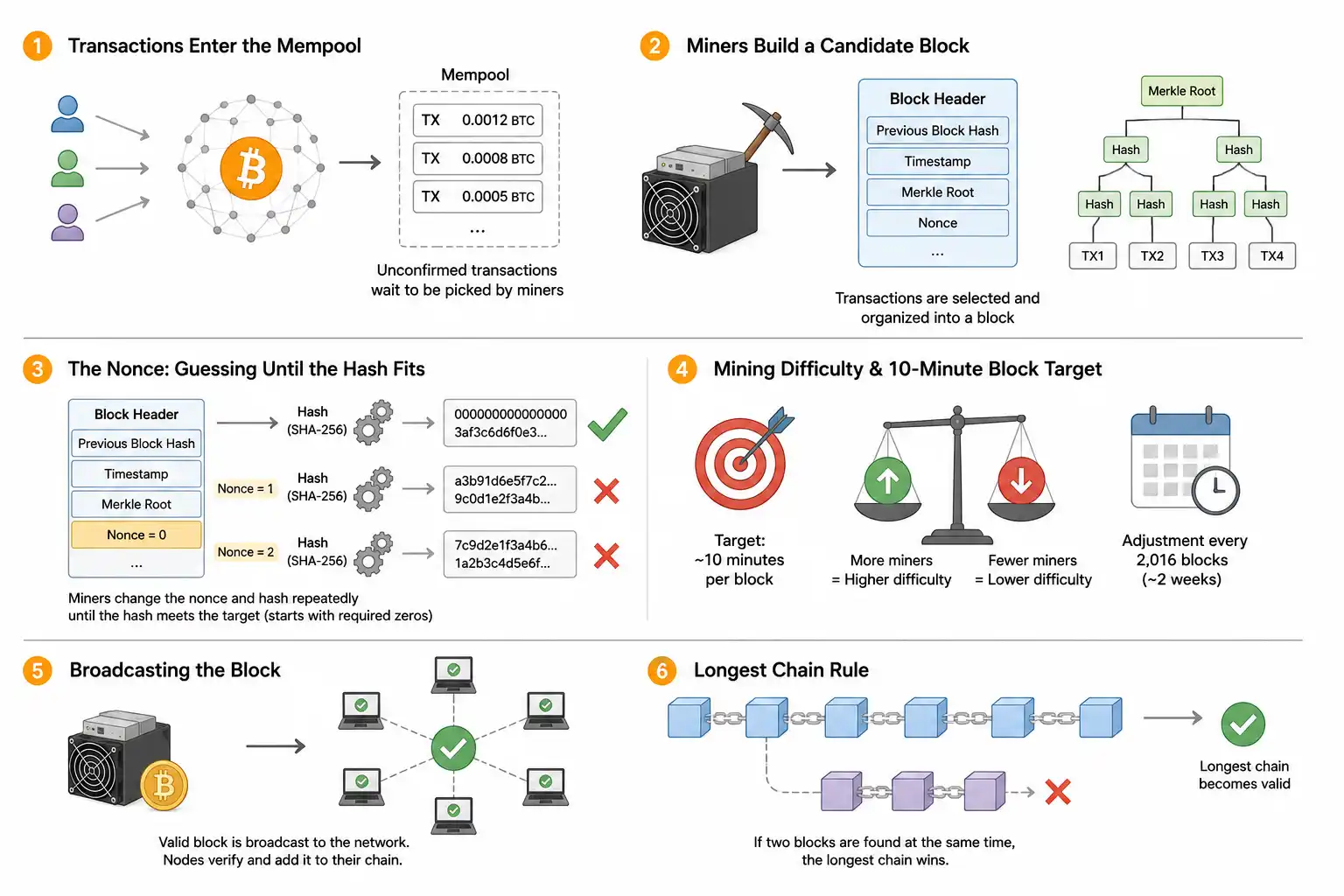
When someone broadcasts a bitcoin transaction to the network, it does not go directly into a block. It first enters the mempool (memory pool), a holding area where unconfirmed transactions wait to be picked up by miners. Each transaction in the mempool includes a fee set by the sender. Miners generally select transactions with higher fees first, since fee revenue adds to the block reward they collect.
During periods of high network activity, the mempool fills up and fees rise as senders compete to have their transactions picked up faster. During quiet periods, fees drop and transactions clear quickly. The mempool is publicly visible, and anyone can inspect which transactions are waiting to be confirmed.
Miners Build a Candidate Block
A miner selects a set of transactions from the mempool and assembles them into a candidate block. Each block includes a header containing a reference to the previous block, a timestamp, a summary of all included transactions called the Merkle root, and a few other fields. The Merkle root is a single hash value that represents every transaction in the block. If any transaction changes, the Merkle root changes, making tampering detectable instantly.
SHA-256 and the Hash Function: What It Actually Does
Bitcoin uses a cryptographic algorithm called SHA-256 (Secure Hash Algorithm, 256-bit). A hash function takes any input of any length and produces a fixed-length output of 64 characters. The same input always produces the same output. But changing even a single character in the input produces a completely different output with no predictable relationship to the original.
A simple example: the input “Hello, world!” produces a specific 64-character SHA-256 hash. Change one character to “Hello, world.” and the output is entirely different, with no resemblance to the first. This property is what makes hash functions useful for securing the blockchain. If someone altered a transaction inside a block, the block’s hash would change, and the entire chain of blocks after it would no longer connect correctly.
The Nonce: Guessing Until the Hash Fits
For a block to be accepted by the network, its hash must meet a specific requirement: it must begin with a certain number of zeros. The network sets this requirement, called the target hash, based on the current mining difficulty. A valid hash cannot be predicted or engineered directly. The only way to find one is through repeated trial and error.
Miners modify a small field in the block header called the nonce (number used once), hashing the block header with each new nonce value and checking whether the resulting hash meets the target. A modern ASIC miner performs hundreds of trillions of these attempts every second. The miner that finds a valid hash first wins the block reward and broadcasts the completed block to the network.
This is the core of Proof of Work: the winning miner proves they did the work by producing a valid hash, and that proof is trivially easy for every other node on the network to verify. The work is hard to do and instant to check.
Mining Difficulty and the 10-Minute Block Target
Bitcoin’s protocol targets one new block every ten minutes on average. As more miners join the network and bring more computing power, blocks would be found faster than every ten minutes without an adjustment. The protocol corrects for this through a difficulty adjustment that runs every 2,016 blocks, which is approximately every two weeks.
If the previous 2,016 blocks were mined faster than the ten-minute target, the difficulty increases, making the target hash harder to hit. If blocks came in slower, difficulty decreases. This automatic calibration keeps the block rate stable regardless of how many miners are active, whether the network has 100 participants or 100,000.
The current state of Bitcoin mining difficulty shows exactly where the target sits today and how it has moved over time. The full comparison of Proof of Work vs Proof of Stake covers how this difficulty mechanism fits into the broader consensus model.
Broadcasting the Block and the Longest Chain Rule
When a miner finds a valid hash, they broadcast the completed block to the network. Other nodes verify the block independently. If the block is valid, they add it to their copy of the blockchain and begin working on the next block. If two miners find valid blocks simultaneously, the network temporarily has two competing versions of the chain. The protocol resolves this with a simple rule: the longest chain wins. Whichever competing chain gets the next block added to it first becomes the accepted version, and miners abandon the shorter chain entirely.
Proof of Work vs Proof of Stake
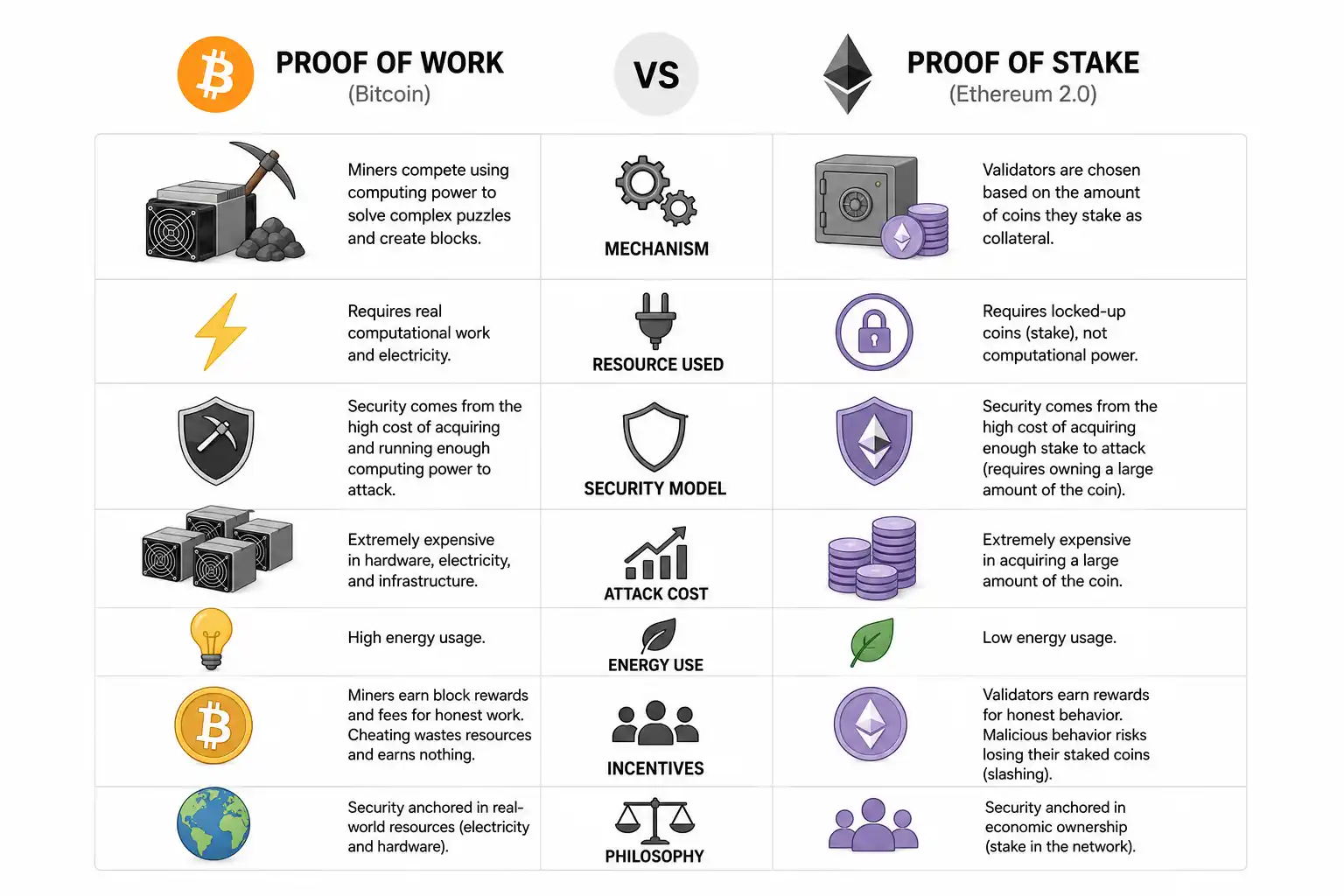
Bitcoin uses Proof of Work. Ethereum, after its Merge in September 2022, switched to Proof of Stake (PoS). These are two different approaches to the same fundamental challenge: how does a decentralized network reach agreement on transaction history without trusting any single participant?
What Proof of Work Actually Requires
Proof of Work requires miners to spend real computational resources, electricity and hardware, to participate in block production. This energy expenditure is not waste. It is the security mechanism. Attacking the Bitcoin network requires controlling enough computing power to outpace the rest of the network, which means acquiring and running hardware at a scale that makes the attack enormously expensive and practically infeasible at current network size.
How Proof of Stake Is Different
In a Proof of Stake system, validators are chosen to produce blocks based on how many coins they lock up as collateral, their stake. There is no computational competition. Validators are selected randomly, weighted by their stake, and they earn rewards for producing valid blocks. The security model is different: attacking the network requires acquiring a large stake in the coin, which makes an attack financially self-destructive.
Why Bitcoin Sticks with Proof of Work
Bitcoin’s core developers and most long-term holders treat Proof of Work as a feature rather than a flaw. The energy cost creates a direct link between the physical world, electricity and hardware, and the security of the digital ledger. Game theory supports this model: miners who follow the rules earn rewards, and miners who attempt to cheat waste their own resources and earn nothing. This structure creates what economists call a Nash Equilibrium, a state where no individual participant can improve their outcome by changing their behavior unilaterally. Proof of Stake, while energy-efficient, ties security to coin ownership rather than real-world resource expenditure, which is a fundamentally different trust assumption.
Understanding how altcoins differ from Bitcoin in their consensus mechanisms helps clarify why this design choice matters for long-term security.
Bitcoin Mining Hardware: From CPUs to ASICs
The hardware used to mine Bitcoin has gone through four distinct generations since 2009, each replacing the previous one as the competition for block rewards intensified and mining became more specialized.
CPU Mining: 2009 to 2010
When Satoshi Nakamoto mined the first Bitcoin block on January 3, 2009, ordinary computer processors (CPUs) were sufficient. Bitcoin had no monetary value and almost no participants. The mining difficulty was minimal, and a standard laptop could mine competitively. As awareness grew and early enthusiasts joined the network, CPUs became inadequate within roughly 18 months.
GPU Mining: 2010 to 2013
Graphics processing units (GPUs) perform many parallel calculations simultaneously, which makes them far better suited to the repetitive hashing work of Bitcoin mining than CPUs. A single GPU could outperform dozens of CPUs. The GPU era brought the first serious wave of competitive mining and the first meaningful increase in network difficulty. Mining farms running racks of graphics cards became the standard.
FPGA Mining: The Transition Phase
Field-programmable gate arrays (FPGAs) are chips that can be configured after manufacture to run specific calculations efficiently. FPGA miners offered better performance per watt than GPUs, but the advantage was short-lived. Custom-built hardware soon made FPGAs obsolete as well.
ASIC Mining: The Current Standard
Application-specific integrated circuits (ASICs) are chips designed from the ground up to perform one task: Bitcoin mining. They run SHA-256 hashing calculations many times faster and more efficiently than any general-purpose hardware. A modern ASIC miner operates at speeds measured in terahashes per second (TH/s), performing trillions of hash calculations per second.
Two of the most widely deployed units as of 2026 are the Antminer S19 Pro, which runs at approximately 110 TH/s, and the WhatsMiner M30S++, which reaches around 112 TH/s. Both consume roughly 3,000 to 3,500 watts continuously. Home mining with a general-purpose computer is no longer viable. Mining Bitcoin in 2026 means running one or more ASIC units in a location with access to cheap electricity and adequate cooling.
What You Need to Start Mining Bitcoin
Getting a Bitcoin mining operation running requires four components working together. Missing or underestimating any one of them is one of the most common reasons home mining operations fail to cover costs.
ASIC Hardware
The ASIC miner is the core of any mining setup. New units from major manufacturers Bitmain (Antminer series) and MicroBT (WhatsMiner series) cost between $2,000 and $10,000 each depending on model and generation. Used machines on secondary markets cost less but run less efficiently and may be near the end of their profitable lifespan. The hash rate and efficiency rating (joules per terahash) are the two numbers that matter most when evaluating hardware.
Mining Software
Mining software connects your hardware to the Bitcoin network or to a mining pool. It manages the communication between the ASIC and the pool or node, monitors performance, and handles payout address configuration. Commonly used options include Kryptex Miner, Awesome Miner, Easy Miner, and ECOS. Most major ASIC manufacturers also provide their own firmware that handles basic pool connectivity without third-party software.
Mining Pool Membership
A mining pool is a group of miners who combine their computing power and split the block rewards proportionally based on each member’s contributed hash rate. The largest pools by share of total Bitcoin hash rate include Foundry USA, AntPool, F2Pool, and ViaBTC. Joining a pool gives smaller operators a predictable income stream rather than the lottery-like odds of solo mining. Pools charge a fee, typically 1% to 3% of earnings, for the service.
A Bitcoin Wallet for Your Payouts
Mining pools pay out earned bitcoin to a wallet address you specify. Leaving earnings inside a pool’s internal wallet exposes them to the risk of the pool being hacked or going offline. Moving payouts to a wallet you control is standard practice. For larger accumulated balances, a hardware wallet stored offline eliminates the risk of remote theft entirely. Understanding how private keys work explains the security trade-offs that matter most for mining payouts specifically.
Solo Mining vs Pool Mining vs Cloud Mining
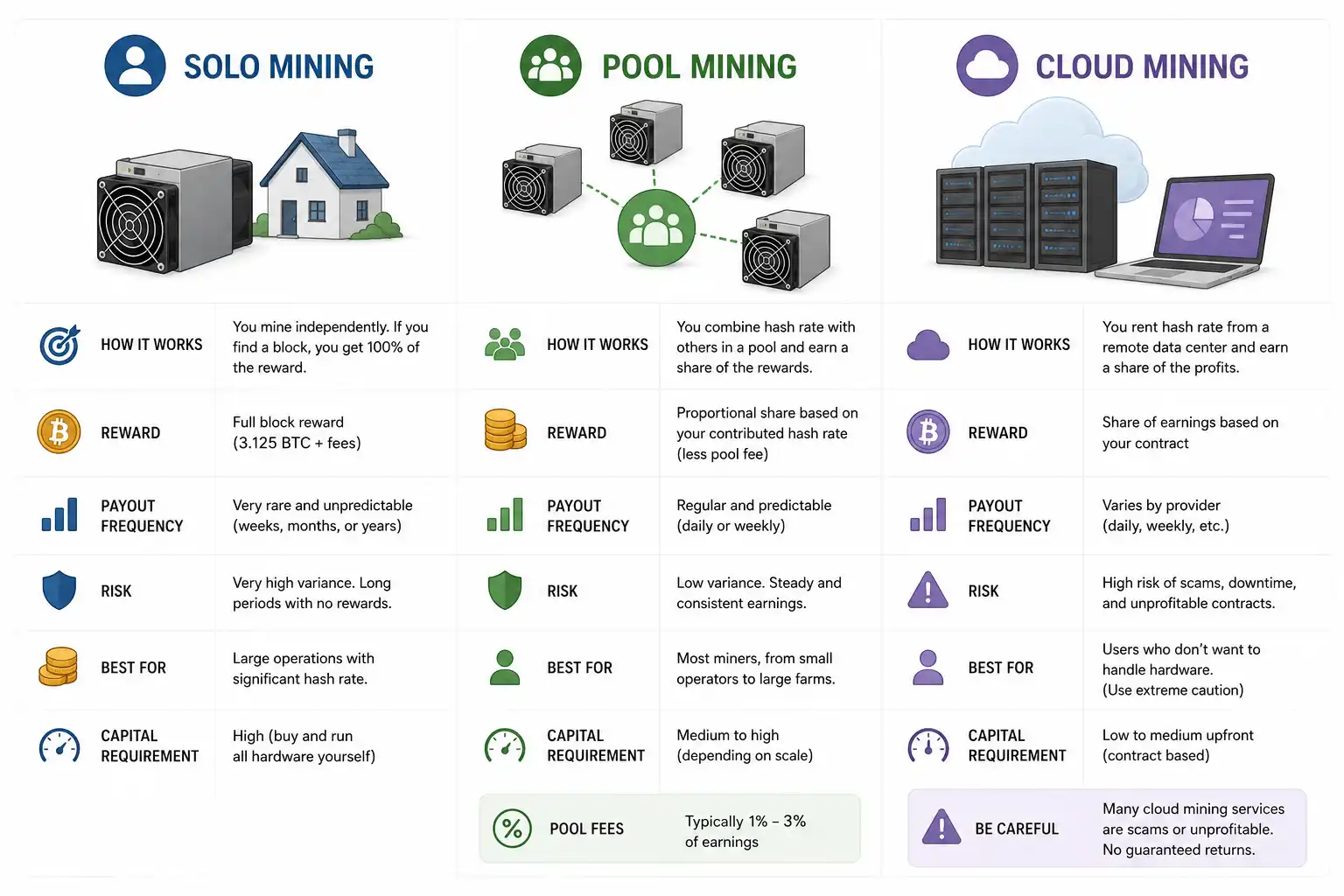
Miners can participate in the block reward competition in three different ways, each with a different risk-reward profile and capital requirement.
Solo Mining
In solo mining, a miner competes independently. If they find a valid block, they collect the full 3.125 BTC block reward plus all transaction fees in that block. The catch is probability. At current network hash rates, a single home miner with one ASIC unit would statistically need years or decades to find a block alone. Solo mining is viable for large commercial operations running significant hash rate, not for individuals with one or two machines.
Pool Mining
Pool mining is the standard approach for most miners. By combining hash rate with hundreds or thousands of other miners, a pool finds blocks regularly, and each participant earns a proportional share of the reward based on how much hash rate they contributed. Payouts are small but frequent and predictable. Pool fees range from 1% to 3% of earnings. This is how the majority of Bitcoin blocks are mined today.
Cloud Mining
Cloud mining involves renting computing power from a remote data center rather than buying and running hardware yourself. You pay a contract fee and receive a share of whatever the rented hash rate earns. The appeal is removing the hardware, electricity, and maintenance burden. The significant risk is that many cloud mining operations have turned out to be fraudulent, taking upfront payments and returning nothing, or running operations that are structurally unprofitable for customers even when legitimate. Any cloud mining offer that guarantees returns regardless of Bitcoin price or difficulty deserves immediate skepticism.
Bitcoin Block Rewards and Transaction Fees
Every miner who successfully adds a block to the blockchain collects two types of revenue: the block reward, which is newly issued bitcoin, and the transaction fees attached to every transaction in that block.
How the Block Reward Has Changed Over Time
Bitcoin launched in 2009 with a block reward of 50 BTC. The protocol reduces this reward by half every 210,000 blocks, an event known as the halving, which occurs approximately every four years. The reward has followed this path:
- 2009 to 2012: 50 BTC per block
- 2012 to 2016: 25 BTC per block
- 2016 to 2020: 12.5 BTC per block
- 2020 to 2024: 6.25 BTC per block
- 2024 to 2028: 3.125 BTC per block (current)
- 2028 onward: 1.5625 BTC per block
The complete mechanics of how the block reward schedule works and what it means for Bitcoin’s supply over time are covered in the guide on the Bitcoin halving and how each reward reduction fits into the full supply schedule.
Transaction Fees: The Long-Term Revenue Model
As the block reward shrinks toward zero over successive halvings, transaction fees become an increasingly important part of miner revenue. Currently, fees represent a relatively small share of what miners earn per block compared to the subsidy. Over time, as the subsidy approaches zero, the security of the network will depend on fees being sufficient to incentivize miners to keep validating transactions. Whether that fee market develops proportionally with adoption is one of the more significant open questions in Bitcoin’s long-term economic model.
The full Bitcoin halving dates page covers every past and projected future reward reduction and what each one meant for miners and the broader market.
How Long Does It Take to Mine 1 Bitcoin
A single Bitcoin is not mined directly. Mining produces block rewards, and each block reward is currently 3.125 BTC. To work out how long it takes for a specific miner to accumulate 1 BTC, you need to know their hash rate and compare it to the total network hash rate.
As of mid-2026, the Bitcoin network’s total hash rate exceeds 800 exahashes per second (EH/s). A single Antminer S19 Pro contributes roughly 0.00000013% of that total. At those proportions, a single ASIC running solo would statistically take many years to find a block alone. Through a pool, the same machine earns a tiny fraction of each block the pool finds, accumulating toward 1 BTC over a period that depends entirely on the machine’s hash rate, the pool’s total hash rate, and the current block reward split.
For practical purposes, the answer for a home miner with one machine in a pool in 2026 is somewhere between several months and over a year to accumulate 1 BTC, depending on all the variables above. The broader context of what Bitcoin is and how its network is structured helps explain why the total hash rate level matters so much for individual miner returns.
Is Bitcoin Mining Profitable in 2026
Mining profitability depends on four variables that move independently of each other: hardware efficiency, electricity cost, Bitcoin price, and network difficulty. A change in any one of them can swing the economics from profitable to loss-making or back again.
Electricity Costs: The Biggest Variable
An Antminer S19 Pro running continuously draws roughly 3,250 watts. At a typical residential electricity rate of $0.12 per kWh, that machine costs approximately $9.36 per day in electricity. At a commercial rate of $0.05 per kWh, the same machine costs $3.90 per day. That difference alone determines whether many operations are viable. Industrial mining operations in regions with cheap hydroelectric or stranded natural gas power have a structural cost advantage that home miners in high-cost electricity regions cannot overcome.
Hardware Costs and Payback Period
A new mid-tier ASIC costs between $2,000 and $5,000. Profitability calculations must account for the cost of hardware depreciation across the machine’s productive life, typically estimated at two to four years before a newer generation makes it uncompetitive. If electricity and Bitcoin price hold steady, a machine purchased at $3,000 at current block reward levels may recover its cost in 12 to 24 months, but that estimate is highly sensitive to price movements in either direction.
Bitcoin Price and Mining Revenue
A miner earns BTC, not dollars. If the Bitcoin price rises, the dollar value of block rewards rises with it, making previously marginal operations profitable. If the price falls, the reverse happens. Mining operations that took on debt to purchase hardware are particularly exposed to price downturns, since their fixed costs remain while revenue in fiat terms drops.
How to Use a Bitcoin Mining Profitability Calculator
Before investing in mining hardware, running the numbers through a mining profitability calculator takes most of the guesswork out of the initial assessment. Tools like the calculators at WhatToMine, CryptoCompare, and NiceHash let you input your hash rate, power consumption, electricity cost, and current pool fee to see estimated daily, monthly, and annual earnings against costs. The output is only as accurate as its inputs, so using realistic electricity costs and factoring in hardware depreciation gives a more honest picture than optimistic assumptions.
The Environmental Impact of Bitcoin Mining
Bitcoin mining consumes significant amounts of electricity, and that consumption is one of the most debated aspects of the network. The Cambridge Bitcoin Electricity Consumption Index (CBECI), maintained by the Cambridge Centre for Alternative Finance, estimates that Bitcoin mining consumes electricity at a rate comparable to some mid-sized countries.
The energy source matters as much as the total amount. Mining operations that run on renewable energy, hydroelectric power in regions like Iceland, Paraguay, and parts of Canada, or stranded natural gas that would otherwise be flared, have a substantially lower carbon footprint than operations running on coal-powered grids. Estimates of the renewable energy share in Bitcoin mining vary, but multiple industry surveys place it between 40% and 60% of total consumption.
The full picture of what Bitcoin’s energy use looks like and how it compares to traditional financial infrastructure is covered in the broader context of how cryptocurrency networks consume and justify their energy use.
Bitcoin Mining Security: The 51% Attack
The most discussed theoretical attack on the Bitcoin network is the 51% attack. If a single entity controlled more than 50% of the total network hash rate, they could potentially reorganize recent blocks, reverse their own transactions, and in theory double-spend coins. They could not, however, steal coins from other wallets, create new coins outside the protocol’s issuance schedule, or change the rules of the protocol itself.
In practice, a 51% attack on Bitcoin is not a realistic threat at current network scale. Acquiring and operating more hash rate than the rest of the entire global network combined would require billions of dollars in hardware and ongoing electricity costs. The attacker would also destroy the value of the asset they were attacking in the process of attacking it. Smaller proof-of-work cryptocurrencies with lower total hash rates have suffered 51% attacks. Bitcoin’s scale makes it a fundamentally different target.
Is Bitcoin Mining Legal
Bitcoin mining is legal in most major economies including the United States, the European Union, Canada, Australia, Japan, and the United Kingdom. In these jurisdictions, mining income is typically treated as ordinary income at the time coins are received, with capital gains tax applying if the mined coins are later sold at a profit.
A smaller number of countries have restricted or outright banned Bitcoin mining. China banned mining in 2021, pushing a significant share of the global hash rate to relocate to the United States, Kazakhstan, and other jurisdictions. Countries including Algeria, Bangladesh, Egypt, and Morocco have banned cryptocurrency activities broadly, which includes mining.
Even in jurisdictions where mining is legal, local zoning regulations, electricity contracts, and noise ordinances can affect whether a specific mining operation is permissible at a given location. Anyone planning a commercial or large-scale home mining setup should verify local regulations before investing in hardware.
How to Store Your Bitcoin Mining Rewards
Mining pools pay rewards to a bitcoin address you specify when setting up your account. Many miners leave earnings in the pool’s internal wallet for convenience, which creates real risk. Exchanges and pools have been hacked, shut down without warning, and in some cases operated fraudulently. Coins left in a pool wallet are not in your possession.
The standard practice among experienced miners is to set a payout threshold and have the pool send rewards directly to a wallet you control. For anything beyond small, frequently spent amounts, a hardware wallet stored offline provides the strongest protection against remote theft. Once coins are in a hardware wallet with proper backup of the seed phrase, they are accessible only to someone with physical access to the device or the seed phrase backup, not to any remote attacker. The guide on smart contracts explains the broader infrastructure that makes self-custody meaningful in a programmable blockchain context.
Alternatives to Running Your Own Mining Operation
Most people researching Bitcoin mining quickly realize that running a profitable home operation in 2026 is difficult without cheap electricity and the right hardware. Several alternatives offer bitcoin exposure or mining-related returns without the hardware overhead.
The pickaxe strategy, named after the classic gold rush observation that selling pickaxes was often more profitable than mining gold, involves investing in companies that manufacture or operate mining hardware rather than mining directly. Publicly traded companies like Marathon Digital Holdings, Riot Platforms, and CleanSpark give investors exposure to Bitcoin mining economics through shares, without managing hardware. Mining ETFs bundle several of these companies into a single fund.
Cloud mining contracts offer another route, renting hash rate from a remote data center, but the risk of fraud in this space is well documented. Any cloud mining offer that guarantees fixed returns regardless of Bitcoin’s price or network difficulty is not operating on honest economics. Legitimate cloud mining operations expose customers to the same price and difficulty risks that all miners face.
For those who simply want to accumulate bitcoin over time without either mining or trading actively, recurring purchases through an exchange are the simplest and most cost-transparent approach. The mechanics of buying and moving bitcoin through a platform are covered in the guide on how a crypto exchange works.
Two external references used in preparing this guide:
- Revolut: What Is Bitcoin Mining and How Does Mining Work
- Blockpit: Bitcoin Mining Complete Guide for Beginners
Frequently Asked Questions
Can I mine Bitcoin on a regular laptop or PC?
Not profitably, and not competitively. CPUs and GPUs in standard computers cannot generate meaningful hash rate compared to modern ASICs. Running a laptop at full CPU load to attempt Bitcoin mining would earn fractions of a cent in rewards while costing significantly more in electricity. The hardware would also sustain wear from running at maximum load continuously. Bitcoin mining in 2026 requires dedicated ASIC hardware to have any realistic chance of earning more than it costs.
What is a mining pool and how does the payout work?
A mining pool combines the hash rate of many individual miners to compete for blocks collectively. When the pool finds a block, the 3.125 BTC reward is split among all participants in proportion to the hash rate each one contributed during the period. If you contributed 0.1% of the pool’s total hash rate, you receive 0.1% of the reward, minus the pool’s fee. Most pools use a payout method called PPLNS (Pay Per Last N Shares) or PPS (Pay Per Share), which determine exactly how the reward calculation works on a per-submission basis.
What happens to miners after all 21 million Bitcoin are mined?
The last bitcoin is expected to be mined around the year 2140. By that point, the block subsidy will have declined to zero through successive halvings. Miners will earn only transaction fees from that point forward. Whether transaction fees alone will provide sufficient incentive to keep miners securing the network at that stage is one of the open long-term questions in Bitcoin’s design. Most analysis of this assumes that Bitcoin’s transaction volume and fee levels will grow substantially over the next century, making a fee-only revenue model viable.
Is cloud mining worth it or is it a scam?
The cloud mining space has a poor track record. Many operations that marketed cloud mining contracts over the past decade turned out to be fraudulent, collecting upfront payments and either delivering nothing or operating Ponzi-like structures where early customers were paid with later customers’ funds. Legitimate cloud mining exists, but even honest operations expose customers to the same price and difficulty risks that all miners face, with the added layer of counterparty risk. Research any cloud mining company thoroughly before committing funds, and treat any guaranteed return claim as a red flag.
What is the difference between mining and staking?
Mining uses real computational work and electricity to compete for the right to add blocks to a Proof of Work blockchain like Bitcoin. Staking locks up coins as collateral to be selected as a validator on a Proof of Stake blockchain like Ethereum. Mining earns rewards through competitive computation. Staking earns rewards through coin ownership and validation. Bitcoin uses Proof of Work exclusively and has no staking mechanism. Most other major cryptocurrencies have moved to Proof of Stake or launched with it from the beginning.
Does Bitcoin mining damage the environment?
Bitcoin mining consumes significant electricity, and that consumption has an environmental cost that depends heavily on the energy source. Operations running on renewable energy, hydroelectric, wind, or solar, have a much lower carbon footprint than those running on coal or gas-powered grids. The Cambridge Bitcoin Electricity Consumption Index estimates total Bitcoin energy use comparable to a mid-sized country. Industry surveys suggest between 40% and 60% of that comes from renewable sources, though the figures are disputed and vary by methodology. The environmental debate around Bitcoin mining centers less on the total energy used and more on what that energy could otherwise power and where it comes from.