Bitcoin can be a good investment in 2026 if you have a time horizon of at least five years, a genuine tolerance for sharp price swings, and are putting in no more than 1-5% of your overall portfolio. It is not a good investment if you need the money in the next year or two, have no emergency fund, or would panic-sell during a 50% drawdown. The real question is not whether Bitcoin is good in some universal sense, but whether it fits your specific financial situation.
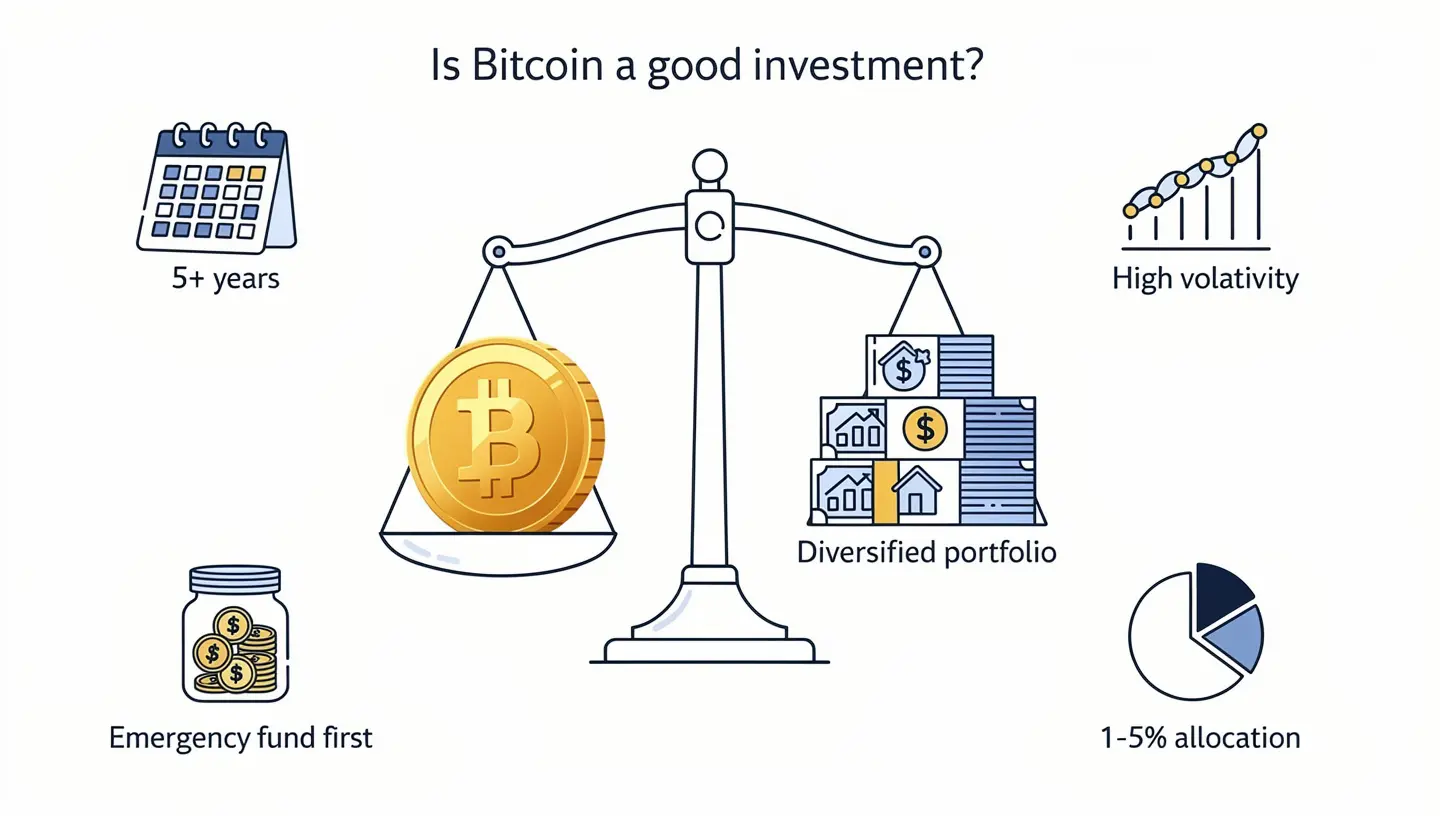
This guide covers what makes Bitcoin attractive, what risks remain, how it compares to other asset classes, who it suits, and how to think about the decision without guessing at price targets.
Bitcoin in 2026: where things stand
Before evaluating Bitcoin as an investment, it helps to know where it sits in its current market cycle.
- Bitcoin reached a new all-time high of approximately $126,000 in October 2025
- As of April 2026, it trades around $68,000-$69,000, roughly 45% below that peak
- Bitcoin’s market capitalization remains above $1 trillion
- BlackRock’s IBIT spot ETF reached $50 billion in assets under management faster than any ETF in history
- An estimated 71% of institutional investors held digital assets as of mid-2025
- 72% of Bitcoin’s total supply has not moved in over a year, signaling long-term holding intent
- An estimated 950 million cryptocurrency investors globally as of end-2025
A 45% drop from an all-time high sounds dramatic but fits within normal Bitcoin cycle behavior. The 2014 bear market saw a 57% decline, 2018 saw 74%, and 2022 saw 64%. All were followed by recoveries to new highs.
For background on Bitcoin’s price history across each of these cycles, see our Bitcoin history guide.
What makes Bitcoin attractive as an investment?
Several structural properties and recent developments explain why Bitcoin draws serious attention from both retail and institutional investors.
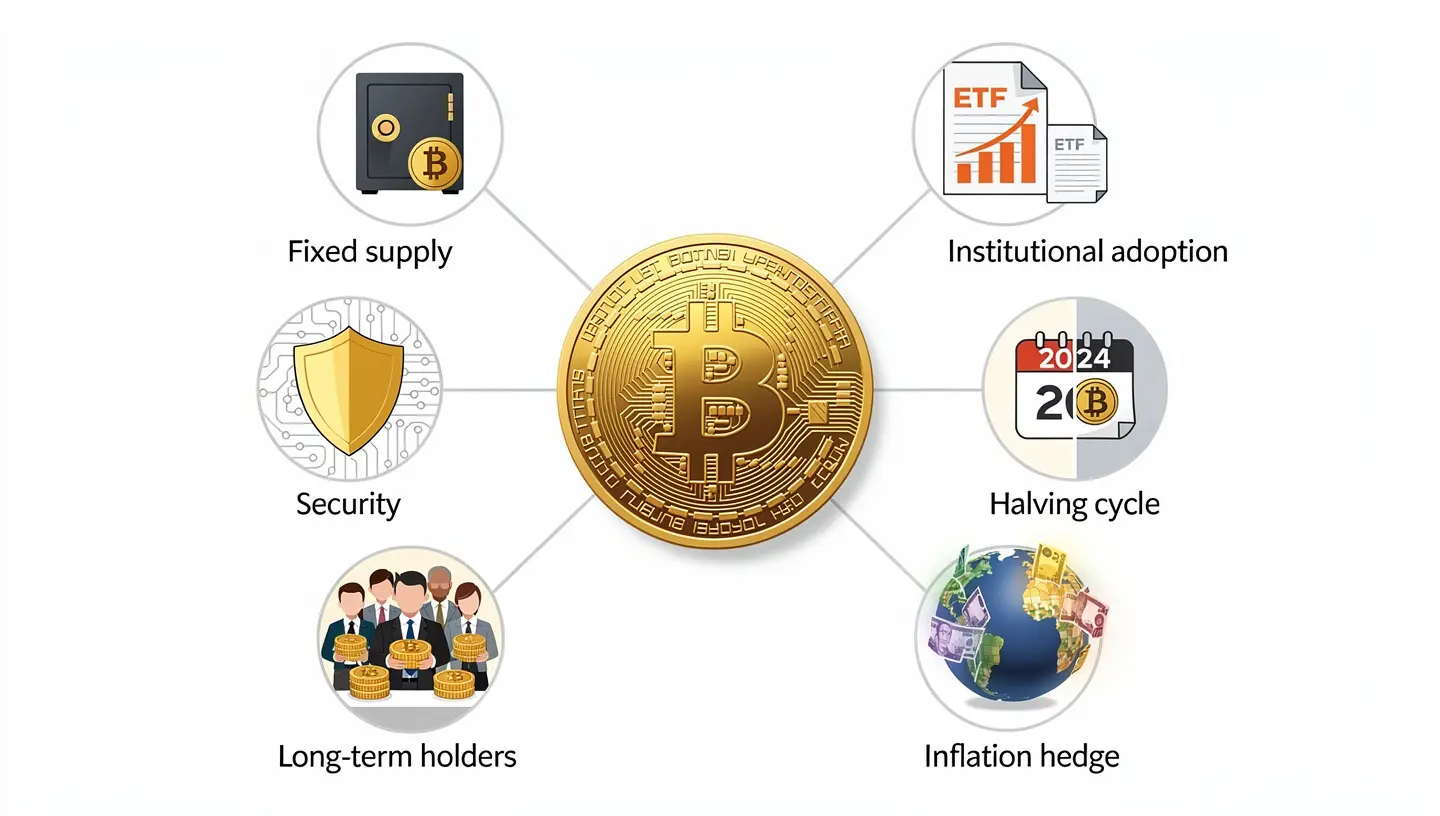
Fixed supply of 21 million coins. Bitcoin is the only major asset with a mathematically guaranteed upper limit on supply that cannot be changed without consensus from the entire network. Central banks can print more fiat currency. Bitcoin cannot be printed. This scarcity is built into the code. For more on what Bitcoin is and how it works, see our guide on what is Bitcoin.
Institutional adoption has crossed a major threshold. The approval of spot Bitcoin ETFs in the United States in January 2024 created a regulated, simple entry point for institutional buyers. BlackRock, Fidelity, and Vanguard now offer Bitcoin investment products. In 2025, the US government announced it would hold Bitcoin and other cryptocurrencies in a strategic reserve. These are not the signals of a niche technology experiment.
Proven security track record. The Bitcoin network has operated continuously for over 15 years without a successful attack at the blockchain level. The network itself has never been hacked. Individual exchanges and wallets have been compromised, but the underlying blockchain has not. That is a longer security track record than most financial institutions can claim.
Post-halving cycle dynamics. The April 2024 Bitcoin halving cut the block reward from 6.25 to 3.125 BTC. Every halving to date has been followed by a new all-time high within 12 to 18 months. The current cycle is playing out along similar lines. For a full explanation of how halvings work, see our guide on what is the Bitcoin halving.
Long-term holder concentration. The fact that 72% of Bitcoin’s supply has not moved in over a year reflects something important: most of the people who own Bitcoin are not trading it. They are holding it. That kind of conviction in a holder base is unusual among volatile assets.
Global adoption as an inflation hedge. In countries with high inflation or unstable currencies, Bitcoin adoption as a store of value and for remittances has grown steadily. El Salvador made it legal tender. Argentina, Turkey, and Nigeria have seen significant adoption driven by local currency weakness.
What are the risks of investing in Bitcoin?
A balanced evaluation requires taking the risks as seriously as the positives.
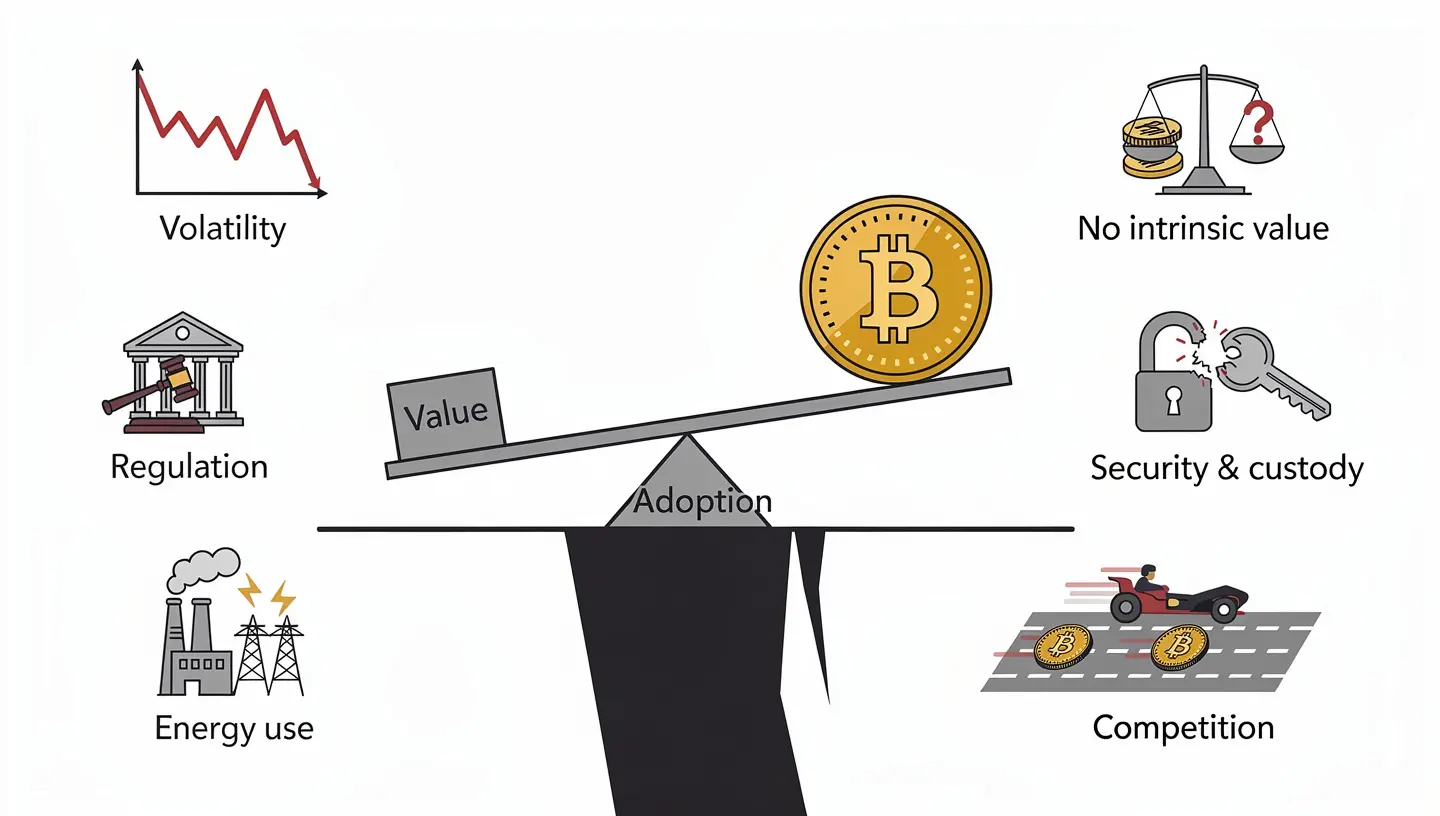
1. Extreme volatility. Bitcoin regularly drops 20% or more in short periods. The historical drawdowns tell the story: -57% in 2014, -74% in 2018, -64% in 2022, and -45% from its October 2025 peak by April 2026. Over the short to medium term, Bitcoin is not a stable store of value.
2. No intrinsic valuation method. Unlike stocks or bonds, Bitcoin produces no cash flows, earnings, or dividends. There is no discounted cash flow model that can tell you whether Bitcoin at $68,000 is cheap or expensive. Valuation is entirely driven by supply and demand dynamics in a global market. This makes informed price evaluation extremely difficult.
3. Regulatory uncertainty. While the US federal government has taken a more crypto-friendly stance under the Trump administration, many countries lack clear frameworks. China has banned crypto trading. The SEC has taken enforcement action against multiple exchanges. Central bank digital currencies from major economies could compete with Bitcoin’s use cases. Future regulatory shifts can move the price significantly in either direction.
4. Custody and security risks. Lose your private key and your Bitcoin is gone permanently. Fall for a phishing attack and the transfer is irreversible. Exchange failures, including Mt. Gox in 2014 and FTX in 2022, have cost investors billions. Even holding Bitcoin through an ETF introduces third-party counterparty risk, though of a different kind. For an explanation of how private keys work and why controlling them matters, see our guide on private key crypto.
5. Energy consumption. Bitcoin’s proof-of-work mining requires substantial electricity. This environmental footprint has drawn regulatory attention in some jurisdictions and criticism from investors with sustainability mandates.
6. Competition from other blockchains. Ethereum, Solana, and newer networks offer faster transactions, lower fees, and programmable smart contracts. Bitcoin’s base layer cannot natively support DeFi applications. These competitors may chip away at Bitcoin’s utility argument over time, though Bitcoin’s store-of-value thesis does not depend on transaction speed.
Bitcoin’s historical performance: what the data shows
Bitcoin has been the best-performing asset in 10 of the 13 years measured since 2012. From approximately $5 in 2012 to around $90,000 at the end of 2025, that represents a gain of roughly 1,800,000%. No other asset class comes close. The caveat is that those gains came with periods of losses that would test any investor.
2009-2016: from zero to the first major cycle
Bitcoin launched in January 2009. The genesis block was mined by Satoshi Nakamoto. In May 2010, the first known commercial Bitcoin transaction was 10,000 BTC for two pizzas, coins now worth hundreds of millions of dollars at later prices. Bitcoin crossed $1 in 2011, reached $1,000 in 2013, and then collapsed 57% following the Mt. Gox exchange failure in 2014. The period demonstrated both the asset’s potential and its exposure to infrastructure failures in the early network.
2017-2018: the ICO boom and crash
Bitcoin rose from around $900 in January 2017 to nearly $20,000 by December 2017, a gain of approximately 2,100%. The rally was driven by ICO speculation, retail FOMO, and a first wave of mainstream media coverage. The correction was equally sharp: Bitcoin fell 74% to around $3,200 by December 2018 as regulators cracked down on ICOs and the speculative frenzy unwound.
2020-2021: the institutional era begins
Bitcoin climbed from around $10,000 in late 2020 to $68,789 by November 2021, a gain of roughly 588%. This cycle was qualitatively different from 2017. MicroStrategy and Tesla added Bitcoin to their corporate treasuries. Institutional investors entered through Grayscale products. COVID-era fiscal stimulus and inflation concerns drove interest in alternative stores of value. The bear market that followed took Bitcoin to $16,500 by late 2022, a 64% decline, accelerated by the FTX collapse in November 2022.
2024-2026: the ETF era
The approval of spot Bitcoin ETFs in the United States in January 2024 marked a structural shift. Mainstream brokerage accounts could now hold Bitcoin exposure without cryptocurrency exchange accounts or private keys. Donald Trump’s election victory in November 2024, on a broadly crypto-friendly platform, sent Bitcoin past $100,000 for the first time in December 2024. A new all-time high of approximately $126,000 followed in October 2025. The current correction to $68,000-$69,000 is 45% off that peak, consistent with historical mid-cycle pullbacks rather than a bear market breakdown.
How does Bitcoin compare to other investments?
Bitcoin vs. gold

Bitcoin and gold are often compared because both are positioned as stores of value with limited supply. The comparison reveals meaningful differences.
| Feature | Bitcoin | Gold |
|---|---|---|
| Supply | Fixed 21 million coins | ~2% annual increase from mining |
| Custody | Digital keys, hacking risk | Physical storage, theft risk |
| Volatility | 60-80% annual swings | 15-20% annual swings |
| Track record | 15 years | 5,000+ years |
| Portability | Instant global transfer | Physical transport required |
| Liquidity | 24/7 global markets | Business hours, wider spreads |
The most defensible view is coexistence rather than replacement. Bitcoin offers superior portability and a harder supply cap. Gold offers lower volatility and millennia of crisis performance data. Most investors who take both seriously hold both for different purposes.
Bitcoin vs. stocks
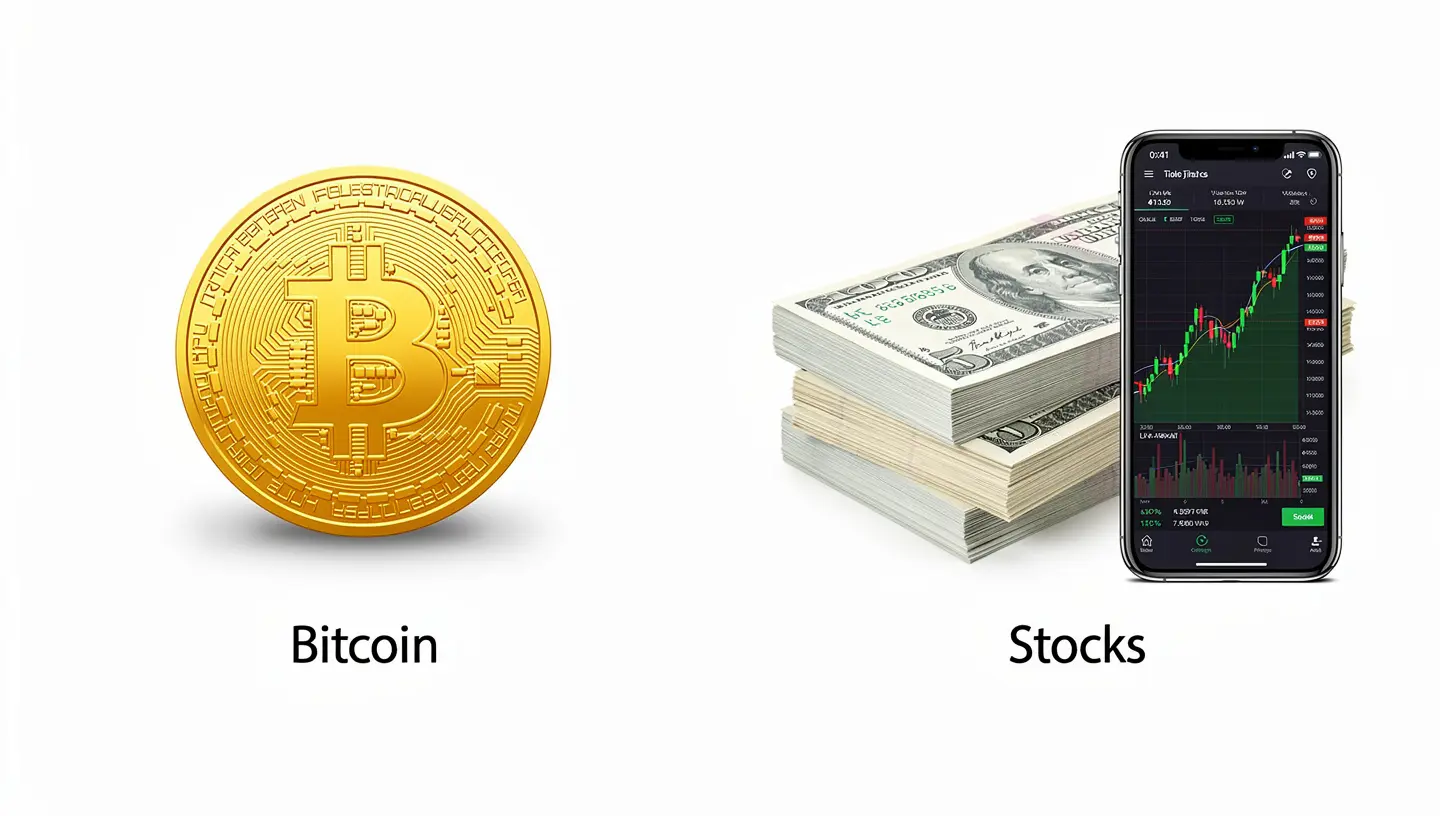
The S&P 500 has returned approximately 10% annually over long periods. Bitcoin has returned far more over its history, but with dramatically higher volatility and without the fundamental underpinning of corporate earnings. Stocks pay dividends, generate cash flows, and can be valued using discounted earnings models. Bitcoin cannot. Additionally, Bitcoin’s correlation with the stock market has increased during periods of market stress, which reduces its diversification value precisely when diversification is most needed.
Bitcoin vs. real estate

Real estate generates rental income, has physical utility, and can be purchased with mortgage financing. Bitcoin generates no income. Real estate is illiquid and expensive to transact. Bitcoin can be bought or sold in seconds at any amount from any location. Real estate is local and regulated. Bitcoin is global and borderless. They serve different roles in a portfolio and are not substitutes for each other.
Bitcoin vs. Ethereum
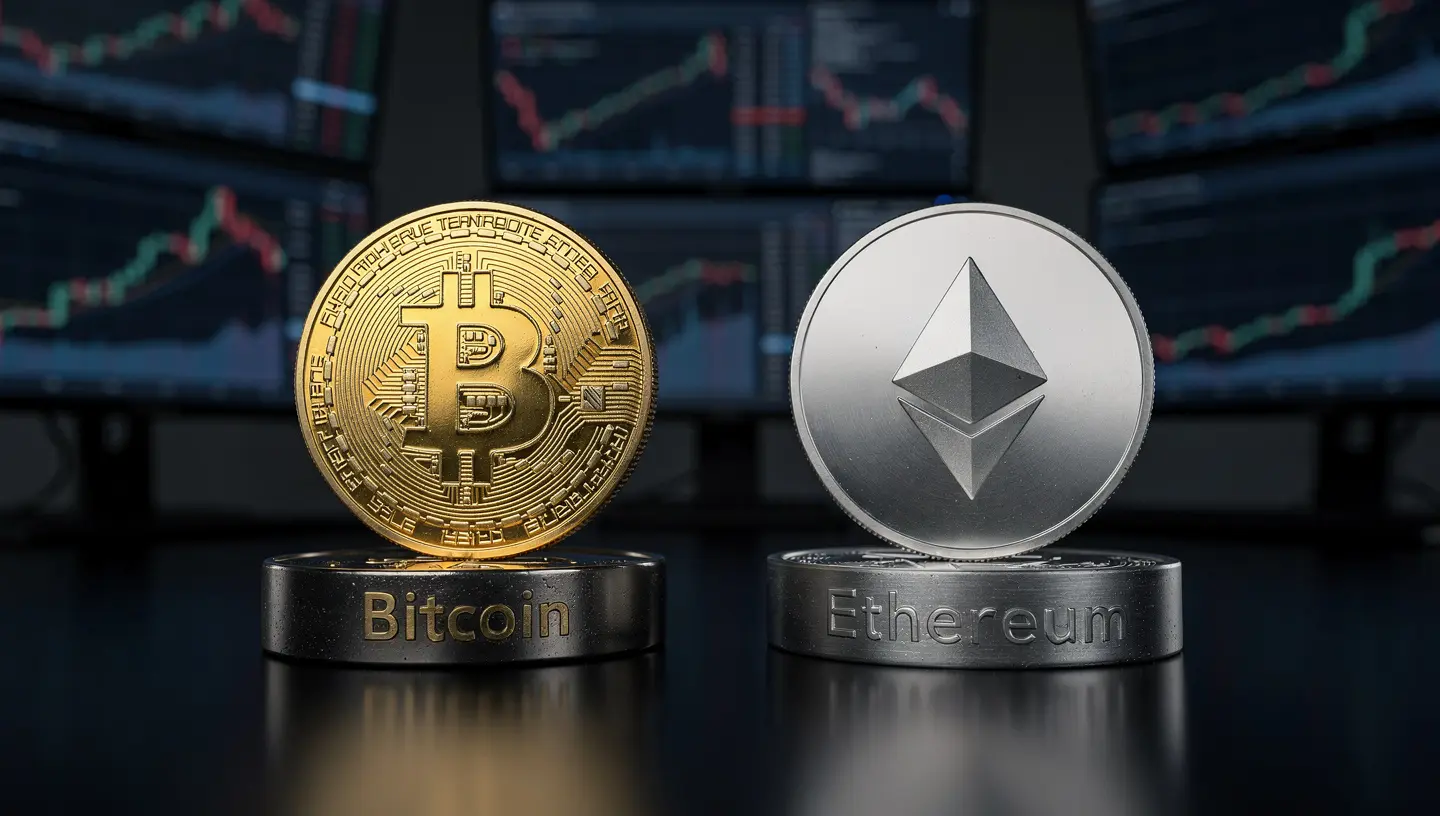
Bitcoin and Ethereum serve different purposes. Bitcoin is a decentralized currency and store of value with a fixed supply and simple design. Ethereum is a programmable platform on which developers build applications: DeFi protocols, NFT marketplaces, and more. Bitcoin has clearer regulatory status as a commodity in most jurisdictions. Ethereum has a more active development base and a growing transaction economy. Many investors hold both, treating them as complementary rather than competing positions. For more on how Ethereum and other altcoins compare to Bitcoin, see our guide on what is an altcoin.
Who should (and shouldn’t) invest in Bitcoin?
Bitcoin may be a good fit if you…
- Have a time horizon of at least five years. Bitcoin’s price cycles have historically rewarded patient holders while punishing those who needed liquidity during downturns.
- Genuinely tolerate large drawdowns, not just claim you can. If a 40-60% decline would prompt panic selling, this asset is not suitable for you yet.
- Would keep Bitcoin as a small position (1-5%) within a diversified portfolio, not a primary holding.
- Have an emergency fund covering three to six months of expenses, no high-interest debt, and stable income. Bitcoin is a speculative position, not a financial foundation.
- Understand what you are buying and why, not because “everyone else is.”
Avoid Bitcoin if you…
- Will need this money within one to two years for a specific goal.
- Have no emergency fund or carry high-interest debt. Paying 18% on a credit card balance while speculating on Bitcoin makes no mathematical sense.
- Have a proven tendency to sell during market drops. Bitcoin’s 24/7 volatility and dramatic swings will trigger that behavior at the worst possible time.
- Would allocate more than 10% of your portfolio. Concentrated risk at that level can damage overall financial health if the position moves against you.
Bitcoin investment decision framework
Before buying, work through this checklist. Each “No” answer increases the probability of selling at the worst moment or taking preventable losses. If you answer “No” to more than two of these, pause before proceeding.
| Criteria | Why it matters |
|---|---|
| Time horizon of 5+ years? | Short-term holders are punished by volatility during down cycles |
| Emergency fund of 3-6 months? | Never invest money you might need suddenly; you would be forced to sell at the wrong time |
| High-interest debt cleared? | Guaranteed 18% interest savings beats speculative upside |
| Can handle a 50% drawdown without selling? | Be honest: have you held through a real bear market before? |
| Keeping allocation at 5% or below? | A small position cannot destroy your overall finances |
| Custody plan decided? | ETF, exchange, or hardware wallet: decide before you buy |
| Exit or rebalance rules written down? | Without a written plan, emotions drive decisions at exactly the wrong moments |
How much Bitcoin should you allocate?
Allocation size matters more than entry timing for most investors. Here are three common approaches based on risk tolerance.
Conservative allocation (0-1%)
For investors prioritizing capital preservation. At this level, a total loss would not materially affect financial goals, while a 10x gain provides meaningful upside. Rebalancing rule: if Bitcoin grows beyond 2% of total portfolio value through price appreciation, trim back and redirect proceeds to bonds or stable assets.
Balanced allocation (1-3%)
For investors comfortable with moderate risk who want meaningful but manageable exposure. Rebalancing rule: trim when Bitcoin exceeds 5% of total portfolio value. Consider adding during drawdowns of 30% or more from recent highs to maintain target allocation.
Aggressive allocation (3-5%+)
For investors with high risk tolerance and a long time horizon. Requires strong conviction and discipline to prevent over-concentration. Set a hard cap at 10% maximum and trim systematically regardless of price momentum whenever that cap is approached. Without disciplined rebalancing, a 10x gain can inadvertently make Bitcoin the majority holding in your portfolio.
Bitcoin investment strategies
Position sizing and approach are more important than timing the market.
Dollar-cost averaging (DCA) means buying a fixed amount at regular intervals regardless of price. Instead of trying to time the market, you buy $100 or $200 worth of Bitcoin every month. When prices are low, your fixed amount buys more. When prices are high, it buys less. Over time, this averages your entry price across market cycles and removes emotional decision-making from the process. Analysts and long-term holders consistently cite DCA as the most reliable approach for investors who believe in Bitcoin but cannot predict short-term price movements.
HODL (long-term holding) means buying and holding through market cycles without trying to time exits and re-entries. Every Bitcoin halving cycle has historically rewarded holders who stayed through the drawdown. The psychological challenge is significant: watching a position fall 60% without selling requires a written plan created before the drawdown begins, specifying under what conditions you would sell. Without that plan, most investors sell at the bottom.
Rebalancing is the discipline that long-term investors most commonly skip. When Bitcoin’s strong performance pushes it from 3% to 12% of a portfolio, trimming back to 3% systematically locks in gains and prevents the concentration risk that destroys portfolios in bear markets. The rule: when Bitcoin exceeds your target allocation by a significant margin, sell the excess and redistribute to other assets.
For a full introduction to cryptocurrency as an asset class and how to get started safely, see our crypto for beginners guide.
Expert price predictions for Bitcoin in 2026
Price predictions should be treated with significant skepticism. The historical accuracy of Bitcoin forecasts, even from well-resourced institutions, is poor in both directions.
With that caveat stated, the range of institutional forecasts for Bitcoin in 2026 is wide:
- Standard Chartered: price target of $300,000 by end of 2026, based on continued institutional inflows and supply scarcity post-halving
- Bernstein Research: $200,000 target for 2026, citing ETF demand and the post-halving supply dynamic
- Bearish scenarios: some analysts see potential for a drop to $40,000-$50,000 in a prolonged risk-off environment or significant regulatory setback
The problem with all of these is not that they are made by people who are not smart. The problem is that Bitcoin’s price is determined by millions of independent market participants making decisions based on information nobody fully has. The right use of price predictions is as a range of possible outcomes, not a number to plan around.
What can be tracked with more reliability: Bitcoin ETF inflow and outflow data, on-chain data showing wallet behavior, and macroeconomic conditions like inflation rates and interest rate decisions. These are leading indicators rather than price targets. On-chain data is freely available through tools like Glassnode and CoinGlass, both of which track holder behavior, ETF flows, and network activity without requiring a subscription for basic metrics.
What is the future of Bitcoin? Three scenarios
Rather than a single prediction, here are three plausible paths, each with different implications for investors.
Bull case: adoption and macro tailwinds
Continued institutional adoption, Bitcoin integration into corporate treasuries and sovereign reserves, and favorable regulatory frameworks enable mainstream participation. Concerns about fiat currency debasement drive demand for assets with fixed supply. In this scenario, Bitcoin captures a meaningful percentage of gold’s $12 trillion market and reaches multi-trillion dollar market capitalization. The largest institutional forecasts cluster around this outcome.
Base case: cycles continue with gradual growth
Bitcoin continues its historical pattern of extreme volatility, 4-year halving cycles, and gradual price appreciation interrupted by severe bear markets. Regulation stabilizes without killing the industry. Institutional adoption grows slowly. Bitcoin becomes a permanent but relatively niche asset class, larger than today but smaller than the bull case projects. Most long-term Bitcoin investors are implicitly betting on something close to this outcome.
Bear case: regulatory shock or systemic failure
Severe regulatory crackdowns eliminate fiat on/off ramps. A prolonged risk-off environment causes all speculative assets to decline together, and Bitcoin correlates with stocks downward. Or an unexpected technical vulnerability or major custody failure shakes confidence at a critical moment. In this scenario, Bitcoin survives but remains a niche speculative asset. Total failure is theoretically possible but requires global coordination against a decentralized network, which no government has managed to achieve.
What to watch in 2026
- Bitcoin ETF monthly inflow and outflow data from BlackRock and Fidelity
- US and EU regulatory framework developments for crypto assets
- Macro conditions: inflation trajectory, Federal Reserve rate decisions
- Halving cycle effects continuing (April 2024 halving, typical 12-18 month post-halving window)
- Lightning Network adoption for payments and transaction fee revenue growth
- CBDC launches from major economies and their potential competitive effect
For more on how the halving cycle has historically affected Bitcoin’s price and market behavior, see our guide on Bitcoin halving dates.
Is Bitcoin a good long-term investment?
The historical record answers this more clearly than any prediction. Bitcoin has been the best-performing major asset in 10 of the 13 years measured since 2012. Every bear market to date has ended with a new all-time high in the following cycle. The pattern has been consistent across four distinct market cycles with very different catalysts.
The challenge is that the 30-80% drawdowns within those cycles are real and sustained. They last months or years. Investors who bought at the 2017 peak of $20,000 waited more than three years for Bitcoin to return to that price. Those who bought at the 2021 peak of $68,789 waited until late 2024 for Bitcoin to recover. Long-term investing in Bitcoin means being genuinely comfortable with that kind of timeline, not just saying you are.
Position sizing matters more than entry timing. An investor who bought at the 2021 peak with 2% of their portfolio has recovered and is in profit as of 2026. An investor who put 40% of their savings in at the same price would have faced a deeply uncomfortable period with few good options. The size of the position determines whether the volatility is a temporary discomfort or a financial crisis.
For more on how market cap helps contextualize Bitcoin’s size relative to other asset classes, see our guide on what is market cap in crypto.
How to buy Bitcoin safely
If you have decided that Bitcoin fits your situation, here is how to proceed.
Step 1: Choose where to buy. Major regulated exchanges include Coinbase, Kraken, Gemini, and Binance (where available). For investors who prefer not to manage exchange accounts or private keys, spot Bitcoin ETFs through a standard brokerage account (iShares IBIT, Fidelity FBTC) provide regulated exposure with familiar mechanics. See our guide on what is a crypto exchange for a full comparison.
Step 2: Verify your identity. Regulated exchanges require KYC verification: government-issued ID, proof of address, and sometimes a selfie. This is a legal requirement, not optional. Verification typically takes a few minutes to 48 hours.
Step 3: Decide on custody. Three options with different tradeoffs: leaving Bitcoin on an exchange (convenient but the exchange holds your keys), moving to a software wallet on your phone or computer (you control the keys, still connected to the internet), or a hardware wallet like Ledger or Trezor (your private keys stay offline and protected from remote attacks). For amounts you plan to hold long-term, hardware wallets offer the strongest security model. For Bitcoin ETF holders, custody is handled by the fund administrator.
Step 4: Enable two-factor authentication and start with DCA. Enable 2FA using an authenticator app, not SMS. Begin with an amount you could lose entirely without financial hardship. Use dollar-cost averaging, which means buying a fixed amount monthly, rather than a single large purchase. This removes the timing decision and builds position over multiple price points.
Frequently asked questions
Is it too late to invest in Bitcoin?
That depends entirely on your time horizon. Approximately 5-6% of the global population owns any cryptocurrency as of 2026. If Bitcoin’s adoption follows the pattern of past technological transitions, early majority adoption is still ahead, not behind. Whether that translates to price appreciation depends on factors that cannot be predicted with confidence. If you believe in the long-term thesis, dollar-cost averaging over 12-24 months removes the pressure of trying to identify a single “right” entry point.
Can Bitcoin go to zero?
Theoretically yes, practically very unlikely at this stage. A return to zero would require a complete global ban that could somehow prevent decentralized participation, or a fundamental cryptographic failure of the SHA-256 algorithm that secures the network, or a mass simultaneous abandonment by all current holders. None of these are plausible in the near term. A more realistic downside is a severe drawdown of 70-80% from the current level, which has happened before and could happen again without Bitcoin going to zero.
Is Bitcoin a hedge against inflation?
Bitcoin is a long-term inflation hedge in theory due to its fixed supply, but it has not consistently behaved like one in the short term. During the 2021-2022 US inflation surge, Bitcoin fell sharply as the Federal Reserve raised interest rates, behaving more like a risk asset correlated with equities than a defensive inflation hedge. Over longer time horizons of five or more years, Bitcoin has preserved purchasing power far more effectively than most fiat currencies, but it does not provide the short-term defensive characteristics that traditional inflation hedges like TIPS or gold have historically offered.
Should I buy Bitcoin directly or through an ETF?
ETFs are simpler: you buy shares through a standard brokerage, the fund holds the Bitcoin, and you do not need to manage wallets or private keys. They suit investors who want exposure without the technical complexity, and they fit naturally inside tax-advantaged accounts. Direct Bitcoin ownership gives you true self-custody and access to the Bitcoin network directly, but requires managing private keys and security. Beginners or those investing through retirement accounts typically find ETFs more practical. Experienced users who want full control choose self-custody.
When will Bitcoin reach $200,000?
Nobody knows, and anyone claiming to know is making a guess. Standard Chartered and Bernstein Research have published $200,000 to $300,000 targets for 2026, based on ETF demand and post-halving supply dynamics. Equally credible analysts have argued Bitcoin could trade below $50,000 if macro conditions deteriorate. Price predictions have historically been wrong in both directions by large margins. The more useful question is whether Bitcoin’s long-term adoption thesis remains intact, which is more answerable than specific price targets.
How much should a beginner invest in Bitcoin?
Start with an amount you could lose entirely without affecting your daily life or financial plans. For most people, that is a small fraction of savings, often 1-3%. A common suggestion for first-time investors is to start with $50 to $200 to learn how the process works before committing larger amounts. Use dollar-cost averaging to add gradually over time rather than investing everything at once. Never borrow money to buy Bitcoin.
Is Bitcoin better than gold?
They serve different functions. Bitcoin is easier to transfer globally, has a harder supply cap, and has produced far higher returns over its short history. Gold has 15-20% annual volatility compared to Bitcoin’s 60-80%, a 5,000-year track record as a crisis asset, and established regulatory clarity worldwide. Bitcoin offers higher upside with higher risk. Gold offers lower returns with greater stability. Most serious investors in Bitcoin do not sell gold to buy it; they treat both as different types of diversification with different risk profiles.
What is the biggest risk of investing in Bitcoin?
For most individual investors, the biggest risk is not the regulatory environment or technical security of the blockchain. It is buying too much at the wrong time and being forced to sell during a drawdown due to financial pressure or psychological stress. The position size determines whether Bitcoin’s volatility is a temporary discomfort or a financial emergency. Investors who keep Bitcoin to 1-5% of their portfolio can handle 80% drawdowns without major consequences. Investors who put 40% of their savings in Bitcoin face a very different situation when those drawdowns arrive.