Bitcoin and cryptocurrency are often used as if they mean the same thing, but they don’t. Bitcoin is one specific digital currency, while cryptocurrency is the broader category that Bitcoin belongs to. This mix up happens because Bitcoin was the first cryptocurrency ever created, and for years it was the only one most people had heard of. Today there are thousands of other coins and tokens on the market, each built on different technology and serving a different purpose. Understanding the difference between Bitcoin and cryptocurrency matters if you’re trying to make sense of crypto news, thinking about buying your first coin, or just tired of nodding along in conversations you don’t fully follow. This guide breaks down what cryptocurrency actually is, what makes Bitcoin different from the rest, and why the two terms keep getting confused even though they don’t mean the same thing.
What Is Cryptocurrency?
A cryptocurrency is a form of digital money that uses cryptography to keep transactions secure. Unlike the money sitting in your bank account, cryptocurrency has no physical form and doesn’t rely on a bank, government, or any central authority to manage it. Instead, it runs on a decentralized network of computers that work together to record and confirm every transaction.
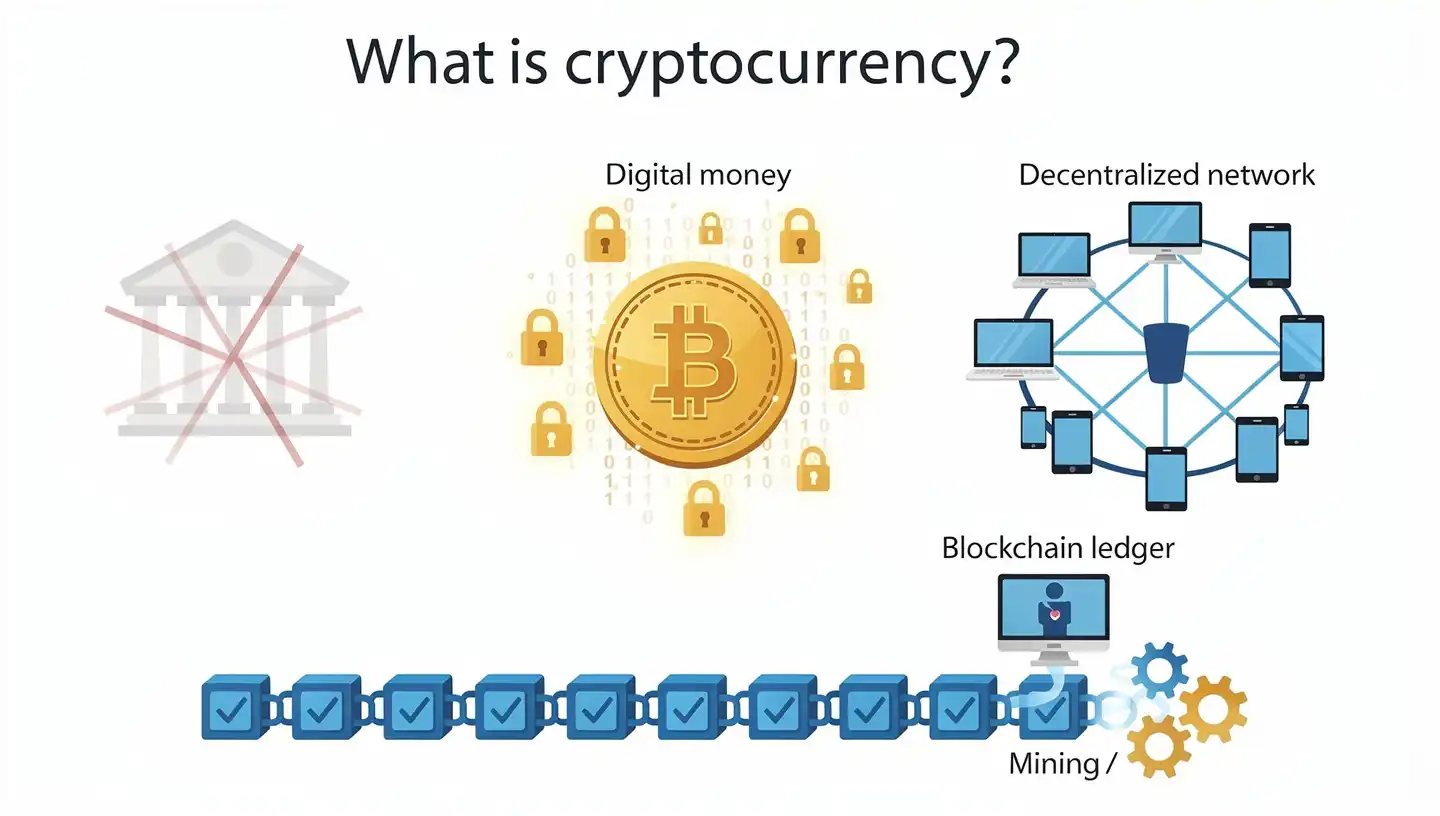
This record keeping happens through a blockchain, which works like a shared ledger that anyone on the network can see. Every time someone sends or receives cryptocurrency, that transaction gets added to the ledger and confirmed by the network itself rather than by a bank teller or a payment processor. What actually makes something a cryptocurrency goes into more depth on how this fits together if you want the fuller picture.
New units of cryptocurrency are usually created through mining, a process where computers solve complex mathematical problems and get rewarded with newly created coins for the effort. Not every cryptocurrency works this way, but it’s how Bitcoin and many of the earliest coins were designed.
There are now more than 20,000 different cryptocurrencies in existence, ranging from well known names like Ethereum and Solana to smaller, far more obscure projects. Some are built purely as digital cash, while others power entire platforms for lending, trading, or building applications. This wide range of purposes is part of why lumping every cryptocurrency into the same basket as Bitcoin doesn’t really work.
What Is Bitcoin?
Bitcoin is the first cryptocurrency ever created, and it remains the most widely recognized one today. It was introduced in 2008 through a white paper published under the name Satoshi Nakamoto, whose real identity has never been confirmed. The first Bitcoin block was mined in January 2009, marking the official start of the network.

Bitcoin was built with a specific goal in mind: to let people send money to each other directly, without needing a bank or payment company in the middle. It uses the same blockchain and cryptography principles found in other cryptocurrencies, but with a few features that set it apart.
One of the most important is its fixed supply. Only 21 million bitcoins will ever exist, and that limit is written into the code itself. This scarcity is a big part of why Bitcoin is sometimes called digital gold, since like gold, its supply can’t simply be increased on demand.
Bitcoin transactions are irreversible once confirmed, and the network doesn’t ask for a name or personal details to process a payment, only the addresses involved. That combination of permanence and anonymity is part of what has made Bitcoin both praised and criticized over the years.
Is Bitcoin the Same as Cryptocurrency?
This is where most of the confusion starts. Bitcoin is a cryptocurrency, but not every cryptocurrency is Bitcoin. Think of it the way you’d think about fruit and apples. An apple is a fruit, but saying fruit and apple mean the same thing would be wrong, since oranges, bananas, and grapes are fruit too. Bitcoin and cryptocurrency work the same way.
If you own Bitcoin, you own a cryptocurrency. But if you own a cryptocurrency, there’s a good chance it isn’t Bitcoin at all. It could be Ethereum, Litecoin, or one of thousands of other coins that came after Bitcoin and borrowed pieces of its design while changing others.
The reason the two terms get mixed up so often comes down to timing and popularity. Bitcoin came first, so for a long stretch it was the only cryptocurrency most people knew about. Coins created after Bitcoin are often called altcoins, short for alternative coins, precisely because they came second. Bitcoin and cryptocurrency aren’t interchangeable words, even though the mix up is an easy one to make.
Bitcoin vs Cryptocurrency: Key Differences
Once you separate the two terms, several concrete differences show up between Bitcoin and the wider cryptocurrency market. These differences show up in how each one was created, how it’s supplied, how transactions get approved, and what it’s actually used for.
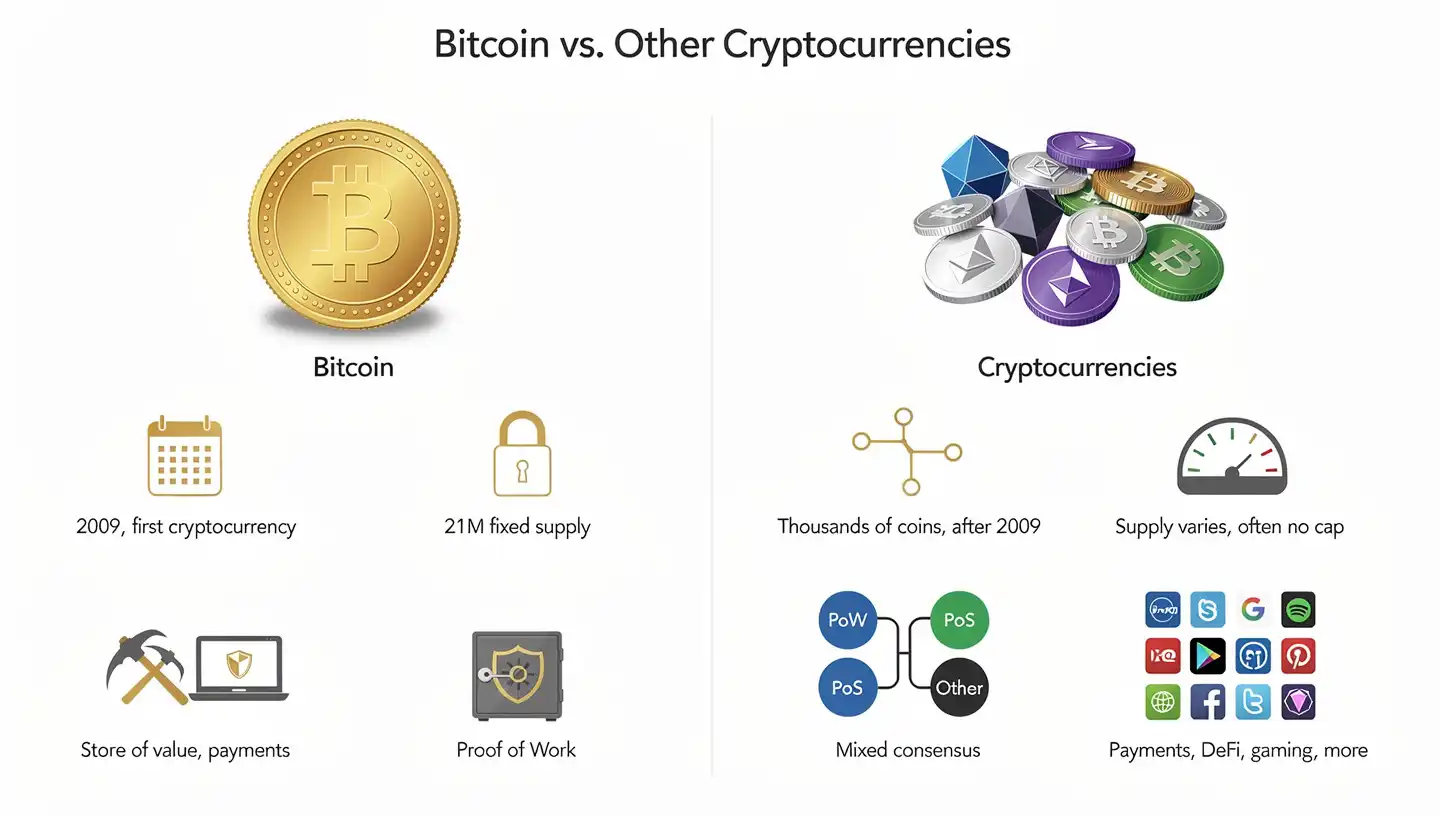
The table below lays out the main points side by side, and the sections after it go into more detail on each one.
| Point of Comparison | Bitcoin | Cryptocurrency (general) |
|---|---|---|
| Origin | First cryptocurrency, created in 2009 | Includes thousands of coins created after Bitcoin |
| Supply | Fixed at 21 million coins | Varies by coin, some have no fixed cap |
| Consensus method | Proof of work | Proof of work, proof of stake, or other methods |
| Main use | Store of value and payments | Payments, smart contracts, gaming, lending, and more |
| Decentralization | Very high, no single controlling entity | Varies, some coins are more centralized |
Origin and History
Bitcoin’s origin is well documented. It was created by Satoshi Nakamoto and launched in 2009 as open source software anyone could download and run. Who actually created Bitcoin remains one of the more debated mysteries in the space, since Nakamoto disappeared from public view a few years after launch and has never been identified with certainty.
Every other cryptocurrency came after Bitcoin, often building directly on its code or borrowing ideas from it. Litecoin, for example, launched in 2011 as a faster, lighter version of Bitcoin. Ethereum arrived in 2015 with a different goal entirely, adding the ability to run programs called smart contracts on top of its own blockchain. This staggered timeline is part of why Bitcoin holds a kind of founding status that no other coin can claim, regardless of price or popularity.
Supply and Monetary Policy
Bitcoin’s 21 million coin limit is hard coded and enforced by the network itself, meaning no person, company, or government can decide to create more. New coins enter circulation slowly through mining rewards, and that reward gets cut in half roughly every four years in an event known as the halving.
Cryptocurrency as a whole doesn’t share this uniform rule. Some coins have no maximum supply at all, meaning new units can be created indefinitely. Others set their own limits that have nothing to do with Bitcoin’s 21 million figure. This difference in monetary policy directly affects how each coin behaves over time, particularly when it comes to scarcity and long term value.
Decentralization Level
Bitcoin is widely considered the most decentralized cryptocurrency network in existence. Thousands of independent computers, called nodes, verify transactions and hold copies of the ledger, and no single company or government controls the network.
Not every cryptocurrency reaches that same level of decentralization. Some newer coins are issued and managed by a company or foundation that keeps significant control over the network, at least in its early years. Others rely on a smaller number of validators than Bitcoin does, which can make them faster but less resistant to outside interference. Decentralization sits on a spectrum, and Bitcoin sits near one end of it.
Consensus Mechanism: Proof of Work vs Proof of Stake
Every cryptocurrency needs a way to agree on which transactions are valid without a bank or central authority making that call. This is called a consensus mechanism, and it’s one of the clearest technical differences between Bitcoin and much of the rest of the market.
Bitcoin uses proof of work, where computers called miners compete to solve a mathematical puzzle, and the winner adds the next block of transactions to the chain along with a reward in new bitcoin. This process takes real computing power and electricity, which is part of what keeps the network secure.
Many newer cryptocurrencies use proof of stake instead. Rather than competing with computing power, validators lock up a certain amount of the coin as collateral, and the network picks who confirms the next block based partly on how much they’ve staked. The difference between proof of work and proof of stake covers this in more detail, including why some networks have switched from one method to the other.
Use Cases
Bitcoin was designed with a fairly narrow purpose: moving value from one person to another without a middleman, and increasingly serving as a long term store of value that people hold rather than spend. It doesn’t support the kind of programmable features that some other blockchains offer.
Plenty of other cryptocurrencies were built to do more than that. Ethereum and similar networks support smart contracts, which are self executing agreements that power things like decentralized finance platforms, lending protocols, and digital collectibles. Some coins exist mainly to pay transaction fees on their own network, while others are designed purely as a fast, low cost way to move money between exchanges. This range of purposes is a major reason cryptocurrency as a category can’t be summed up the same way Bitcoin can.
Volatility and Regulation
Both Bitcoin and the broader cryptocurrency market are known for sharp price swings, and neither is immune to sudden drops or rallies. That said, Bitcoin’s larger market size and longer track record tend to make it somewhat less volatile than many smaller coins, though it certainly is not stable.
Regulation is still catching up in most parts of the world. Some countries treat Bitcoin and cryptocurrency as property for tax purposes, others have banned certain activities outright, and a growing number are working on formal rules for exchanges and stablecoins. Because the rules differ so much by country and even by coin, it’s worth checking local regulations before buying, selling, or holding any cryptocurrency.
How Bitcoin and Cryptocurrency Work
At the center of both Bitcoin and most other cryptocurrencies is the blockchain, a digital ledger that records every transaction in blocks linked together in order. Once a block is added, it’s extremely difficult to alter, which is part of what makes the system trustworthy without needing a bank to vouch for it.
Getting new coins into circulation usually happens through Bitcoin mining, where specialized computers race to solve a puzzle and confirm a batch of transactions. Miners are rewarded with newly created bitcoin plus any transaction fees included in that block. Other cryptocurrencies that use proof of stake skip mining entirely and instead reward validators for locking up coins and behaving honestly.
Sending cryptocurrency doesn’t involve handing over anything physical. Instead, you’re updating the ledger to show that ownership of a certain amount has moved from your address to someone else’s. Access to your coins is controlled by a private key, a long string of characters that acts like a password. Lose that key, and there is generally no way to recover the coins, since there’s no customer service line to call and no central authority holding a backup.
A Brief History of Bitcoin and Cryptocurrency
The idea of digital money existed before Bitcoin, though earlier attempts never quite worked. In the 1980s, researcher David Chaum proposed early concepts for anonymous digital transactions. In 1998, a proposal called b money outlined a decentralized electronic currency system, and in 2004 a project called Bit Gold introduced a proof of work style concept years before Bitcoin existed.
Bitcoin itself arrived in October 2008, when Satoshi Nakamoto published a white paper titled Bitcoin: A Peer to Peer Electronic Cash System. The first block of the Bitcoin blockchain and its full timeline was mined in January 2009, officially launching the network.
For several years, Bitcoin operated in relative obscurity, used mostly by early adopters for small transactions. That changed as more people took notice, exchanges opened up, and by 2011 the first altcoins started appearing. A short list of milestones shows how quickly things moved from there:
- 2011: Litecoin launches as one of the first major altcoins
- 2015: Ethereum introduces smart contracts, expanding what cryptocurrency can do
- 2021: The first Bitcoin futures ETF launches in the United States
- 2024: The first spot Bitcoin ETFs are approved, giving traditional investors easier access
Bitcoin and cryptocurrency have continued to evolve together since then, with each new milestone drawing more attention from everyday investors rather than just early adopters and developers.
Benefits of Bitcoin and Cryptocurrency
Both Bitcoin and cryptocurrency in general offer a handful of advantages that traditional money doesn’t. Decentralization removes the need for a bank or government to approve every transaction, which can mean fewer delays and less red tape, particularly for cross border payments.
Transaction fees are often lower than what banks or wire services charge, especially for international transfers, since there’s no chain of intermediaries taking a cut along the way. Because Bitcoin has a hard supply cap, some see it as a hedge against inflation, in the same way people have traditionally turned to gold.
Transparency is another point in favor of cryptocurrency. Every transaction is recorded on a public ledger that anyone can inspect, which makes it harder to hide fraudulent activity compared to some traditional financial systems. For people without easy access to a bank account, cryptocurrency can also offer a way to store and move money using little more than an internet connection and a crypto exchange account.
Risks and Disadvantages of Bitcoin and Cryptocurrency
None of this comes without real downsides. Price volatility is probably the most obvious one. It’s common for Bitcoin and other cryptocurrencies to swing by double digit percentages in a single day, which makes them risky for anyone who can’t afford to lose what they put in.
The lack of central oversight cuts both ways. It removes red tape, but it also means there’s no bank to call if something goes wrong. Send cryptocurrency to the wrong address, and that transaction typically can’t be reversed. Lose your private key, and your coins are effectively gone for good.
Security is another concern, particularly around exchanges and wallets that have been targeted by hackers over the years. Regulatory uncertainty adds another layer of risk, since rules can change quickly and differ from one country to the next. Taken together, these risks are why most financial professionals suggest treating cryptocurrency as a small, high risk part of a portfolio rather than a core holding.
Why Bitcoin Is Treated Differently From Other Cryptocurrencies
Even among people who are skeptical of cryptocurrency generally, Bitcoin often gets treated as something separate from the rest. Part of this comes down to its network effect. Bitcoin has more computing power securing its network, more long term holders, and more name recognition than any altcoin that has come after it.
Its history also plays a role. Bitcoin has been running continuously since 2009 without a major shutdown or hack of its core protocol, something not every newer coin can claim. That track record has earned it a level of trust that newer projects still have to build.
There’s also the digital gold framing that has taken hold among investors, positioning Bitcoin as a long term store of value rather than a currency for everyday spending. Other cryptocurrencies rarely get described this way, since most were built with a different purpose from the start, whether that’s running applications, powering a specific platform, or simply moving value quickly between exchanges. This is part of why some people draw a sharp line between Bitcoin and cryptocurrency, even while acknowledging that Bitcoin is technically one of the thousands of coins out there.
Investing in Bitcoin vs Cryptocurrency
People generally take one of two approaches when it comes to putting money into this space. The first is a Bitcoin focused strategy, where most or all of the investment goes into Bitcoin itself, based on the idea that it’s the most established and battle tested option. The second is a broader cryptocurrency portfolio approach, spreading money across several coins in hopes that some will outperform Bitcoin over time.
Each approach carries its own tradeoffs. Whether Bitcoin is a good investment depends heavily on personal risk tolerance, time horizon, and how much volatility someone can handle without panic selling. A diversified cryptocurrency portfolio can offer higher upside if a smaller coin takes off, but it also comes with more exposure to projects that could fail entirely or turn out to be scams.
Taxes are worth thinking about too. In many countries, both Bitcoin and other cryptocurrencies are treated as property rather than currency, which means selling or trading them can trigger capital gains tax. Rules vary widely by country, so it’s worth checking local tax guidance before making any moves. None of this is financial advice, just a starting point for understanding what’s involved before putting real money into Bitcoin or any other cryptocurrency.
Conclusion
Bitcoin and cryptocurrency get used as if they’re interchangeable, but by now the differences should be clear. Bitcoin is the original cryptocurrency, built with a fixed supply and a specific goal of moving value without banks or middlemen. Cryptocurrency is the much larger category that Bitcoin started, now home to thousands of coins built for everything from payments to gaming to running entire applications. Whether you’re just curious or thinking about buying your first coin, keeping this distinction in mind will make it a lot easier to follow what’s actually being discussed the next time Bitcoin or cryptocurrency comes up in conversation.
Frequently Asked Questions
Is Bitcoin the same as cryptocurrency?
No. Bitcoin is one specific cryptocurrency, the first one ever created, while cryptocurrency is the broader category that includes Bitcoin along with thousands of other coins and tokens. Every bitcoin is a cryptocurrency, but not every cryptocurrency is Bitcoin.
Which is better, Bitcoin or other cryptocurrencies?
There’s no single right answer, since it depends on what someone is looking for. Bitcoin is generally seen as the more established and less experimental option, while other cryptocurrencies can offer features Bitcoin doesn’t, along with higher risk and higher potential reward.
Is Bitcoin a type of cryptocurrency?
Yes. Bitcoin fits every definition of a cryptocurrency: it’s digital, it uses cryptography for security, and it runs on a decentralized blockchain network without a central authority managing it.
What are the main types of cryptocurrency?
Cryptocurrencies are generally grouped into a few categories, including payment coins like Bitcoin and Litecoin, tokens that power specific platforms or applications, stablecoins pegged to assets like the US dollar, and coins issued by central banks, though those work quite differently from the rest.
Why is Bitcoin treated differently than other cryptocurrencies?
Bitcoin’s status as the first cryptocurrency, combined with its size, security, and long track record, has earned it a level of trust and recognition that most other coins haven’t matched. This has led many people to think of Bitcoin as being in a category of its own.
Can cryptocurrency exist without Bitcoin?
Yes, in theory, but Bitcoin’s launch is what proved the underlying technology could work at all. Most cryptocurrencies that exist today borrowed at least some ideas from Bitcoin’s original design, even the ones that work quite differently from it now.