Bitcoin and Ethereum together account for more than 60 percent of the total cryptocurrency market capitalization. One was built as digital money that moves without a bank or intermediary, the other as a programmable network where financial protocols, digital markets, and applications run on top of a shared blockchain. The question of which makes the better investment has no single answer, because these two assets don’t serve the same purpose. Bitcoin (BTC) is capped at 21 million units and is widely described as digital gold, a store of value with a predictable and shrinking supply. Ethereum (ETH) powers smart contracts and decentralized applications, and its value rises and falls alongside the activity running on the network. This guide compares both assets across price history, technology, supply mechanics, institutional adoption, and investor profile, so that anyone weighing a purchase can make a well-informed decision.
What Is Bitcoin?
Bitcoin is the first decentralized cryptocurrency, launched in January 2009. It arrived at a moment when the global financial crisis had exposed how dependent banking was on intermediaries and central control. The system was designed so that two parties could exchange value directly, without a bank, a government, or a clearinghouse in between. Every transaction is recorded on a public ledger called the blockchain, which anyone can access and verify at any time. Unlike traditional currencies that central banks can print in unlimited quantities, Bitcoin has a strictly fixed supply built into its code from day one.

The total supply of Bitcoin is capped at exactly 21 million coins, and that limit cannot be changed. New Bitcoin enters circulation through a process called mining, where computers compete to solve mathematical puzzles and earn a reward in newly created coins for each confirmed block of transactions. That reward is cut in half every 210,000 blocks, roughly every four years, in an event known as the halving. After the fourth halving in April 2024, the block reward dropped to 3.125 BTC. This fixed, predictable supply schedule is what draws investors who compare Bitcoin to gold as a long-term store of value. A fuller explanation of what Bitcoin is and why it was built the way it was can be found in our guide on what Bitcoin is.
Satoshi Nakamoto, the pseudonym of the person or group that created Bitcoin, never revealed their identity and stepped away from the project in 2010. That anonymity reinforces the decentralized nature of the network, since there is no single founder for regulators to target or investors to follow. The full story of who built Bitcoin and the circumstances surrounding its creation is covered in our piece on who created Bitcoin.
What Is Ethereum?
Vitalik Buterin launched Ethereum in 2015 with the idea that a blockchain didn’t have to be just a ledger for recording transactions. It could also run programs. Those programs are called smart contracts, and they execute automatically when pre-set conditions are met, with no bank, notary, or broker needed in the middle. Thousands of decentralized applications run on Ethereum today, from lending and exchange protocols inside decentralized finance, to NFT marketplaces and blockchain-based games. Every operation on the network is paid for in Ether (ETH), the network’s native currency, which means demand for ETH rises and falls directly with how much the network gets used.

Ether is sometimes called digital silver in contrast to Bitcoin’s digital gold label, though that comparison doesn’t fully capture what ETH actually is, because its utility is fundamentally different from Bitcoin’s. What separates the two isn’t just price but philosophy: Bitcoin focuses on doing one thing reliably, Ethereum is built as a platform for almost anything that can be automated and programmed on a blockchain without a central authority running it.
A significant technical shift came in 2022, when Ethereum switched from proof of work to proof of stake in a network upgrade known as The Merge. That change cut the network’s energy consumption by more than 99 percent, making Ethereum one of the most energy-efficient major blockchain networks in operation. Unlike Bitcoin, Ethereum has no hard supply cap, but it uses a fee-burning mechanism that can make ETH deflationary during periods of high network activity.
Bitcoin vs Ethereum: Key Differences
Although both assets use blockchain technology and attract overlapping groups of investors, a direct bitcoin vs ethereum comparison reveals fundamental differences in purpose, technology, and economic design.
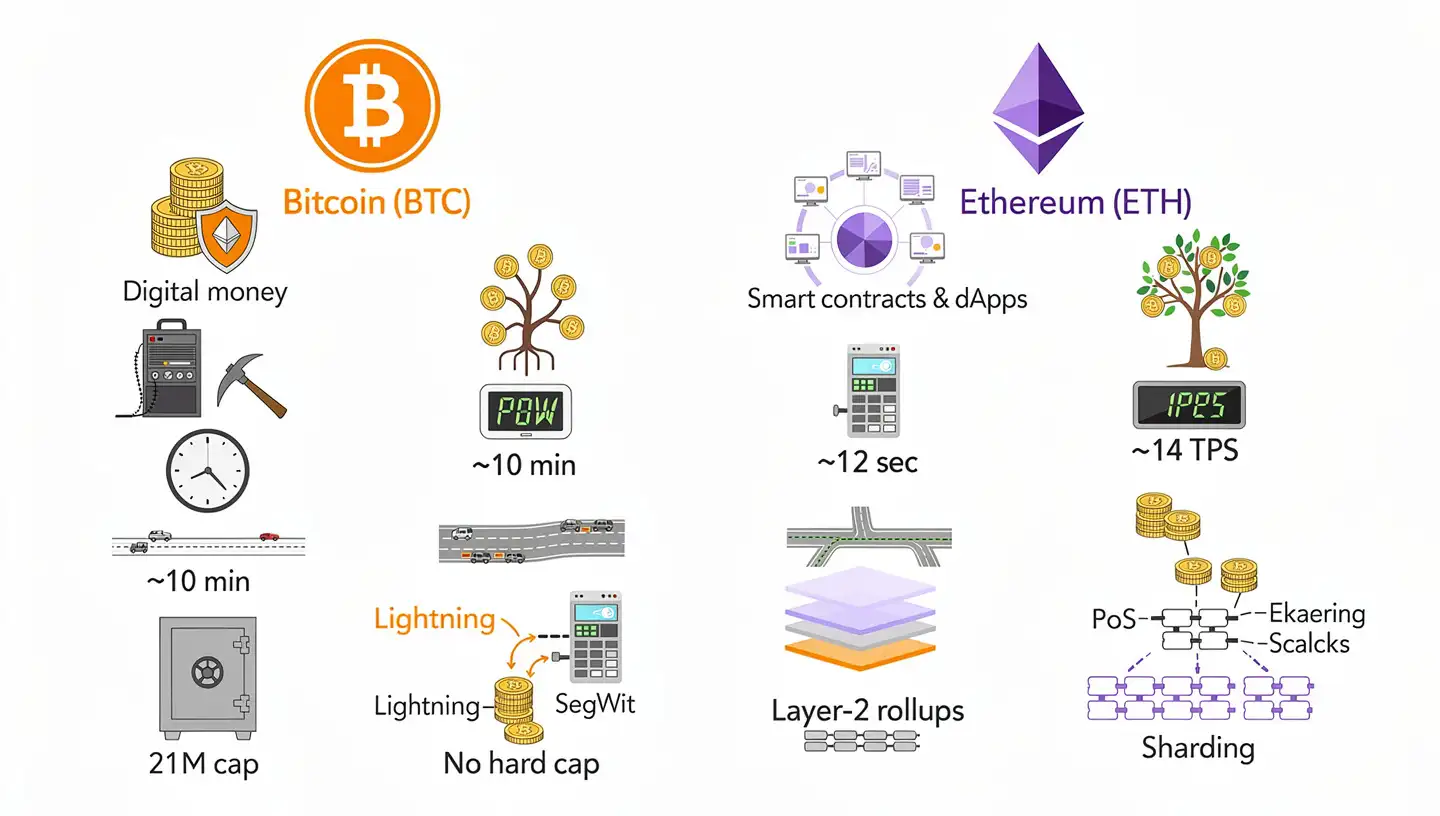
The table below summarizes the most important technical distinctions between the two networks:
| Feature | Bitcoin (BTC) | Ethereum (ETH) |
|---|---|---|
| Creator | Satoshi Nakamoto | Vitalik Buterin and co-founders |
| Launch year | 2009 | 2015 |
| Primary purpose | Digital money, store of value | Platform for smart contracts and dApps |
| Consensus mechanism | Proof of Work (PoW) | Proof of Stake (PoS) |
| Average block time | ~10 minutes | ~12 seconds |
| Transaction throughput | ~7 transactions per second | ~14 transactions per second |
| Total supply | Capped at 21 million BTC | No hard cap, partially deflationary |
| Scalability solutions | Lightning Network, SegWit | Layer-2 rollups, sharding |
Proof of Work vs Proof of Stake
Bitcoin uses proof of work, where miners spend computing power and electricity to solve cryptographic puzzles and confirm transactions. Each confirmed block earns a reward in newly created Bitcoin. This approach secures the network because attacking it would require controlling more than 50 percent of the global mining hash rate, which is both practically and financially out of reach for any realistic attacker. Critics point to the large energy draw as a drawback, particularly when mining runs on electricity from fossil fuels. Bitcoin proponents counter that a growing share of mining is powered by renewables, and that Bitcoin mining often uses stranded or surplus energy that would otherwise go to waste.
Ethereum moved away from proof of work in 2022 and now runs on proof of stake, where validators lock up a minimum of 32 ETH as collateral to earn the right to confirm transactions and collect rewards. Instead of physical computing power, the collateral is what keeps the network honest: a validator who tries to cheat risks losing their staked ETH through a penalty mechanism called slashing. The Ethereum Foundation estimated that The Merge cut energy consumption by more than 99 percent. A side-by-side breakdown of how both mechanisms work, including their security trade-offs, is available in our guide on proof of work vs proof of stake.
Supply and Scarcity
Bitcoin’s scarcity is mathematically guaranteed. There will never be more than 21 million Bitcoin, and new coins enter circulation on a fixed schedule that halves every four years. That schedule makes Bitcoin a deflationary asset with a fully known supply curve, which is what draws investors seeking a hedge against inflation and the devaluation of fiat currencies that central banks can expand at will.
Ethereum has no hard supply cap. New ETH is issued to validators as rewards, but a portion of every transaction fee is burned, permanently removed from circulation, through a mechanism known as EIP-1559, introduced in 2021. During periods of high network activity, the burn can outpace new issuance, making ETH deflationary. But that doesn’t happen consistently, and Ethereum carries none of the hard mathematical guarantees that Bitcoin’s fixed cap provides, which is one of the core arguments investors make when they favor BTC as a long-term store of value over ETH.
Transaction Speed and Fees
Bitcoin’s base layer confirms a block every 10 minutes and processes around 7 transactions per second. That speed is inadequate for everyday small payments but entirely sufficient for large-value transfers. The solution for speed and cost on Bitcoin is the Lightning Network, a second-layer network that operates off the main chain and enables near-instant, low-cost payments. By 2025, the Lightning Network supported a growing market for micropayments and more complex payment applications that the base layer alone could never handle.
Ethereum confirms a block every 12 seconds and handles around 14 transactions per second on its base layer. Transaction costs on Ethereum are known as gas fees, and they can spike sharply during periods of high network congestion. The answer to that problem is a set of layer-2 networks, including Arbitrum, Optimism, and Polygon, which process transactions off the main chain and post compressed proofs back to it. By 2025, layer-2 networks handled more than 60 percent of all Ethereum transactions, and average gas fees on those networks fell below one dollar for standard transfers, a dramatic improvement from the congestion-driven highs of 2020 and 2021.
Smart Contracts and Use Cases
Bitcoin supports a limited scripting language that is deliberately simple to reduce the risk of bugs and security vulnerabilities. The focus is on one thing: reliable, trustless transfer of value. Ethereum is Turing-complete by design, meaning it can execute virtually any algorithm, which makes it the foundation for complex financial protocols, prediction markets, games, and governance systems that run without a central authority.
All of this runs through the Ethereum Virtual Machine (EVM), a decentralized global computer that executes smart contracts identically on every node in the network. Token standards like ERC-20 for fungible tokens and ERC-721 for NFTs originated on Ethereum and became the industry standard that dozens of other blockchain networks have adopted. The bulk of the DeFi market, including lending protocols, decentralized exchanges, and derivatives platforms, runs on Ethereum. A closer look at how smart contracts work in practice is available in our guide on smart contracts, and the broader DeFi picture is covered in our piece on what DeFi is.
Bitcoin vs Ethereum: Environmental Impact
Bitcoin’s annual energy consumption is comparable to that of some smaller countries, a fact that has drawn sustained criticism from environmental groups and ESG-focused investors. The mining industry has responded by pointing to a growing share of renewable energy in its power mix and to the argument that miners often consume surplus energy that the grid would otherwise curtail. Ethereum eliminated mining entirely with The Merge in 2022, cutting energy use by more than 99 percent and making it significantly more acceptable to institutions and funds operating under strict environmental investment criteria. For many institutional investors, this distinction between the two networks matters when deciding which one fits inside their portfolio guidelines.
Bitcoin vs Ethereum: Historical Price and Returns
The price history of both assets shows extraordinary but deeply volatile returns. Long-term investors who entered in the early years generated enormous gains, but the path involved drawdowns of 80 percent or more during bear market cycles. Every bull run brought a fresh all-time high followed by a sharp correction, and neither asset has been immune to the broader sentiment swings that drive crypto markets. Current historical price data for both assets is available on CoinGecko’s historical data page.
Bitcoin Price History
Bitcoin launched in 2009 with no market value. It gained its first measurable price in 2010, when 10,000 BTC were traded for two pizzas worth around $25. From there, each major market cycle produced a new all-time high. Bitcoin crossed $1,000 for the first time in 2013, reached nearly $20,000 in 2017, and climbed to just under $69,000 in 2021 at the peak of that cycle’s bull run. In January 2024, the approval of the first spot Bitcoin ETFs in the United States brought a surge of institutional buying, and the fourth halving in April 2024 reinforced the supply-side narrative that has historically preceded Bitcoin’s strongest price periods. Bitcoin’s market capitalization now sits above $1.5 trillion, making it by far the largest crypto asset.
Nasdaq data shows that Bitcoin price rose approximately 31,267 percent from 2015 to 2025, placing it among the fastest-appreciating assets in the history of modern financial markets, though that figure comes alongside periods of extreme volatility that wiped out many short-term holders. A full breakdown of the halving dates that shaped those cycles, including the projected date of the fifth halving in 2028, is covered in our guide on Bitcoin halving dates.
Ethereum Price History
Ethereum launched in 2015 at under one dollar. It first attracted wide attention during the 2017 and 2018 ICO boom, when the surge in token projects and early DeFi protocols pushed ETH to a then-record near $1,400. In 2021, the explosion of DeFi volume and the NFT market drove Ethereum to a new all-time high of just under $4,800. After The Merge in 2022 and the approval of spot Ethereum ETFs in the United States in July 2024, ETH has held its position as the second-largest crypto asset by market capitalization, consistently valued between $250 billion and $350 billion depending on market conditions.
Nasdaq data shows that Ethereum price rose approximately 26,750 percent from 2015 to 2025, somewhat below Bitcoin’s return over the same full period. In the five-year window from 2020 to 2025, however, Ethereum had a slight edge, returning around 637 percent compared to Bitcoin’s 533 percent. That data point illustrates how the btc vs eth return comparison shifts depending on which time frame you measure, which is why both the entry point and the holding period matter when comparing these two assets.
Bitcoin vs Ethereum: Market Cap and Dominance
Market capitalization measures the total value of all units of an asset in circulation and is one of the key indicators of size and market position. Bitcoin leads with a market cap above $1.5 trillion and a share of around 56 percent of the total crypto market, a figure tracked as Bitcoin dominance. Ethereum sits in second place with a market cap between $250 billion and $350 billion, which is still more than three times larger than any other crypto asset. Together, these two assets account for roughly 70 percent of the entire crypto market. A clear explanation of how market cap is calculated and why it matters for comparing investments is available in our guide on what market cap means in crypto.
Bitcoin dominance is not static. During bull markets, capital often rotates out of Bitcoin and into Ethereum and smaller assets, pulling Bitcoin’s dominance down. In bear markets, investors typically move back toward Bitcoin as the more established asset, pushing dominance back up. Tracking that rotation offers useful context for understanding where a market cycle stands and how money is moving between the two largest assets. Our dedicated piece on Bitcoin dominance explains how to read and use that metric in practice.
The Flippening: Can Ethereum Overtake Bitcoin?
The Flippening is the term used to describe the hypothetical moment when Ethereum would surpass Bitcoin by market capitalization, becoming the largest crypto asset by value. The idea has circulated since 2017, when ETH briefly closed to within about 10 percent of Bitcoin’s market cap, prompting wide speculation that a reversal could happen within months.
It hasn’t happened. Bitcoin has maintained its lead for several reasons: a longer track record of reliability, greater institutional adoption, a simpler investment thesis, and the first-mover status that generates a network effect that has proven difficult to close. Joseph Lubin, one of Ethereum’s co-founders, has publicly argued that ethereum flipping bitcoin is a matter of when, not if, pointing to Ethereum’s role as core infrastructure for digital finance. Critics respond that Bitcoin doesn’t need to be more programmable to be more valuable, because its simplicity and predictability are precisely what make it a trustworthy reserve asset. The market has so far sided with Bitcoin, but the gap in market capitalization narrows and widens with each market cycle, making the flippening an ongoing debate rather than a settled question.
Bitcoin as an Investment
Bitcoin’s investment case rests on constrained supply and growing demand. With each halving, the number of new Bitcoin entering circulation is cut in half, while the user base and institutional interest have historically continued to expand. That combination of shrinking new supply and rising demand is the foundation of the stock-to-flow model, which many Bitcoin analysts use as a long-term valuation framework, though the model has serious critics who point out that past cycles don’t guarantee future ones.
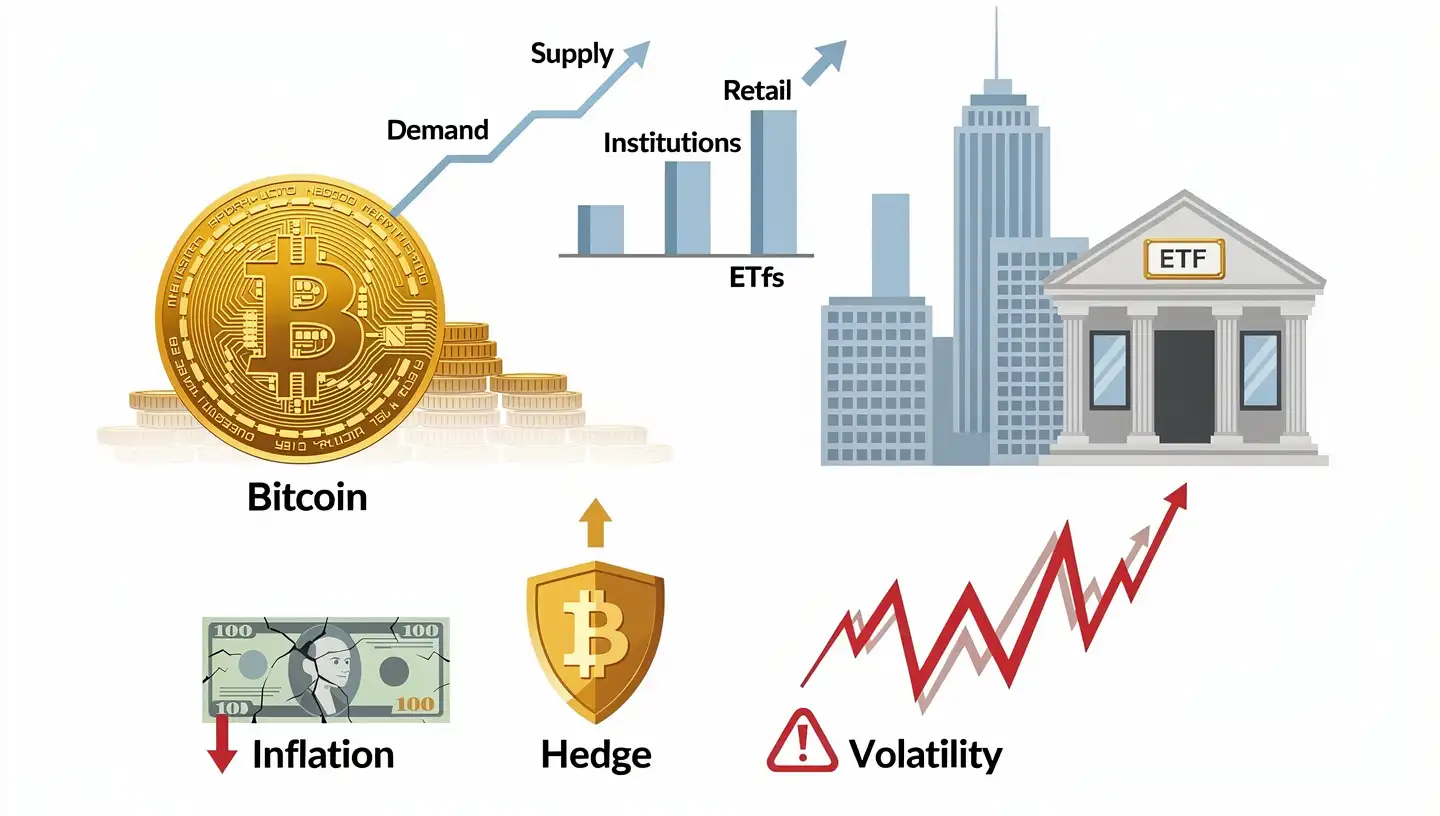
In January 2024, the U.S. Securities and Exchange Commission approved the first spot Bitcoin ETFs, including funds from BlackRock (IBIT) and Fidelity (FBTC). That approval opened Bitcoin to pension funds, endowments, and standard brokerage accounts that previously had no regulated way to hold crypto. By the end of 2025, spot Bitcoin ETFs in the United States held around 12 percent of Bitcoin’s total circulating supply, a figure that shows the scale of institutional entry into the asset class. Everything you need to know about how these products are structured, which ones are available, and how to buy them is covered in our guide on what a Bitcoin ETF is.
Bitcoin is also increasingly treated as an inflation hedge, particularly in countries with unstable currencies or governments running large deficits. Unlike fiat currencies that central banks can expand without formal limits, Bitcoin has a fixed supply schedule that no authority can alter. Companies like MicroStrategy and several sovereign governments have begun holding Bitcoin in their reserves for exactly this reason. The risks are real nonetheless: Bitcoin remains a highly volatile asset, regulatory shifts in major economies can move the price sharply, and the long-term security of the network after block rewards run out remains an open question that won’t be settled for decades. How the halving schedule shapes Bitcoin’s investment profile over each four-year cycle is explained in detail in our piece on Bitcoin halving.
Ethereum as an Investment
Ethereum’s investment case is different from Bitcoin’s. Where Bitcoin offers scarcity and predictability, ETH offers exposure to network revenue. Every time a DeFi protocol gets used, an NFT gets traded, or a decentralized application runs on Ethereum, a portion of the fee goes to validators and a portion gets burned, permanently reducing the circulating supply. Ethereum is one of the only large crypto assets whose value is directly tied to how much the network gets used, rather than to mining economics or pure market speculation. The DeFi sector that drives much of that activity is covered in our guide on what DeFi is.
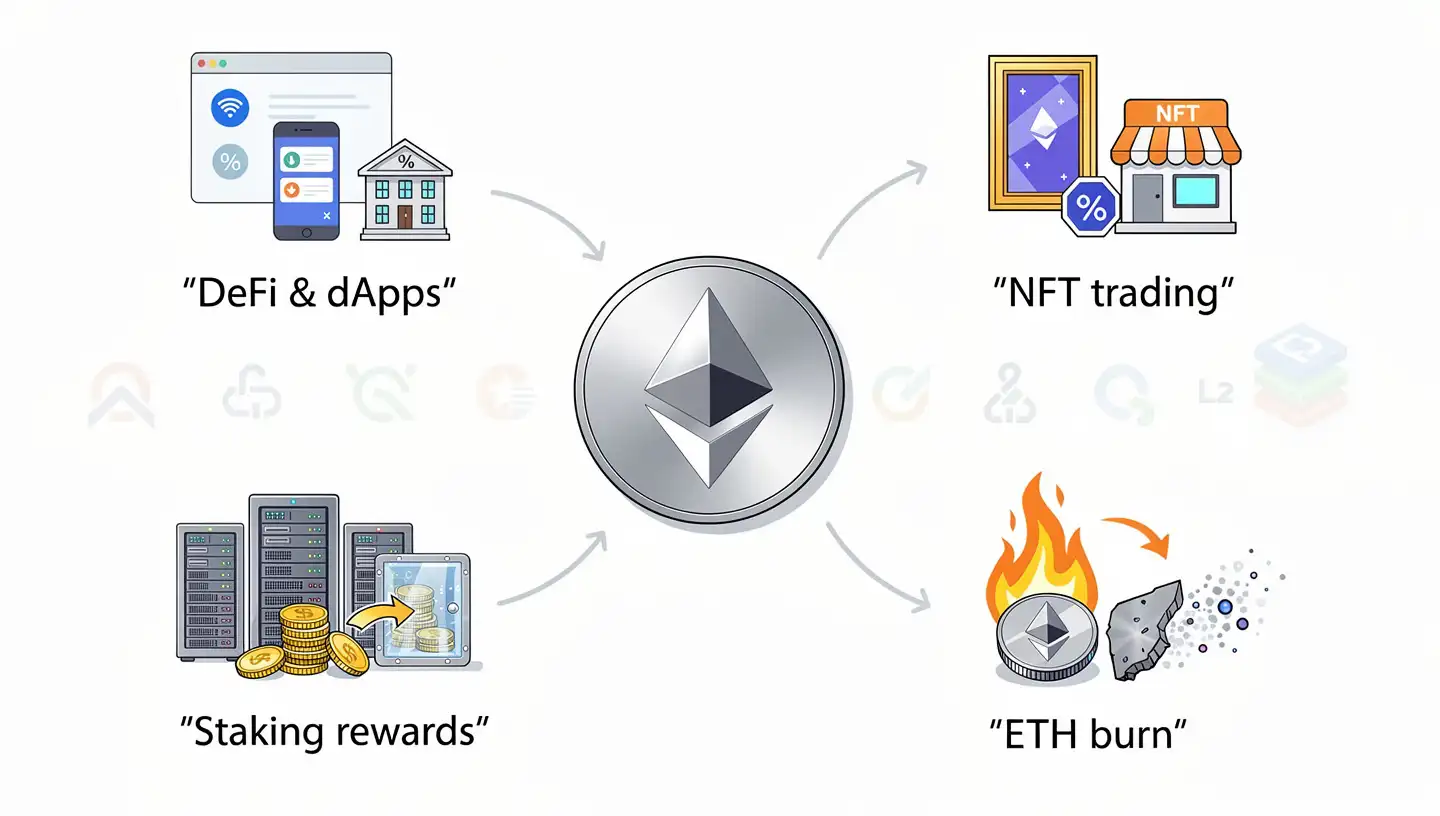
The move to proof of stake in 2022 introduced another layer to Ethereum’s investment case: staking rewards. Validators who lock up a minimum of 32 ETH earn annual yields between 4 and 6 percent, making ETH one of the only major crypto assets that pays a yield comparable to interest, without a centralized intermediary taking a cut. Smaller investors can access similar returns through liquid staking platforms, where they don’t need to lock up 32 ETH or run their own validator. A full breakdown of how crypto staking works and what to watch for is available in our guide on crypto staking.
Institutional interest in Ethereum is growing alongside the Bitcoin ETF wave. VanEck and other asset managers have argued that Ethereum could become the foundational settlement layer for tokenized real-world assets, including bonds, equities, and real estate, which would generate enormous demand for ETH as the “fuel” for those transactions. The risks are specific and worth understanding clearly. Competition from high-throughput blockchain networks like Solana, which offers faster transactions and lower costs, is a serious challenge. There’s also a question of whether Ethereum’s base layer retains enough fee revenue as more activity migrates to cheap layer-2 networks, since the burn mechanism depends on base-layer fees to reduce supply over time.
Bitcoin vs Ethereum: Community and Development
Bitcoin’s development community is known for its conservative approach. Changes to the protocol go through a lengthy review and consensus process that can take years. Upgrades like SegWit and Taproot were introduced only after extended debate, and the Bitcoin Core client is maintained by a small group of developers who are deliberately cautious about any modification to a network that secures hundreds of billions in value. Bitcoin proponents see this slow, careful process as a strength because it minimizes the risk of unintended consequences.
Ethereum’s development community moves faster and experiments more openly. The Ethereum Foundation and hundreds of independent teams continuously push protocol improvements through a formal proposal process called EIPs. The Merge, one of the most technically complex operations ever performed on a live blockchain, transferred a network worth hundreds of billions of dollars to a new consensus mechanism without a single moment of downtime. Layer-2 teams building on Ethereum, including Arbitrum, Optimism, and Polygon, are treated as a core part of the broader development plan rather than as competitors to the main network.
Is Ethereum Better Than Bitcoin?
The question of whether Ethereum is better than Bitcoin doesn’t have a universal answer because both assets suit different investment objectives. Bitcoin is the stronger choice for investors who want a predictable, scarce asset that behaves like digital gold and whose investment thesis doesn’t depend on following developer roadmaps or tracking network activity. Its simplicity and multi-year track record make it more accessible to institutions and conservative investors who aren’t interested in the technical details of blockchain development.
Ethereum is the stronger choice for investors who want exposure to the growth of decentralized finance, NFT markets, tokenized assets, and Web3 applications. ETH is the fuel that powers all of those transactions, so its value grows when network activity grows. The ethereum vs bitcoin debate ultimately isn’t about which asset is objectively superior, but about which one aligns better with a given investor’s goals and risk tolerance. Coinbase has noted clearly that Bitcoin and Ethereum are more complementary than competitive, since they serve different purposes and can coexist within the same portfolio rather than forcing an either-or decision.
Bitcoin vs Ethereum for Beginners
For someone entering crypto for the first time, the bitcoin vs ethereum for beginners debate tends to land on the same conclusion: Bitcoin is the easier starting point. Its investment thesis is simpler to understand, liquidity is higher, regulatory clarity has advanced further in the United States and Europe, and spot ETFs now make it accessible through standard brokerage accounts without needing a crypto exchange account or a digital wallet.
Ethereum requires a bit more background knowledge to understand properly. An investor needs to follow development progress, understand the role of layer-2 networks, track gas fee dynamics, and keep an eye on competition from other blockchain networks. Forbes and Coinbase both recommend Bitcoin as the starting point for newcomers, with Ethereum as a logical next step after gaining a working understanding of the crypto market. Anyone starting from scratch can find a clear foundation in our guide on crypto for beginners.
Should You Hold Both Bitcoin and Ethereum?
Many experienced crypto investors don’t frame it as Bitcoin or Ethereum but as how much of each. The portfolio split that comes up most often is 60 to 70 percent BTC and 30 to 40 percent ETH, with Bitcoin serving as the more stable base and Ethereum as exposure to higher growth potential alongside higher risk. That combination covers both the store-of-value narrative and the decentralized infrastructure narrative without forcing a binary choice between them.
The arguments for holding both are grounded in how the two assets behave differently across market cycles. Bitcoin tends to hold value better during downturns and attracts the bulk of institutional buying. Ethereum tends to outperform during periods when DeFi and NFT activity picks up, and it offers staking yields that Bitcoin cannot match. Historically, both assets rise together in bull markets and fall together in bear markets, but Ethereum typically moves by a larger percentage in both directions, making it more volatile but potentially more rewarding for investors with a longer time horizon and a higher tolerance for drawdowns. Whether you should hold one or both comes down to your time horizon, your conviction in each asset’s long-term development path, and how much volatility you’re comfortable carrying.
Bitcoin vs Ethereum FAQ
Is Bitcoin better than Ethereum?
Bitcoin is better for investors who want a scarce, predictable asset with a long track record and growing institutional support. Ethereum is better for investors who want exposure to decentralized applications, DeFi growth, and the ability to earn staking rewards. Neither is objectively better because they serve different purposes and suit different investor profiles.
Should I buy Bitcoin or Ethereum?
It depends on what you’re looking for. If you want a digital store of value with a fixed supply and broad institutional backing, Bitcoin fits that profile. If you believe in the growth of blockchain-based applications, decentralized finance, and asset tokenization, Ethereum is the more relevant bet. Many investors buy both, typically in a ratio weighted toward Bitcoin, to cover both investment narratives without having to choose between them.
What is the difference between Bitcoin and Ethereum?
The core difference is purpose. Bitcoin was designed as decentralized money and a store of value with a hard supply cap of 21 million coins. Ethereum is a programmable blockchain network that enables smart contracts and decentralized applications, with a dynamic supply that can become deflationary during periods of high activity. Bitcoin uses proof of work, while Ethereum has used proof of stake since 2022.
Can Ethereum flip Bitcoin in market cap?
The Flippening, as the event is known, has not happened. Ethereum has closed the gap in some market cycles but Bitcoin has held its lead through institutional adoption, a longer track record, and first-mover advantages that are difficult to overcome. Whether the Flippening ever happens depends on the pace of Ethereum’s network growth versus the continued expansion of Bitcoin’s institutional base.
Which is more volatile, Bitcoin or Ethereum?
Ethereum has historically been more volatile than Bitcoin. In bull markets, ETH has typically posted larger percentage gains, and in bear markets, larger percentage losses. That makes Ethereum potentially more rewarding for risk-tolerant investors but also more dangerous for conservative portfolios that can’t absorb sharp drawdowns.
Do Bitcoin and Ethereum move together?
Yes, there is a strong correlation between the price movements of Bitcoin and Ethereum, especially during broad market sell-offs or rallies. However, Ethereum can diverge from Bitcoin in periods when specific factors, such as advances in network development, surges in DeFi activity, or regulatory news targeting one asset specifically, drive one more than the other.
Is Ethereum a good investment?
Ethereum is one of the few crypto assets with a clear use case that generates real transaction revenue, a staking mechanism that produces annual yields of 4 to 6 percent, and growing institutional adoption through approved spot ETFs. It also carries specific risks: competition from faster blockchain networks, uncertainty about long-term fee revenue as more activity moves to layer-2 networks, and the complexity of ongoing protocol development. Any investment decision should weigh those factors against individual risk tolerance and time horizon.
What happens to Ethereum after all Bitcoin is mined?
Ethereum and Bitcoin operate entirely independently, so the end of Bitcoin mining, expected around 2140, has no direct effect on Ethereum. Ethereum eliminated mining with The Merge in 2022 and now runs on proof of stake. Its future issuance and validator rewards are tied to network activity and protocol upgrades, not to a mining schedule or Bitcoin’s remaining supply.