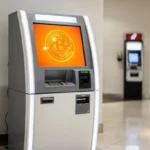
A Bitcoin ATM is a physical kiosk that lets you buy Bitcoin with cash or a debit card. Some machines also let you sell Bitcoin and collect cash. Unlike a regular bank ATM, a Bitcoin ATM does not connect to a bank account. It connects directly to the blockchain and sends Bitcoin to your digital wallet when you complete a transaction. Think of it as a bridge between physical cash and digital currency.
The alternative name is Bitcoin Teller Machine (BTM), though Bitcoin ATM is the term most people use. The first machine of this kind opened on October 29, 2013, at Waves Coffee Shop in Vancouver, Canada. Since then, the number has grown to over 38,000 machines worldwide as of 2025, with the United States hosting the large majority: roughly 90% of all Bitcoin ATMs in North America are located there.
Bitcoin ATMs can be found in convenience stores, gas stations, supermarkets, pharmacies, shopping malls, airports, and hotel lobbies. Most operate 24 hours a day, seven days a week, and do not require a bank account to use.
Bitcoin ATM vs. traditional ATM
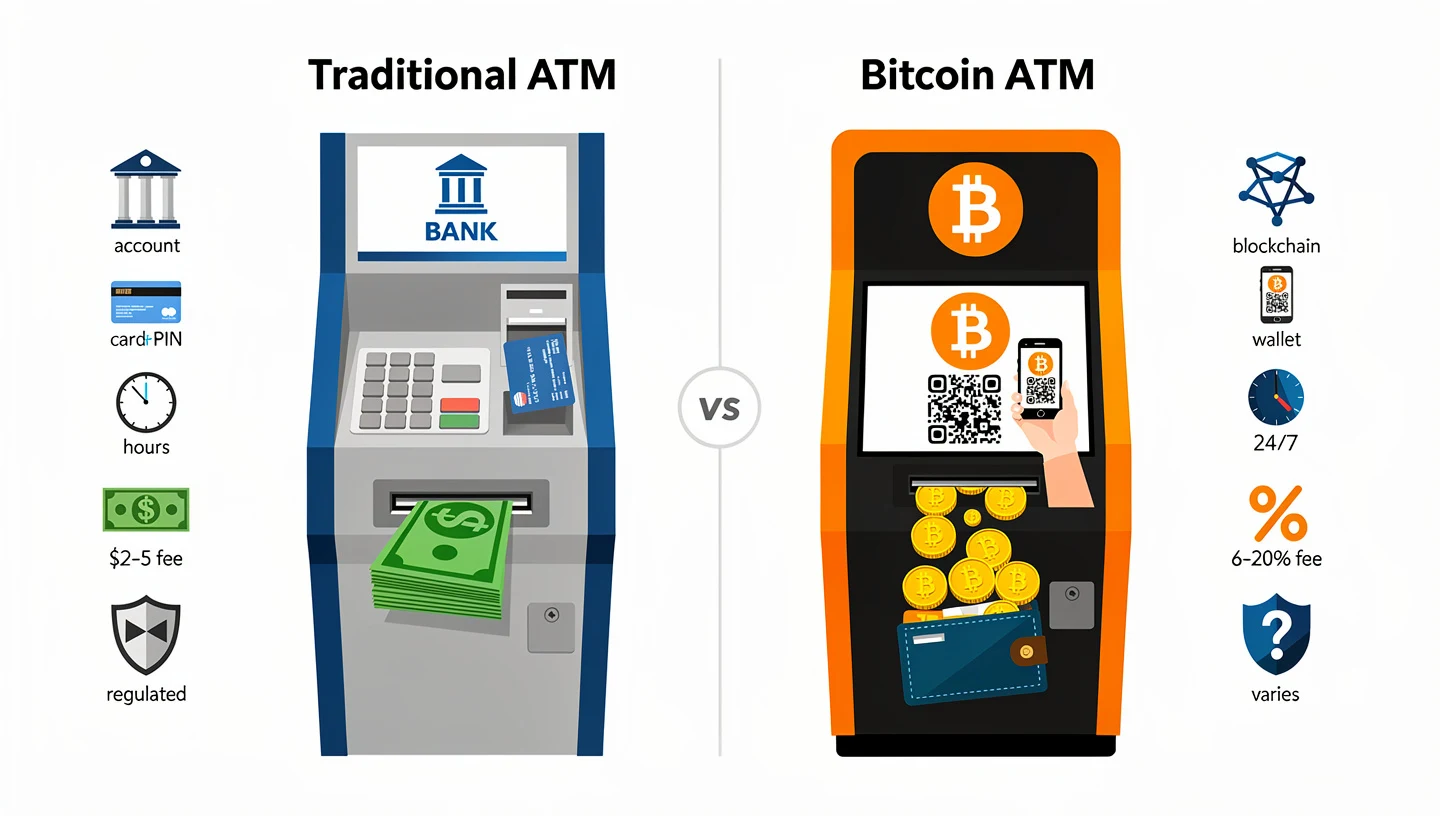
Bitcoin ATMs look similar to regular ATMs from the outside, but they work in a fundamentally different way.
| Feature | Traditional bank ATM | Bitcoin ATM |
|---|---|---|
| Connected to | Bank account | Blockchain network |
| Access method | Bank card and PIN | Digital wallet (QR code) and phone |
| Output | Cash from your account | Bitcoin sent to your wallet |
| Hours | Varies by location | Usually 24/7 |
| Fees | $2-5 per withdrawal | 6-20% of transaction amount |
| Bank account required | Yes | No |
| Regulatory oversight | Strictly regulated | Varies by country and operator |
A traditional ATM gives you access to money already in your bank account. A Bitcoin ATM converts your cash into Bitcoin and sends it to an address on the blockchain. The transaction does not touch a bank at any point.
For a broader explanation of how cryptocurrency transactions work on the blockchain, see our guide on how Bitcoin works.
Types of Bitcoin ATMs
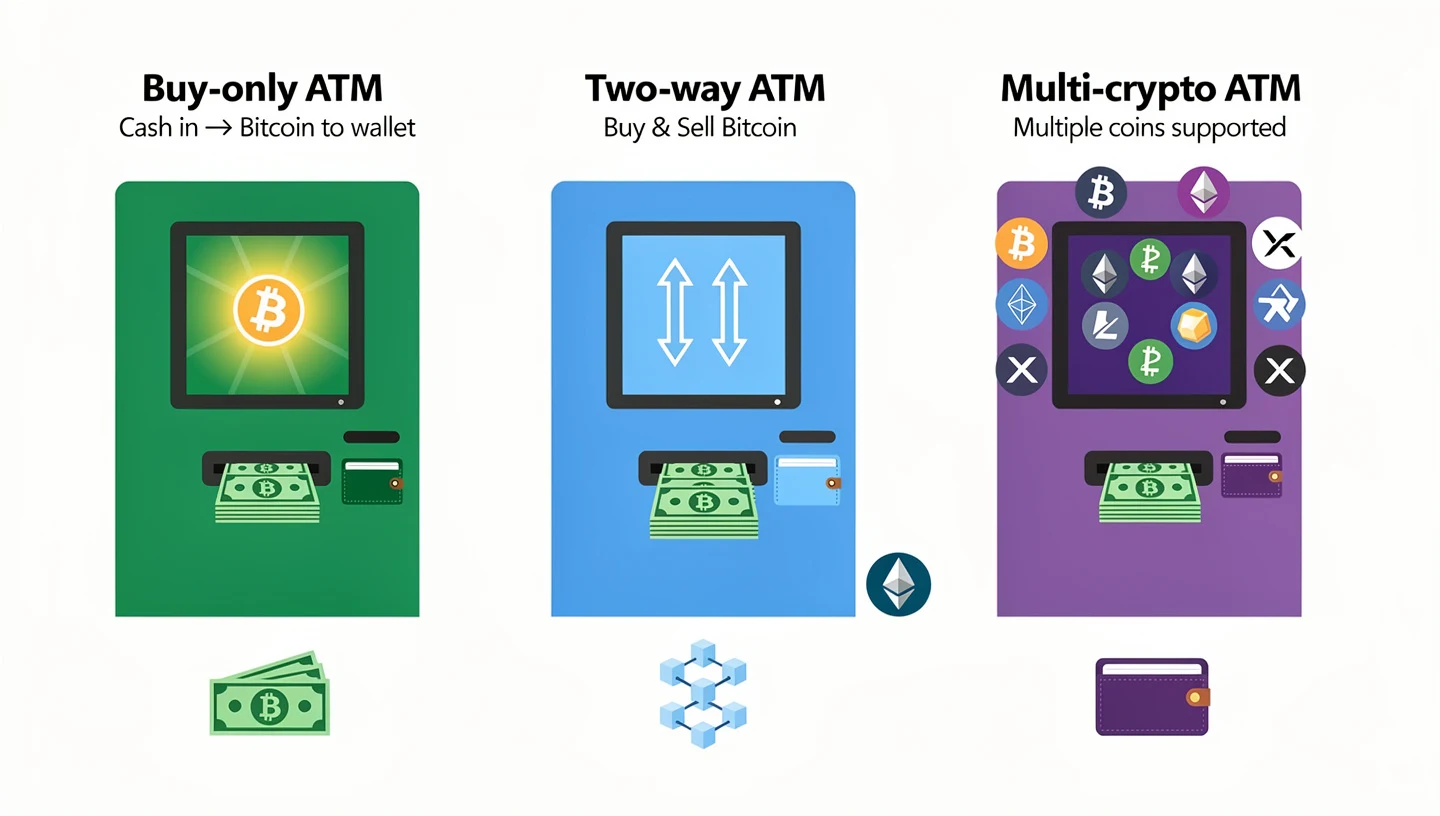
Not all Bitcoin ATMs work the same way. Before heading to one, it helps to know which type you are dealing with.
Buy-only Bitcoin ATMs
The most common type. These machines accept cash and send Bitcoin to your wallet. They do not allow you to sell Bitcoin or collect cash from the machine. Buy-only machines are cheaper to operate and maintain, which is why they make up the majority of Bitcoin ATMs globally. If you are looking to purchase Bitcoin with cash, these cover the need.
Two-way (bidirectional) Bitcoin ATMs
Two-way machines support both buying and selling. You can insert cash to buy Bitcoin, or you can send Bitcoin to the machine and collect cash. These are less common than buy-only machines but their numbers are growing. When selling, the process takes longer because the machine needs to wait for at least one blockchain confirmation before dispensing cash.
Multi-cryptocurrency ATMs
Some machines support more than just Bitcoin. You may find kiosks that also handle Ethereum, Litecoin, XRP, and other major coins. Litecoin in particular is sometimes preferred for selling at ATMs because its transaction confirmations arrive faster than Bitcoin, reducing the time you spend waiting at the machine.
What do you need to use a Bitcoin ATM?
Using a Bitcoin ATM requires a few basic things. Having them ready before you arrive makes the process faster and avoids issues at the machine.
- A digital wallet. This is where the Bitcoin will be sent after your purchase. It can be a mobile wallet app, a hardware wallet, or any other type that displays a QR code for your wallet address. If you do not have a wallet, some machines can create a basic one for you on the spot, though using your own is safer. For more on how wallets and private keys work, see our guide on private key crypto.
- A mobile phone. Required for SMS verification. You will receive a one-time code by text message that you enter into the ATM to verify your identity. Your phone is also how you display your wallet’s QR code for the machine to scan.
- Cash. Bitcoin ATMs accept paper banknotes, not coins. Check the minimum purchase amount for the specific machine: some start at $10, others at $20 or $50.
- A government-issued ID (for larger amounts). For transactions below roughly $900, most operators only require your name, date of birth, and phone number. Amounts above that threshold typically require a passport, driver’s licence, or national ID card.
How to buy Bitcoin at a Bitcoin ATM
The buying process is the same at most machines, though the exact screen layout varies by operator. Here is what to expect.
- Find a Bitcoin ATM near you. Use CoinATMRadar, Google Maps, or the app of a major operator like Bitcoin Depot or CoinFlip. Filter by “buy” functionality if you want to confirm the machine supports purchases. Check the operating hours and address before you go.
- Start the transaction. At the machine, select the option to buy Bitcoin. Some operators offer pre-registration through their mobile app, which saves time at the kiosk by completing the identity verification step before you arrive.
- Verify your identity. Enter your phone number. The machine sends an SMS code that you type into the screen. For purchases above the operator’s ID threshold, you will also need to scan your government-issued ID using the kiosk’s built-in camera.
- Enter your wallet address. Scan your wallet’s QR code using the machine’s camera. This is the most important step. If the address is wrong, the Bitcoin goes to the wrong place and cannot be recovered. If you do not have a QR code available, some machines let you type the address manually, but double-check every character before proceeding.
- Insert your cash. Feed the banknotes into the machine. The screen shows you the current exchange rate, the fee, and the amount of Bitcoin you will receive based on what you have inserted. You can insert more or less than planned at this stage.
- Review and confirm. The screen shows the complete transaction summary: how much cash you inserted, the Bitcoin amount, the rate, and the fee. Once you confirm, the transaction cannot be reversed. Bitcoin transactions on the blockchain are final.
- Receive your Bitcoin. The machine broadcasts the transaction to the Bitcoin network. Delivery to your wallet typically takes 10 to 15 minutes, depending on how congested the Bitcoin network is at that moment. Some operators send an SMS confirmation with the transaction ID so you can track it.
For more on what Bitcoin is and how ownership works on the blockchain, see our guide on what is Bitcoin.
How to sell Bitcoin at a Bitcoin ATM
Selling Bitcoin at an ATM, also called cashing out, is only possible at two-way (bidirectional) machines. Always check that the machine supports selling before you travel to it. CoinATMRadar lets you filter specifically for machines with sell functionality.
- Find a two-way Bitcoin ATM. Use CoinATMRadar’s sell filter to locate machines that dispense cash. Check the minimum and maximum sell amounts for the specific operator, as these vary.
- Start the transaction. Select “Sell Bitcoin” or “Withdraw Cash” on the screen. Enter the amount of cash you want to receive.
- Verify your identity. Enter your phone number and confirm the SMS code. For larger amounts, scan your ID.
- Send Bitcoin to the ATM. The machine displays a QR code with its own Bitcoin wallet address and the exact amount of BTC you need to send. Open your wallet app and send that exact amount to that address. Do not send a different amount; the machine expects a specific sum.
- Wait for blockchain confirmation. This is the longest part of a sell transaction. The machine waits for at least one confirmation on the Bitcoin blockchain before releasing cash. Depending on network activity, this can take anywhere from 10 minutes to 30 minutes or more. Litecoin transactions confirm faster if the machine supports it.
- Collect your cash. Once the blockchain confirms the transaction, one of two things happens. The machine dispenses cash directly, or it sends you an SMS redemption code that you enter at the machine to release the cash. Follow the on-screen instructions for whichever method the operator uses.
Bitcoin ATM fees
Bitcoin ATM fees are significantly higher than online cryptocurrency exchanges. This is the main tradeoff for the speed and convenience they offer.
| Transaction type | Bitcoin ATM fee | Online exchange fee |
|---|---|---|
| Buying Bitcoin | 6% to 20% | 0.1% to 1.5% |
| Selling Bitcoin | 5% to 15% | 0.1% to 1.5% |
| Network fee | $3 to $10 additional | Varies by network |
The fee always appears on-screen before you confirm. A reputable machine will show you the full transaction breakdown, including the exchange rate, fee, and final Bitcoin amount, before you commit. If a machine does not display fees clearly before you confirm, walk away.
Operators charge high fees because they pay rent for the physical space, cover machine maintenance and compliance costs, and build in a spread on the exchange rate on top of the flat or percentage fee. The convenience of buying Bitcoin with cash in five minutes, without a bank account or online exchange login, is what justifies that premium for many users.
A concrete example: buying $500 worth of Bitcoin at a Bitcoin ATM with a 12% fee costs $60 in fees. The same purchase on a major online exchange at 1.5% costs $7.50. The ATM costs $52.50 more, but you can walk away with Bitcoin in under 15 minutes without any account or bank transfer.
Bitcoin ATM limits and ID requirements
Transaction limits and identity requirements vary by operator and location, but most follow a tiered structure based on how much you are buying or selling.
- Below ~$900 (no ID required): Most operators ask for only your name, date of birth, and mobile phone number for SMS verification. No document scanning required. This threshold is common in the US market and reflects standard Anti-Money Laundering (AML) compliance practice.
- $900 to $3,000 (basic ID required): Scan your government-issued photo ID using the kiosk’s camera. Some machines also take a selfie. This is the most common verification level for moderate purchases.
- Above $3,000 (enhanced verification): May require additional documents such as proof of address, or a Social Security Number in the US. Some operators set daily limits that cap how much you can transact regardless of verification level.
- Daily limits: Typically range from $500 to $25,000 depending on the operator and your verification level. Higher verification unlocks higher daily limits.
Regulations differ by country and by state or province within countries. The limits above reflect common US practice. Always check the specific terms of the machine or operator you plan to use before arriving.
For more on how cryptocurrency transactions are tracked and what fiat currency regulations affect the crypto space, see our guide on what is fiat currency.
Bitcoin ATM fees vs. online exchanges: which should you use?
Bitcoin ATMs are not the right tool for every situation. Knowing when they make sense and when they do not saves you money.
Use a Bitcoin ATM when:
- You are paying with cash and do not have a bank account or debit card linked to an exchange
- You need Bitcoin quickly and cannot wait for a bank transfer to clear (typically one to three business days)
- You are buying a small amount and the flat convenience fee is acceptable relative to the total
- You prefer to keep the transaction separate from your banking history
Use an online exchange when:
- You are buying larger amounts where a percentage fee adds up significantly
- You are not in a hurry and can wait for a bank transfer
- You want access to altcoins, stablecoins, or other assets Bitcoin ATMs do not carry
- You trade regularly and want better rates for volume
For a full guide on how online crypto exchanges work and how to choose one, see our guide on what is a crypto exchange.
How to find a Bitcoin ATM near me
Several tools make locating a nearby Bitcoin ATM straightforward.
CoinATMRadar
CoinATMRadar (coinatmradar.com) is the most complete global directory of Bitcoin ATMs. You can filter results by cryptocurrency supported, operator, buy-only vs buy-and-sell functionality, and fee range. Each listing shows the address, operating hours, contact information, and user reviews. If you need to sell Bitcoin, this is the best starting point because the sell filter shows only machines that support cash withdrawals.
Google Maps
Searching “Bitcoin ATM near me” or “crypto ATM near me” in Google Maps surfaces nearby machines with locations, hours, directions, and user reviews. The data is not always as current as CoinATMRadar, but it works well for a quick check and is useful if you are already navigating with Maps.
Operator apps and websites
Major operators including Bitcoin Depot, CoinFlip, RockItCoin, Bitstop, and Coinme all provide machine locators on their websites and mobile apps. The operator apps also offer pre-registration, which lets you complete identity verification at home so you spend less time at the kiosk. If you use one operator’s machines regularly, their app is the most efficient way to find locations and manage your transactions.
Benefits and drawbacks of Bitcoin ATMs
Bitcoin ATMs serve a real purpose for specific groups of people, but they come with clear limitations.
Benefits:
- No bank account needed. You can buy Bitcoin with cash without any bank account, exchange account, or lengthy verification process.
- Speed. The full process from walking up to the machine to receiving Bitcoin in your wallet takes 15 to 30 minutes in most cases.
- Cash access. Bitcoin ATMs are one of the only ways to convert cash directly into Bitcoin without going through a bank or online platform.
- 24/7 availability. Most machines operate around the clock, unlike banks and many online support services.
- Accessible locations. Convenience stores, gas stations, and supermarkets put Bitcoin ATMs close to where people already go.
Drawbacks:
- High fees. Paying 6-20% per transaction is expensive compared to online exchanges. For large purchases, the fee difference is significant.
- Limited coin selection. Most machines only offer Bitcoin. If you want Ethereum, Solana, or altcoins, you typically need an online exchange.
- No deposit insurance. Bitcoin stored in a personal wallet is not insured by any government scheme, unlike bank deposits.
- Scam risk. Bitcoin ATMs are frequently used in fraud schemes. See the next section.
- Uneven geographic coverage. Urban areas have many machines; rural areas often have none.
For a broader look at what makes cryptocurrency different from traditional money and why it lacks the same consumer protections, see our guide on what is cryptocurrency.
Bitcoin ATM scams: how to protect yourself
Bitcoin ATMs have become a tool of choice for fraudsters because transactions are fast, largely irreversible, and can involve large sums of cash. The Federal Trade Commission reported that consumers in the United States lost over $110 million to Bitcoin ATM scams in 2023. In the first six months of 2024 alone, losses exceeded $65 million.
The most common scam formats:
- Government impersonation. Someone calls or messages claiming to be from the IRS, Social Security Administration, local police, or another government agency. They say you owe money, are under investigation, or that your bank account has been compromised. They direct you to withdraw cash and deposit it into a Bitcoin ATM to “protect” your funds or pay a debt. No real government agency accepts or requests Bitcoin payments.
- Tech support scams. A caller claims to be from Microsoft, Apple, or your internet provider. They say your computer has been hacked and ask you to send Bitcoin to fix the problem. Legitimate tech support does not ask for cryptocurrency.
- Romance scams. Someone you have met online, often through a dating app or social media, builds a relationship and then asks for urgent financial help. The request eventually involves sending Bitcoin through an ATM.
- Investment fraud. A stranger or online contact promises guaranteed returns on a Bitcoin investment and tells you to use an ATM to fund an account on a platform they control. Once the money is sent, it is gone.
The single most reliable indicator of a scam: anyone who directs you to a Bitcoin ATM is almost certainly trying to defraud you. Real businesses, government agencies, banks, and courts do not accept or request payments in Bitcoin. If someone is pushing you toward a Bitcoin ATM, stop and call someone you trust before doing anything.
Are Bitcoin ATMs safe to use?
When operated by reputable companies, Bitcoin ATMs are technically secure. They use encrypted connections, require wallet authentication to send funds, and comply with AML and KYC regulations in the jurisdictions where they operate. The machine itself is not the risk.
The risk is social, not technical. Scammers target people at or near Bitcoin ATMs, or convince them to visit one. A machine run by a registered Money Services Business (MSB) in a well-lit, monitored location is safe to use for a legitimate purchase. Machines in poorly lit or unsupervised locations carry more risk of tampering.
Before using any Bitcoin ATM:
- Check that the operator is a registered business with a website and customer support contact
- Confirm that the machine clearly displays fees and the final Bitcoin amount before you confirm
- Only use your own wallet, never one provided or suggested by another person
- Ignore anyone who approaches you near the machine or contacts you about using it
For a detailed explanation of private keys and why controlling your own wallet matters for security, the guide on private key crypto covers exactly that.
The most widely used tool for finding reputable operators is CoinATMRadar, which lists operator details, user reviews, and compliance information for machines worldwide. The FTC’s consumer guide on Bitcoin ATM fraud is published at consumer.ftc.gov.
Frequently asked questions
Are Bitcoin ATMs legal?
Yes, Bitcoin ATMs are legal in most countries where they operate. In the United States, operators must register as Money Services Businesses with the Financial Crimes Enforcement Network (FinCEN) and comply with AML and KYC regulations. In other countries, the specific regulatory framework varies. Using a Bitcoin ATM to buy or sell Bitcoin for personal use is legal where the machines are licensed to operate.
Do Bitcoin ATMs require ID?
It depends on the transaction amount. Most operators do not require a government-issued ID for purchases below approximately $900. Above that threshold, you will typically need to scan a passport, driver’s licence, or national ID card. Some machines also take a selfie or require a Social Security Number for larger amounts. Requirements vary by operator, country, and transaction size.
How long does a Bitcoin ATM transaction take?
Buying Bitcoin at an ATM typically takes 5 to 10 minutes at the machine, plus 10 to 15 minutes for the Bitcoin to arrive in your wallet once the transaction is broadcast to the network. Selling Bitcoin takes longer because the machine waits for at least one blockchain confirmation, which can take 10 to 30 minutes depending on network activity. The full sell process from walking up to the machine to collecting cash can take 20 to 45 minutes.
What is the minimum amount I can buy at a Bitcoin ATM?
Minimums vary by operator. Many machines start at $10 or $20. Some set their minimum at $50. Check the specific machine or operator’s website before you go. There is no universal minimum across all Bitcoin ATMs.
Can I use a Bitcoin ATM without a wallet?
Technically, some machines can generate a basic paper wallet for you on the spot if you do not have one. However, this is not the recommended approach. A paper wallet printed by a third-party machine is less secure than a wallet you control yourself. Before using a Bitcoin ATM, set up a mobile wallet such as Muun, Blue Wallet, or another self-custody option. This takes a few minutes and gives you full control over your Bitcoin.
Are Bitcoin ATMs anonymous?
Not fully, and less so than they used to be. For small transactions below the operator’s ID threshold, you only provide a phone number, which provides some degree of privacy. For larger amounts, identity verification is required and your transaction is logged. Additionally, all Bitcoin transactions are permanently recorded on the public blockchain and can be traced by anyone with the right tools. Bitcoin ATMs are more private than using a bank, but they are not anonymous in the way cash transactions historically were.
Can I send Bitcoin to someone else using a Bitcoin ATM?
Yes. Instead of scanning your own wallet’s QR code when prompted, enter the recipient’s Bitcoin wallet address. The machine sends the Bitcoin directly to that address. This is a common way to send Bitcoin to family members or pay someone who does not have an exchange account. Be absolutely certain the address is correct before confirming. Bitcoin sent to the wrong address cannot be recovered.
Can you buy other cryptocurrencies at a Bitcoin ATM?
Some machines support multiple cryptocurrencies, most commonly Ethereum, Litecoin, and XRP in addition to Bitcoin. The selection depends on the specific machine and operator. Bitcoin remains by far the most widely supported asset. If you want access to a broader range of altcoins, an online exchange will have more options than any Bitcoin ATM. See our guide on what is an altcoin for an overview of the alternatives to Bitcoin.