For most of human history, gold has been the benchmark for preserving wealth. It outlasted every defunct monetary system, survived wars, revolutions, and currency collapses, and ended up in the vaults of central banks across every continent. Bitcoin arrived in 2009 and immediately attracted comparisons to gold, sharing two of the same core properties: scarcity and independence from central authority.
The comparison has grown more serious every year. Bitcoin now has a market capitalization above $1 trillion. Institutional funds, governments, and central banks hold it. BlackRock published research on its role as a portfolio diversifier. Whether Bitcoin can serve the same function gold has served for millennia, or something different altogether, is now a legitimate investment question rather than a speculative one.
This guide compares both assets across the dimensions that matter for a store of value: scarcity mechanics, market performance, volatility, inflation hedging, crisis behavior, storage, portability, and environmental footprint.
What is a store of value?
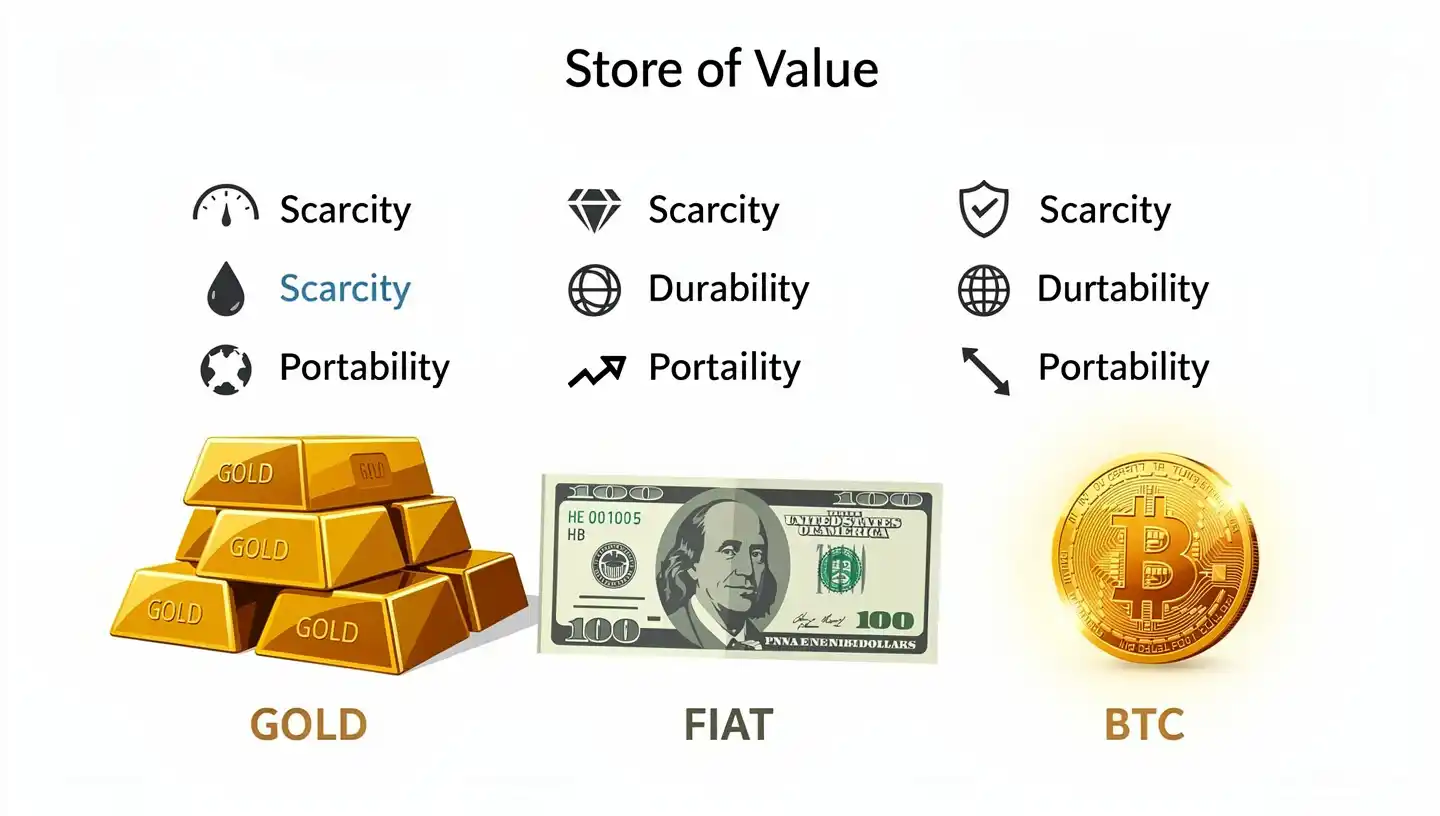
A store of value is an asset that holds its purchasing power over time. Three properties are generally required for something to function reliably in this role.
Scarcity. If an asset can be produced in unlimited quantities, it cannot preserve value. The ability to print more of something dilutes the value of what already exists. This is the fundamental problem with fiat currencies managed by governments with printing presses.
Durability. The asset must not physically degrade or technically expire. Gold does not rust or decay. Bitcoin’s protocol is maintained by a global network and does not deteriorate with time.
Portability. A store of value must be transferable without losing value in the process. Gold fails here relative to other options because physical transfer is costly and complex. Bitcoin transfers globally in minutes without any physical logistics.
Both gold and Bitcoin satisfy all three requirements, but they do so through completely different mechanisms, and those differences shape which asset works better in which situation.
How Bitcoin and gold are created
Both assets enter circulation through a process called mining, but the two processes have almost nothing in common beyond the name.
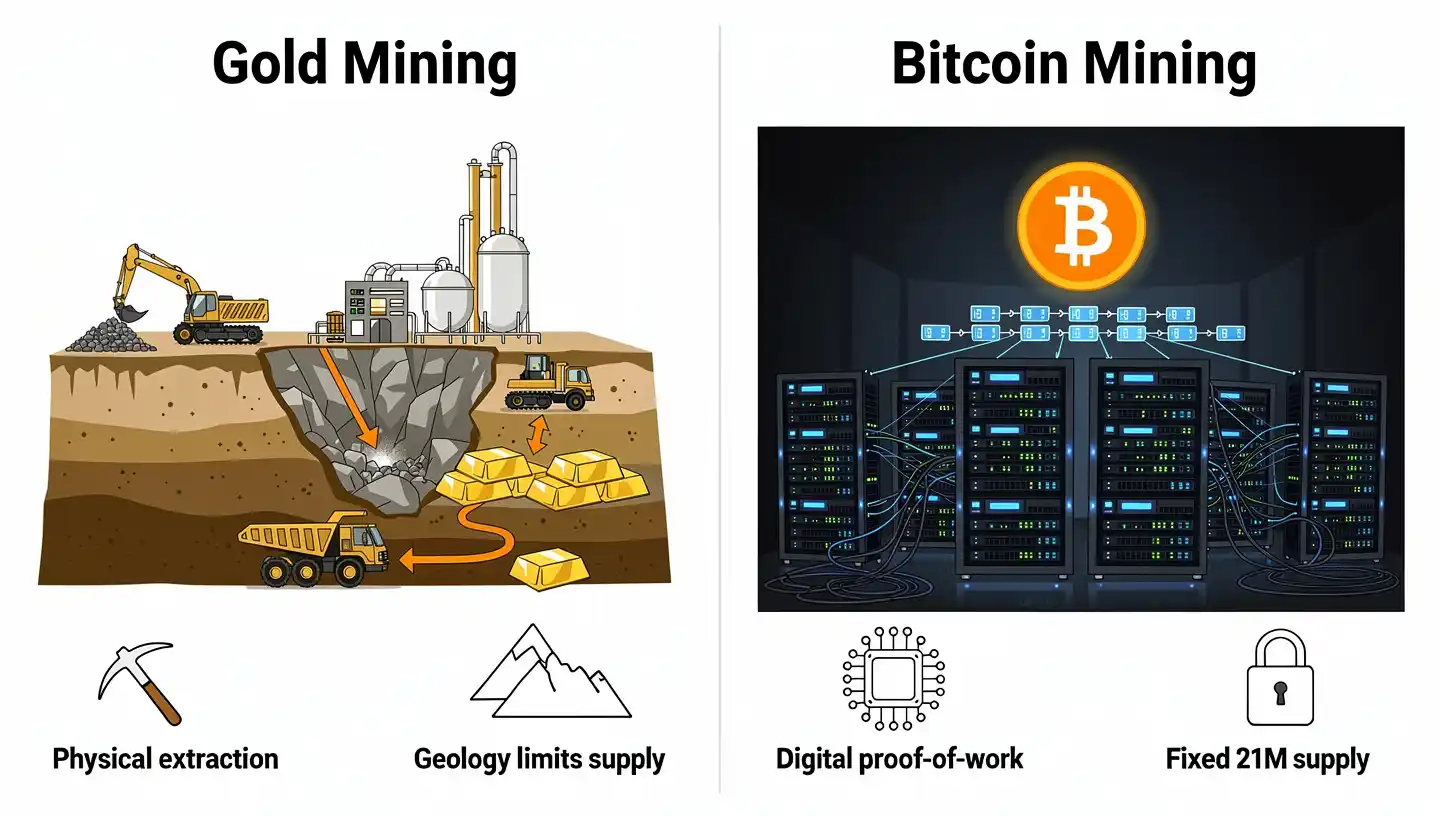
Gold is extracted from the earth through physical mining. Ore-bearing rock is found, extracted, crushed, and processed through chemical treatment to separate the gold. The process requires heavy equipment, significant amounts of water and energy, and is ultimately constrained by geology. New gold cannot be manufactured. It can only be found and extracted from deposits that already exist underground. The frequency of significant new gold discoveries has fallen steadily since the 1990s.
Bitcoin is created through a digital process called proof-of-work mining. Specialized computers called ASICs compete to solve a cryptographic puzzle. The miner who solves it first earns the right to add the next block of transactions to the blockchain and receives a reward in newly minted Bitcoin. This reward is currently 3.125 BTC per block following the April 2024 halving. The process has no geographical constraint: a miner in Iceland and a miner in Texas are competing on equal terms. But unlike gold, the total amount of Bitcoin that can ever exist is mathematically fixed in the protocol.
For a deeper explanation of how Bitcoin’s proof-of-work consensus mechanism works, see our guide on proof of work vs proof of stake.
How does the scarcity of Bitcoin and gold compare?
Scarcity is the central property that gives both assets their monetary appeal. The mechanisms through which each achieves scarcity are fundamentally different.
Gold supply and inflation rate
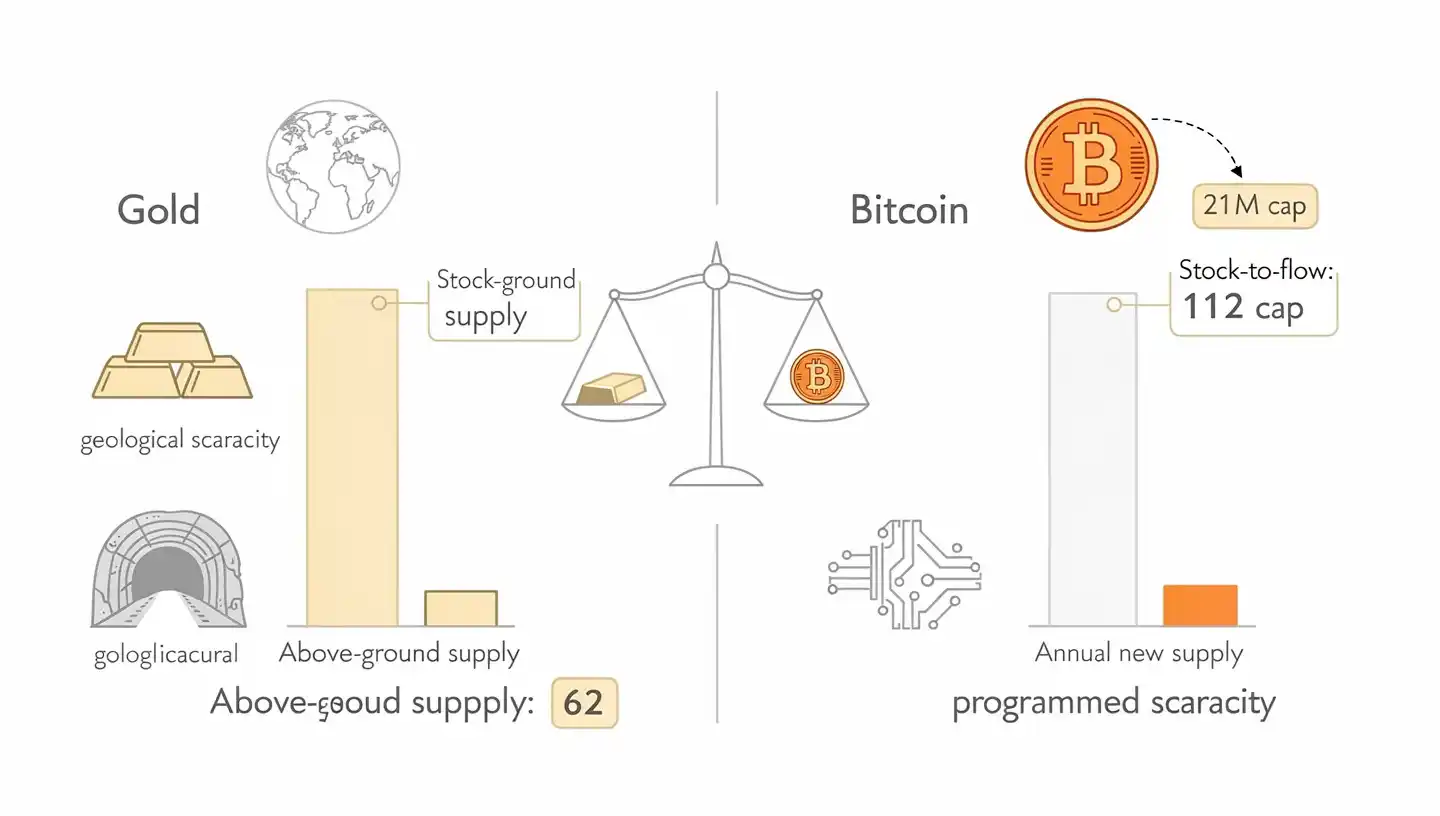
Gold’s scarcity is geological and economic. The above-ground supply currently stands at approximately 220,000 tonnes. Annual production runs between roughly 3,600 and 3,700 tonnes, translating to an annual supply inflation rate of approximately 1.6% to 3%. An estimated 50,000 to 64,000 tonnes of gold remain unmined, though the exact figure is uncertain.
Several structural factors keep gold’s supply growth rate low: declining frequency of new significant deposit discoveries, a production plateau as annual output has leveled off at around 3,600-3,700 tonnes for years, and the high cost of extracting and refining gold ore. The gold stock-to-flow ratio stands at approximately 62, meaning it would take 62 years of current production to double the existing above-ground supply.
Gold’s scarcity is not absolute. A large new deposit discovery or a technological leap in extraction could alter supply dynamics. It has not happened, but it is possible.
Bitcoin’s hard cap and halving mechanism
Bitcoin’s scarcity is programmatic and absolute. The protocol enforces a hard cap of exactly 21 million coins. This limit is embedded in the underlying code and cannot be changed without the consensus of the entire Bitcoin network. As of 2026, approximately 20 million of those 21 million coins have already been mined. The remaining 1 million will be released gradually through the mining reward schedule, with the last Bitcoin expected to be mined around 2140.
Following the April 2024 halving, Bitcoin’s annual supply inflation rate dropped from approximately 1.8% to around 0.8%. That is lower than gold’s supply growth rate. Bitcoin’s stock-to-flow ratio stands at approximately 112 post-2024 halving, making it theoretically scarcer than gold by this measure.
The actual circulating supply is reduced further by permanently lost coins. Wallets whose private keys are lost, intentionally destroyed coins, and inaccessible storage devices have removed an estimated 3 to 4 million Bitcoin from circulation permanently. This supply is gone for good.
| Year | Block reward |
|---|---|
| 2009 (launch) | 50 BTC |
| 2012 | 25 BTC |
| 2016 | 12.5 BTC |
| 2020 | 6.25 BTC |
| 2024 (most recent) | 3.125 BTC |
| ~2028 (next) | 1.5625 BTC |
| ~2140 (final) | 0 BTC |
For a full explanation of how the halving affects Bitcoin’s supply and historically its price, see our guide on what is the Bitcoin halving.
Bitcoin vs gold: performance and market data
The two assets have performed very differently across different time periods. The numbers tell a story that changes significantly depending on which window you examine.
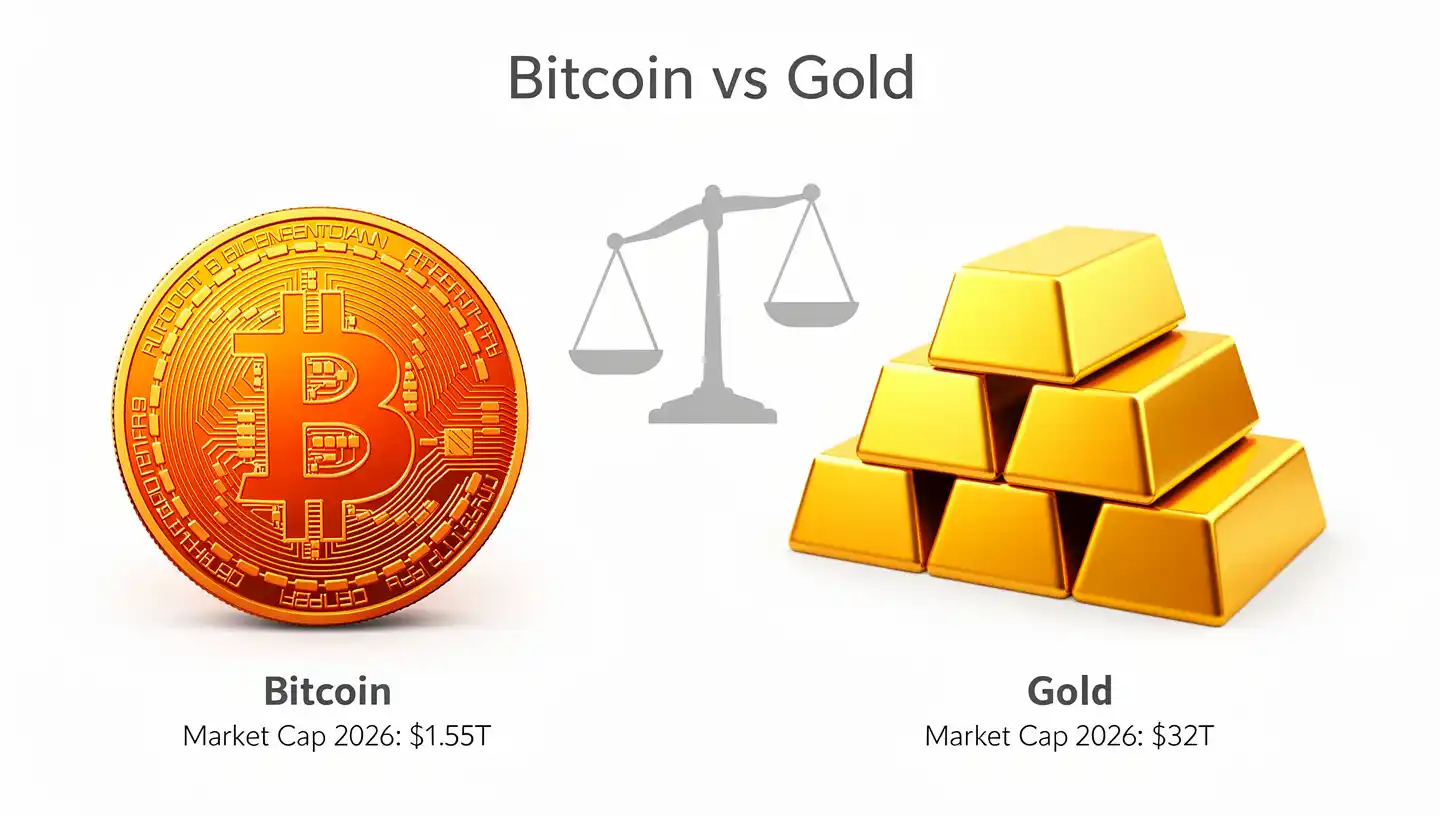
Market capitalization (2026):
- Gold: approximately $32 trillion, a mature, deep, globally established market
- Bitcoin: approximately $1.55 trillion, roughly 4.8% of gold’s total market size
| Time period | Bitcoin return | Gold return |
|---|---|---|
| 10-year (2015-2025) | ~16,350% to 22,890% | ~272% to 335% |
| 5-year (2021-2026) | ~42% | ~149% |
| 2025 full year | -20% YTD (April 2026) | +80% YTD |
The returns table reveals something important: the winner changes dramatically depending on the time window. Bitcoin has obliterated gold over 10 years. Gold has significantly outperformed Bitcoin over 5 years. And in the current 2025-2026 cycle, gold leads by a wide margin while Bitcoin sits well below its October 2025 all-time high of approximately $126,000.
On a risk-adjusted basis, Bitcoin has historically had a Sharpe Ratio of approximately 0.70 to 0.78, compared to gold’s 0.60 to 0.61. A higher Sharpe Ratio indicates better return per unit of risk, though this comparison omits the full emotional weight of Bitcoin’s drawdowns, which past performance numbers cannot capture.
Bitcoin vs gold: volatility comparison
Volatility is where the two assets diverge most sharply. This difference shapes whether each asset is suitable for a given investor or purpose.
Bitcoin’s annualized volatility in 2025 was approximately 50 to 54%. Gold’s was approximately 15%. Bitcoin is roughly four times more volatile than gold on an annual basis. In practice, this means Bitcoin regularly experiences 20% price moves within weeks, and has historically fallen 60 to 74% from peak to trough during bear markets.
Gold’s price changes are typically slower and smaller. During the same periods when Bitcoin has fallen 60% or more, gold has generally held its value or declined modestly. When major economic stresses occur, gold has historically provided either positive returns or limited losses.
The current cycle provides a concrete recent example. Gold hit a record high of $5,589 per ounce on January 28, 2026, driven by geopolitical tensions, the US-Iran conflict that pushed oil above $100 per barrel, and a 2026 inflation forecast of 2.7%. Bitcoin, meanwhile, was down approximately 20% year-to-date by April 2026 after peaking near $126,000 in October 2025. Gold was up roughly 80% from the start of 2025. Same macro environment, opposite reactions.
For more context on how Bitcoin’s all-time highs and subsequent corrections fit into its historical cycle, see our guide on ATH meaning in crypto.
Bitcoin vs gold: inflation hedge
Both assets are described as inflation hedges. The empirical record gives a more complicated answer than the theory suggests.
Gold as an inflation hedge has a multi-century track record. It tends to rise when real interest rates fall, when currency purchasing power erodes, and when governments spend beyond their means. The correlation is imperfect but consistent over long periods. In 2025 and 2026, with inflation running above central bank targets and geopolitical disruption driving oil prices higher, gold rose 80% in roughly 14 months. This is gold doing exactly what inflation hedge proponents claim it does.
The relationship with central bank policy is particularly clear: when the Federal Reserve cut rates in late 2024, gold responded positively. When real yields fall, holding a non-yielding asset like gold becomes relatively more attractive compared to bonds.
Bitcoin as an inflation hedge has a compelling theoretical case. A mathematically fixed supply that no government can expand should protect purchasing power over time. The long-term data supports this view: Bitcoin has dramatically outpaced inflation over 10 years. But the short-term empirical record is inconsistent. When the Federal Reserve raised interest rates aggressively in 2022, Bitcoin fell 64% alongside equities. When inflation was rising in 2021 and 2022, Bitcoin and stocks fell together. In the current cycle, Bitcoin is down 20% in an inflationary environment while gold rises.
The most accurate summary: Bitcoin has proven to be exceptional at protecting purchasing power in emerging markets where local fiat currencies are collapsing, but it has repeatedly failed to act as a short-term safe haven during sudden market panic in developed markets. Over time horizons of 10 years or more, its inflation protection is strong. Over shorter periods, it behaves more like a risk asset correlated with equities than a defensive inflation hedge.
For more on how fiat currency inflation mechanics work and why scarcity matters for monetary value, see our guide on what is fiat currency.
Bitcoin vs gold during crises: what BlackRock found
In September 2025, investment firm BlackRock published a report titled “Bitcoin: A Unique Diversifier.” The research, available through BlackRock’s investment insights, analyzed the performance of Bitcoin versus gold across six distinct economic, political, and geopolitical crises between 2020 and 2025. The findings challenge the simple narrative that gold always wins during turmoil.
What BlackRock found: Bitcoin underperforms gold during the first 10 days of a crisis almost without exception. Initial panic sends money into established safe havens: gold, US Treasuries, and the Japanese yen. Bitcoin, which trades like a risk asset in the short term, falls with equities.
But over a 60-day period following a crisis, Bitcoin almost always outperforms gold. Once the initial panic subsides and investors begin pricing in longer-term monetary consequences, including currency debasement, government debt expansion, and loss of institutional trust, Bitcoin’s fixed supply becomes its advantage.
The April 2025 global tariff announcement illustrates this pattern. Bitcoin fell sharply in the first days of the tariff shock alongside equities. Over the following weeks and months, it recovered significantly and outperformed gold in the subsequent 60-day window.
The May 2026 Middle East tensions offer another data point. Despite ongoing geopolitical upheaval that had been driving gold higher for months, money began flowing into Bitcoin rather than gold during that particular episode. BlackRock’s research helps explain why: the crisis had run long enough that investors were looking beyond short-term safety into longer-term monetary implications.
This does not make Bitcoin a reliable short-term safe haven. It makes it a different kind of asset, one that responds to different signals on different timeframes than gold does.
Bitcoin vs gold: safe haven behavior in 2026
The current market environment puts the Bitcoin vs gold debate in sharp relief. The macro conditions of 2025 and early 2026 represent exactly the kind of environment where gold traditionally thrives: geopolitical conflict, inflation above target, central bank reserve diversification, and currency uncertainty.
Gold’s 2026 position: Record all-time high of $5,589 per ounce on January 28, 2026. Up approximately 80% since the start of 2025. Central banks purchasing an average of 585 tonnes per quarter in 2026 as they diversify reserve holdings away from the US dollar. Gold in 2026 is functioning exactly as its proponents have always argued it would in this type of environment.
Bitcoin’s 2026 position: After reaching an all-time high near $126,000 in October 2025, Bitcoin has declined approximately 20% year-to-date by April 2026. The US-Iran conflict, oil above $100, and an inflation forecast of 2.7% have pushed investors toward established safe havens rather than a 17-year-old digital asset with high volatility. In this specific 12-month cycle, Bitcoin has not served as a safe haven.
The honest interpretation is that both outcomes are consistent with each asset’s known characteristics. Gold is doing what gold does in geopolitical and inflationary crises. Bitcoin is doing what Bitcoin does in short-term risk-off environments: falling with equities. The BlackRock research suggests the longer the crisis runs, the more likely Bitcoin is to recover and eventually outperform gold. Whether that plays out in the current cycle remains to be seen.
Bitcoin vs gold: portability and ownership
Portability and the nature of ownership are among the most practically significant differences between the two assets.
Gold’s portability problem: Moving physical gold across borders requires declarations, insurance, specialist logistics, and significant cost. Storing substantial gold wealth privately requires vaults and insurance, or reliance on institutional custodians. Gold ETFs solve the storage problem but introduce counterparty risk: you hold a claim on gold rather than gold itself, which is a meaningful distinction in a severe financial crisis.
Historically, government seizure of gold has been a real event, not a hypothetical. The US Executive Order 6102 of 1933 required American citizens to surrender their private gold holdings to the Federal Reserve in exchange for paper currency at a fixed exchange rate. Those who did not comply faced criminal penalties. Gold held in institutional custody was particularly vulnerable. Private gold buried or stored without institutional knowledge was harder to reach.
Bitcoin’s portability advantage: Any amount of Bitcoin can be transferred globally in minutes without border declarations, without intermediaries, and without physical logistics. A hardware wallet containing thousands of dollars of Bitcoin weighs less than a smartphone. Bitcoin can cross any border without declaration. It cannot be stopped at customs.
Bitcoin held in self-custody, where you control your own private keys, cannot be seized by any government without access to those keys. “Not your keys, not your coins” captures the full ownership picture: if another entity holds the keys, they hold the Bitcoin. If you hold the keys in cold storage, full ownership rests with you. For more on how private keys work and why controlling them matters, see our guide on private key crypto.
How to store each asset
Storing gold
Physical gold storage involves a choice between convenience, cost, and counterparty risk. Home storage eliminates intermediary risk but creates exposure to theft, fire, and flood, and requires a quality safe. Professional vault storage through a bank or specialist firm is more secure but carries recurring fees of typically 0.1% to 0.4% annually and creates an institutional relationship that history shows can be a vulnerability. Gold ETFs (such as GLD or IAU) remove the storage problem entirely but replace gold ownership with a financial claim: suitable for most purposes, but not equivalent to holding physical metal in a genuine financial emergency.
For investors who believe gold’s value lies partly in its independence from the financial system, gold ETFs undermine that property. The only way to fully own gold outside the financial system is to hold it physically, which reintroduces all the storage and logistics challenges.
Storing Bitcoin
Bitcoin storage options follow the same tradeoff: convenience versus control. Exchange custody (Coinbase, Kraken, Binance) is simple but the exchange holds your private keys. The history of exchange failures, including Mt. Gox in 2014, Bitfinex in 2016, and FTX in 2022, shows exactly what happens when that relationship breaks down. Software wallets on phones or computers give you direct key control but remain connected to the internet, which creates exposure to malware and phishing attacks.
Hardware wallets (Ledger, Trezor) generate and store private keys in a secure offline chip. Transactions are signed directly on the device, meaning the keys never touch an internet-connected environment. A hardware wallet and a 24-word recovery phrase stored separately give you complete, institution-free ownership of your Bitcoin with no ongoing fees and no counterparty exposure.
For context on the Bitcoin halving schedule and how miner rewards affect Bitcoin’s supply mechanics, see our guide on what is Bitcoin mining.
Bitcoin vs gold: environmental impact
Both assets carry a significant environmental cost. The nature of that cost differs between them.
| Metric | Gold | Bitcoin |
|---|---|---|
| Annual energy consumption | ~132 TWh | ~204 TWh |
| CO2 per unit mined | ~31 tonnes per BTC equivalent | ~691 tonnes per Bitcoin |
| Physical land destruction | Significant (open-pit mines, tailings) | None (data centers) |
| Toxic pollution | Cyanide and mercury leaching | None |
| Water use | Thousands of litres per ounce | Minimal |
Bitcoin uses more electricity than gold mining annually. Its per-unit carbon footprint also exceeds gold’s in direct comparison. But Bitcoin’s energy impact is concentrated in electricity consumption and does not involve physical land destruction, deforestation, cyanide leaching into waterways, or mercury contamination of communities near mine sites, all of which are documented consequences of gold mining operations, particularly in less-regulated regions.
An estimated 50 to 60% of Bitcoin mining now uses renewable energy sources, according to 2025 industry estimates. Gold mining’s environmental controls vary enormously by jurisdiction, with some of the most damaging operations occurring in regions where enforcement is minimal.
Bitcoin vs gold: seizure and censorship resistance
The ability to hold wealth that cannot be confiscated or blocked by governments is a property that neither gold nor Bitcoin fully guarantees, but Bitcoin offers significantly stronger protections under specific conditions.
Gold’s historical vulnerability: Executive Order 6102 of 1933 is the clearest historical example. The US government required citizens to surrender private gold at $20.67 per troy ounce. Those who complied were later disadvantaged when Roosevelt raised the price to $35 per ounce, effectively transferring wealth from gold holders to the government. Institutionally-held gold was straightforwardly accessible to authorities. Private gold required more effort but was ultimately traceable in many cases.
Gold held through ETFs or custodians today carries similar legal vulnerability. Any court order can freeze or seize assets held by a regulated financial institution.
Bitcoin’s resistance in self-custody: Bitcoin held in cold storage, with private keys known only to the owner, cannot be seized without access to those keys. The Bitcoin network itself has no central authority that can be ordered to block or reverse a transaction. On-ramps and off-ramps (exchanges, payment processors) can be regulated and shut down, but the underlying network continues to operate regardless.
This property has genuine value for specific use cases: individuals in countries with unstable governments, investors concerned about asset freezing in legal disputes, or people transferring wealth across borders where capital controls apply. It has no practical value for investors who hold Bitcoin through ETFs or exchanges, where regulatory reach is the same as any other financial institution.
For more on how Bitcoin’s decentralized network operates and why it resists central control, see our guide on how Bitcoin works.
Bitcoin vs gold: the full comparison
| Property | Gold | Bitcoin |
|---|---|---|
| Maximum supply | No hard limit; ~220,000 tonnes above ground | 21 million BTC; ~20M already mined |
| Annual supply inflation | ~1.6-3% per year | ~0.8% post-2024, approaching 0% by 2140 |
| Volatility | Low (~15% annualized) | Very high (~50-54% annualized) |
| Inflation hedge reliability | Historically consistent short-term | Strong long-term, unreliable short-term |
| Track record | 5,000+ years of monetary use | ~17 years |
| Portability | Requires logistics, customs, insurance | Transfers globally in minutes, no declaration |
| Self-custody | Possible but costly (vault, insurance) | Complete via hardware wallet, no ongoing cost |
| Seizure resistance | Low (especially if institutionally held) | High (in self-custody cold storage) |
| Divisibility | Limited (cutting changes the form) | To 8 decimal places (1 sat = 0.00000001 BTC) |
| Verifiability | Requires physical testing; counterfeits exist | Cryptographically verifiable by anyone |
| Censorship resistance | Low (subject to capital controls) | High at network level; low on exchanges |
| Energy use | ~132 TWh annually | ~204 TWh annually |
| Market capitalization | ~$32 trillion | ~$1.55 trillion |
| Crisis behavior | Reliable short-term safe haven | Underperforms first 10 days; often outperforms at 60 days |
Who holds Bitcoin and who holds gold?
Understanding who holds each asset reveals something important about the nature of demand and what drives price in each market.
Gold holders: Central banks are the largest institutional holders, averaging approximately 585 tonnes of purchases per quarter in 2026 as they diversify reserves away from the US dollar, according to World Gold Council demand data. Jewelry accounts for more than 50% of annual gold demand, particularly in India and China where gold has deep cultural significance as a form of stored wealth. Institutional investors, including pension funds, endowments, and hedge funds, hold gold through ETFs and allocated accounts. Retail investors hold coins, bars, and jewelry.
Bitcoin holders: Institutional adoption has accelerated dramatically since spot Bitcoin ETF approval in January 2024. BlackRock’s IBIT reached $50 billion in assets under management faster than any ETF in history. MicroStrategy holds over 500,000 Bitcoin as a corporate treasury asset. The US government announced a strategic Bitcoin reserve in 2025. El Salvador’s central bank holds Bitcoin. Retail investors globally, with an estimated 50 million or more wallets holding meaningful balances, represent a diffuse but substantial ownership base. A relatively small number of large addresses, sometimes called “whales,” hold a significant portion of the circulating supply.
The key difference: central banks actively accumulate gold as reserve assets. Government and institutional adoption of Bitcoin, while growing, is newer and more variable across jurisdictions. The trajectory for both groups is toward greater Bitcoin exposure, but gold’s institutional base remains far more established.
For more on how Bitcoin dominance and market capitalization reflect its position relative to other digital assets, see our guide on Bitcoin dominance.
Which is right for different investor types?
Long-term wealth preservation investors
For investors whose primary goal is preserving wealth across decades with minimal volatility, gold is the more reliable option. Its 5,000-year track record as a monetary asset, lower volatility, and established regulatory status across all major markets make it the safer choice for capital preservation. Bitcoin’s long-term case is strong, but a 17-year history with multiple 60-74% drawdowns is not equivalent to millennia of crisis performance.
Growth-seeking investors
For investors who accept high volatility in exchange for higher return potential, Bitcoin’s historical record is unmatched. A 10-year return of 16,000 to 22,000 percent against gold’s 272 to 335 percent makes the comparison stark. The risk is equally stark: four distinct bear markets with drawdowns of 57%, 74%, 64%, and an ongoing one, and that risk must be genuinely accepted, not just intellectually acknowledged.
Risk-averse investors
Gold is the appropriate choice. Bitcoin’s 50-54% annualized volatility makes it unsuitable for investors who cannot tolerate watching a position fall 40-60% and staying the course. Gold’s 15% annualized volatility is far more manageable for investors with limited risk tolerance or short time horizons.
Investors in emerging markets
Bitcoin has demonstrated a specific advantage that gold cannot match: protection against local fiat currency collapse. In Argentina, Turkey, Nigeria, and other countries with histories of devaluation or currency controls, Bitcoin adoption has grown precisely because it provides access to a fixed-supply asset outside the local banking system. Gold is difficult to access, store, and transact in these environments. Bitcoin requires only a smartphone and internet access.
Can you hold both?
Yes, and an increasing number of serious investors do. Gold provides a stable, historically proven anchor for wealth preservation with low correlation to equities. Bitcoin provides a smaller, asymmetric position with higher return potential and exposure to digital asset adoption. A portfolio allocation of 5-10% in gold plus 1-3% in Bitcoin, combined with diversified equities and bonds, represents how many institutional and sophisticated retail investors are currently positioning. The two assets have low correlation with each other in normal market conditions, not zero but meaningfully lower than either has with equities, which improves overall portfolio risk-adjusted returns.
For a complete guide to cryptocurrency as an asset class and how to approach it as a beginner, see our crypto for beginners guide.
Frequently asked questions
Is Bitcoin really digital gold?
Bitcoin shares some key properties with gold: scarcity, decentralization, and independence from government monetary policy. But the comparison breaks down in several ways. Gold has 5,000 years of monetary history; Bitcoin has 17. Gold’s volatility is 15% annualized; Bitcoin’s is 50-54%. Gold reliably acts as a short-term safe haven; Bitcoin does not. The “digital gold” framing captures something real about Bitcoin’s supply mechanics and monetary philosophy, but it does not mean the two assets behave the same way or serve the same function in a portfolio.
What did BlackRock say about Bitcoin vs gold?
In September 2025, BlackRock published “Bitcoin: A Unique Diversifier,” which analyzed the performance of both assets across six crises between 2020 and 2025. The key finding: Bitcoin consistently underperforms gold in the first 10 days of a crisis, when initial panic drives money into established safe havens. Over a 60-day crisis window, Bitcoin almost always outperforms gold. BlackRock concluded that Bitcoin behaves as a genuine portfolio diversifier rather than simply a substitute for gold.
Can Bitcoin replace gold?
Not in the near term. Gold’s $32 trillion market, central bank reserve role, 5,000-year track record, and universal recognition give it an institutional weight that a 17-year-old digital asset has not yet approached. Bitcoin could eventually capture a meaningful share of gold’s monetary role if institutional adoption continues, but replacing gold implies matching its depth and stability, which would require Bitcoin to become far less volatile than it currently is.
Which has better long-term returns: Bitcoin or gold?
Over 10 years, Bitcoin by a wide margin: approximately 16,000-22,000% versus 272-335% for gold. Over 5 years, gold has outperformed: approximately 149% versus 42%. In the 2025-2026 window, gold is up 80% while Bitcoin is down 20%. The answer depends entirely on the time period measured, which is why framing the question as “which is better” without specifying a timeframe is misleading.
Can the government confiscate Bitcoin like it did gold in 1933?
Gold held in institutional custody, through banks, ETFs, or financial intermediaries, is legally accessible to governments through court orders, the same as any financial account. Bitcoin held in self-custody, where only you know the private keys, cannot be seized without access to those keys. The 1933 Executive Order 6102 worked because gold was physical and institutional. Self-custodied Bitcoin does not share that vulnerability, though Bitcoin held on exchanges or through ETFs has no more legal protection than any other regulated financial asset.
What are gold-backed stablecoins and how do they compare?
Gold-backed stablecoins like PAX Gold (PAXG) and Tether Gold (XAUT) are cryptocurrency tokens where each coin represents ownership of one troy ounce of physical gold held in a vault. As of May 2026, these combined have a market capitalization of approximately $5 billion. They attempt to combine gold’s stable value with Bitcoin’s portability and blockchain transferability. They solve gold’s portability problem but introduce the same counterparty risk as any custodial arrangement: you hold a claim on gold, not gold itself. They do not offer Bitcoin’s programmatic scarcity or censorship resistance.
Which is a better inflation hedge in 2026?
In the specific 2025-2026 macro environment, with geopolitical conflict, oil above $100, US-Iran tensions, and a 2.7% inflation forecast, gold has been the superior inflation hedge. It is up 80% while Bitcoin is down 20%. Over longer periods of 10 years or more, Bitcoin’s fixed supply has historically provided greater protection against fiat currency debasement than gold. The right answer depends on your time horizon: gold for the next one to three years in the current environment, Bitcoin for the next decade if you believe in its continued adoption.
Is Bitcoin correlated with gold?
Bitcoin and gold have relatively low correlation in normal market conditions. During periods of market stress, their correlation with equities tends to increase; both have fallen during sharp equity selloffs, though Bitcoin falls much more sharply. Bitcoin and gold do not consistently move together. Gold’s performance is driven by real interest rates, geopolitical risk, and central bank buying, while Bitcoin’s is driven by risk appetite, adoption trends, and its own supply dynamics. The two assets respond to different signals more often than not, which is part of what makes holding both potentially useful from a diversification standpoint.