Bitcoin halving dates mark some of the most closely watched moments in the entire crypto market. Every four years or so, the Bitcoin network cuts the reward miners receive for confirming new blocks in half, slowing down the pace at which fresh coins enter circulation. Four halvings have already taken place, in 2012, 2016, 2020, and 2024, and a fifth one is expected sometime in 2028. This guide walks through every past Bitcoin halving date, explains how the mechanism actually works, and looks at what tends to happen to price and mining activity once the reward gets cut.
What Is Bitcoin Halving?
Bitcoin halving is a built-in rule inside Bitcoin’s code that cuts the block reward paid to miners by fifty percent. It happens automatically once every 210,000 blocks, which works out to roughly four years given the average ten minute block time. The reward started at 50 BTC per block back in 2009 and now sits at 3.125 BTC following the fourth halving in 2024.

The rule was written into Bitcoin from the very start by its creator, and it exists for one main reason: to keep new supply predictable and shrinking over time, the same way a finite resource would behave. If you’re still getting familiar with the basics, our guide on what Bitcoin actually is covers the fundamentals before diving into halving specifics.
When Is the Next Bitcoin Halving?
The fifth Bitcoin halving is expected to land sometime around March or April 2028, once the network reaches block height 1,050,000. As with every previous halving, the exact day shifts slightly depending on how fast blocks get mined, since a faster network pushes the date earlier and a slower one pushes it back. You can track real time progress toward that block height on a live explorer such as mempool.space.
When it happens, the block reward will drop again, from 3.125 BTC down to 1.5625 BTC. That means roughly 225 new bitcoins will enter circulation each day instead of 450, cutting the daily supply growth in half once more.
Bitcoin Halving Dates: Full History
Bitcoin has gone through four halvings since the network launched in January 2009, and a fifth one is on the way.
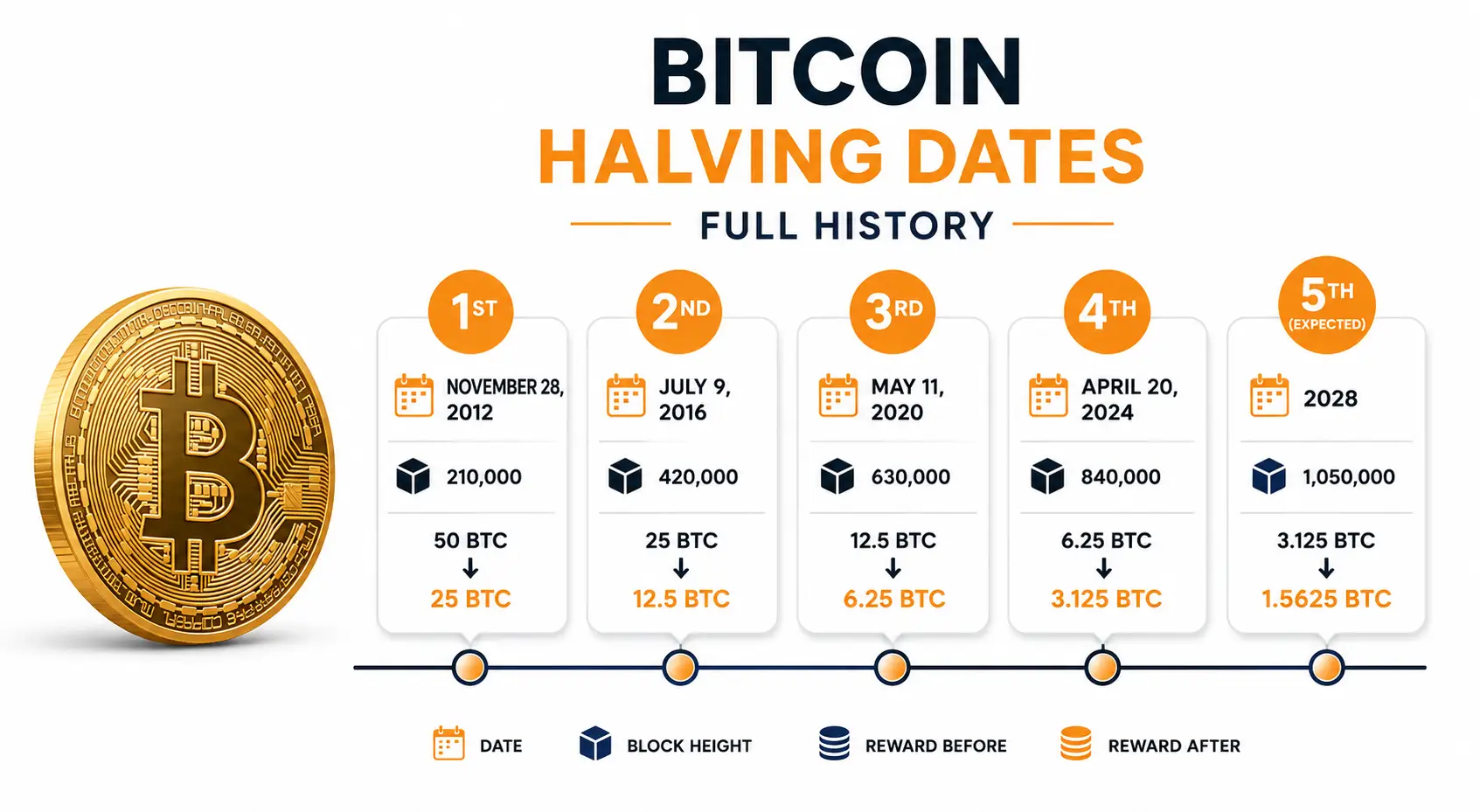
The table below lists every confirmed halving date along with the block height and reward change.
| Halving | Date | Block Height | Reward Before | Reward After |
|---|---|---|---|---|
| 1st | November 28, 2012 | 210,000 | 50 BTC | 25 BTC |
| 2nd | July 9, 2016 | 420,000 | 25 BTC | 12.5 BTC |
| 3rd | May 11, 2020 | 630,000 | 12.5 BTC | 6.25 BTC |
| 4th | April 20, 2024 | 840,000 | 6.25 BTC | 3.125 BTC |
| 5th (expected) | 2028 | 1,050,000 | 3.125 BTC | 1.5625 BTC |
The first halving barely moved the market at the time, since Bitcoin was still trading under $13 and almost nobody outside a small group of early adopters had heard of it. Price action picked up well after the event rather than right on the date itself, a pattern that repeated with the second and third halvings too. The person behind that original code is still anonymous to this day, and our piece on who created Bitcoin goes into that story in more depth.
By the third halving in 2020, Bitcoin had already survived a handful of boom and bust cycles, including the so called crypto winter that followed the 2017 run up. Mining difficulty also climbed sharply across these years as more powerful hardware entered the network, squeezing out smaller operations that couldn’t keep up. The fourth halving in 2024 stood out because it happened after Bitcoin had already touched a fresh all time high rather than before one, which broke the usual script that earlier halvings had followed. For a fuller timeline of everything that happened between these dates, check our Bitcoin history overview.
How Does Bitcoin Halving Work?
Every transaction on the Bitcoin network gets bundled into blocks, and miners compete using computing power to solve a math puzzle that lets them add the next block to the chain. Whoever solves it first gets to claim the block reward, plus any transaction fees attached to that block. This entire setup is called proof of work, and it’s the security model that keeps the network honest without needing a central authority, since no single party controls which transactions get approved.
Once exactly 210,000 blocks have been mined, the code automatically cuts that reward in half, no matter what the price of Bitcoin is doing or how much hash power sits on the network at the time. There’s no committee voting on it and no way to delay it, which is part of why people trust the schedule enough to plan around it years ahead. Newer blockchains often use a different method to validate transactions altogether, and our comparison of proof of work and proof of stake walks through how those two approaches differ.
Why Does Bitcoin Halving Matter?
The whole point of cutting the reward is to keep new supply shrinking on a fixed schedule, similar to how gold becomes harder and more costly to dig out of the ground the longer mining continues. Bitcoin’s total supply is capped at 21 million coins, and halving is the mechanism that makes sure new coins trickle out slower and slower until that cap is reached.
This matters for anyone trying to understand Bitcoin’s value proposition, since a capped, shrinking supply behaves very differently from currencies that central banks can print more of whenever they choose. If you want to see how this scarcity gets reflected in real numbers, our explainer on market cap in crypto shows how supply and price come together to form that figure.
How Does Bitcoin Halving Affect the Price?
Every previous halving has been followed by a period of price growth, though rarely right away. Bitcoin traded around $12 before the first halving and climbed past $1,000 within about a year. Before the second halving it sat near $650, and roughly twelve months later it was approaching $20,000. The third halving saw Bitcoin go from about $8,500 to a peak near $69,000 over the following year and a half. Historical price data for these milestones is publicly available through tools like CoinGecko’s historical data page.
The fourth halving broke that pattern somewhat, since Bitcoin had already hit a record high before the event rather than after it, partly thanks to the launch of spot Bitcoin ETFs earlier that year. Anyone studying these cycles closely should also look at how often Bitcoin sets fresh highs relative to its old ones. Our piece on what ATH means in crypto explains how that term gets used when tracking price records like these.
None of this means price gains are guaranteed going forward. Halving reduces new supply, but demand still depends on a long list of factors outside Bitcoin’s code, including interest rates, regulation, and how much capital flows into the asset from institutions and retail buyers alike.
How Does Halving Affect Bitcoin Miners?
Miners feel the impact of halving more directly than almost anyone else in the space. Overnight, their revenue per block drops by fifty percent, while their electricity bills and hardware costs stay exactly the same. Operations running on thin margins before the halving often become unprofitable right after it, which pushes some miners offline.
This usually shows up as a temporary dip in network hash rate following each halving, before it recovers as inefficient machines get replaced or relocated to cheaper power sources. Larger mining companies with access to lower energy costs tend to weather these transitions better than smaller, independent operators. Over time, as block rewards keep shrinking with each cycle, transaction fees are expected to make up a bigger share of what keeps miners running the network.
Impact on the Wider Cryptocurrency Market
Bitcoin halving events tend to pull attention toward the entire crypto market, not just Bitcoin itself. Media coverage spikes, new buyers show up out of curiosity, and that interest often spreads into other coins as people start exploring what else is out there. Bitcoin’s share of the total crypto market, often tracked as Bitcoin dominance, tends to shift noticeably in the months surrounding a halving as money moves between Bitcoin and smaller projects depending on where investors expect the bigger gains.
Whether that rotation continues this cycle is something only time will tell, but the pattern has held up across every halving so far.
When Will All 21 Million Bitcoin Be Mined?
Based on the current halving schedule, the very last new Bitcoin is expected to be mined around the year 2140. By that point the block reward will have been cut so many times that it rounds down to nothing, since Bitcoin can’t be divided below one satoshi, which is one hundred millionth of a single coin.
Once that happens, miners will rely entirely on transaction fees rather than new coin rewards to stay profitable. Some industry watchers expect this to push the network toward higher transaction volume and more competitive fee markets, though that’s still more than a century away, so plenty could change in how Bitcoin gets used by then.
Bitcoin Halving FAQ
What Does Bitcoin Halving Mean?
Bitcoin halving is an automatic rule in Bitcoin’s code that cuts the block reward paid to miners in half. It happens once every 210,000 blocks, or roughly every four years, and is one of the main reasons Bitcoin’s supply grows slower over time.
When Is the Next Bitcoin Halving Expected?
The next Bitcoin halving is expected around March or April 2028, once the network reaches block height 1,050,000. The exact date depends on how quickly blocks get mined between now and then.
How Often Does Bitcoin Halving Happen?
Halving happens every 210,000 blocks. Since a new block gets mined roughly every ten minutes, that works out to close to four years between each halving event.
Does Bitcoin’s Price Always Go Up After a Halving?
Price has risen in the months and years following each of the four halvings so far, but nothing guarantees that pattern continues. Demand, regulation, and broader market conditions all play a role alongside the supply cut itself.
How Many Bitcoin Halvings Are Left?
There will be 32 halvings in total before block rewards round down to zero. Four have already happened, so there are 28 more to go before the final one expected around 2140.