Picture a vending machine. You put in a dollar, press the button for a soda, and the machine delivers your drink and your change. No cashier, no manager, no one to trust. The machine just runs the program it was given. If your selection is sold out, it returns your money. If you do not pay enough, nothing happens. This is the simplest example of what a smart contract does, and the analogy was proposed by the computer scientist Nick Szabo in the 1990s, decades before the technology existed to build one on a public network. A smart contract is a self-executing program stored on a blockchain that runs automatically when predetermined conditions are met, without any intermediary verifying or enforcing the outcome. You do not need a bank to release the funds. You do not need a lawyer to confirm the terms were met. You do not need to trust the other party. You only need to trust the code. The “if/then” logic built into the program handles everything else. That combination of automation, transparency, and the removal of trusted third parties is why smart contracts are considered one of the most significant developments in blockchain technology since Bitcoin introduced the concept of sending money without a bank.
What Is a Smart Contract?
A smart contract is a digital contract stored on a blockchain that executes automatically when its predetermined conditions are satisfied. The terms of the agreement are not written in legal language on paper. They are written in code, deployed to a network of computers, and run exactly as programmed every time the specified conditions occur. No human approves the execution. No office processes the paperwork. The transaction settles and the record updates on the blockchain the moment the trigger fires.

The word “smart” here does not mean the contract thinks or makes judgment calls. It means the contract operates according to precise programmed rules, which is what makes it reliable. A poorly worded legal contract can be interpreted in multiple ways. A smart contract runs the same code the same way every single time, regardless of who is involved or what the circumstances are. That predictability is what makes the technology appealing for automating agreements between parties who do not fully trust each other.
Smart Contract vs. Traditional Contract
The contrast between a smart contract and a traditional contract comes down to who or what enforces the terms. In a traditional contract, enforcement depends on institutions. If someone breaks the agreement, you take them to court, hire a lawyer, and wait months or years for a resolution. Along the way you pay fees to the bank, the notary, the escrow service, and the legal system. Each of those is an intermediary taking a cut in exchange for providing trust.

A smart contract removes that structure entirely. The code itself enforces the terms. Once the conditions are met, the outcome happens automatically. Once deployed to the blockchain, the contract is immutable: it cannot be changed, overridden, or stopped by any single party. The comparison below captures the key differences.
| Property | Traditional Contract | Smart Contract |
|---|---|---|
| Enforcement | Courts, lawyers, institutions | Code running on a blockchain |
| Speed | Days, weeks, or months | Seconds to minutes |
| Cost | Legal, notary, and intermediary fees | Network transaction fee (gas) |
| Transparency | Private, accessible only to parties | Public, auditable by anyone |
| Modifiable? | Yes, with agreement from both parties | No, immutable once deployed |
The “If/Then” Logic Behind Smart Contracts
At the technical level, a smart contract works on simple “if/then” statements written into code on a blockchain. If a buyer sends payment, then release the goods. If a flight is delayed more than three hours, then trigger the insurance payout. If a borrower fails to maintain the required collateral ratio, then liquidate the position. Each rule is specified precisely in the code before the contract is deployed. Nothing happens unless the exact predetermined conditions are met and verified by the network. The moment those conditions are confirmed, the automated action fires without any human approving it or being in a position to block it.
This approach eliminates the ambiguity that traditional contracts are often written with intentionally. There is no “reasonable interpretation” in code. The program either executes or it does not, based on measurable, verifiable inputs.
How Do Smart Contracts Work?
The full mechanics of how smart contracts work involve three layers: the blockchain that stores and secures the contract, the code that defines its rules, and the network of computers that executes and verifies each transaction. Understanding how those layers interact explains both the strengths and the constraints of the technology.

The Role of Blockchain
A blockchain is a distributed ledger that records transactions across thousands of computers simultaneously. Every record added to it is encrypted, linked to the previous record, and replicated across the entire network. Changing any single record would require altering every copy across every node at the same time, which is computationally impractical. This makes the blockchain immutable in practice.
For smart contracts, this decentralized architecture provides the security foundation. The contract code lives on every node in the network. No single company, government, or individual controls it. When a transaction triggers the contract, every node independently runs the code and checks the result. The network only accepts the outcome if a sufficient majority of nodes reach the same conclusion. This consensus mechanism is what makes the execution trustless: you do not need to trust any single party because the math is verified by thousands of independent computers.
To understand the underlying blockchain mechanics that make all of this possible, the guide on what is cryptocurrency explains how distributed ledgers and consensus work from the ground up.
How a Smart Contract Gets Deployed
Writing and deploying a smart contract is a one-way door. The process starts with a developer writing the contract logic in a programming language. On Ethereum, the dominant platform for smart contracts, this is most commonly done in a language called Solidity, which was created specifically for writing contract code on the Ethereum network. Other languages exist for other platforms, but Solidity is by far the most widely used.
Once written, the code goes through a smart contract audit: a security review where developers or specialist firms check the logic for bugs, unintended behaviors, and known vulnerability patterns. After that review, the contract is broadcast to the blockchain network just like any other transaction. Once confirmed by the network, the contract is live. Its address is recorded on-chain. Its code is publicly visible to anyone who wants to inspect it. And it cannot be changed. Deploying a smart contract to a blockchain is permanent. There is no update mechanism, no rollback, and no way to correct a mistake after the fact unless the contract itself was written with an upgrade mechanism from the start.
What Are Oracles?
A blockchain is a closed system. It knows only what has been written to it directly. A smart contract can verify that a payment was made on-chain, because that transaction is recorded on the same ledger. But it has no native way to know whether a flight landed on time, whether a drought destroyed a crop, or what the current price of oil is. Those are real-world facts that exist outside the blockchain.
This is where oracles come in. An oracle is a service that feeds real-world data into a blockchain, making it available to smart contracts as a verified input. Chainlink is the most widely used decentralized oracle network, providing price feeds, weather data, and other external information to contracts on multiple blockchains. The oracle does not execute the contract. It only provides the data that the contract uses to decide whether its conditions have been met. Without reliable oracles, a large proportion of the most valuable smart contract applications, including DeFi lending rates, parametric insurance, and cross-chain asset transfers, would not be possible.
How Smart Contracts Work: Step by Step
Knowing the theory is one thing. Walking through the actual lifecycle of a smart contract from creation to completion makes the mechanics concrete.

Britannica’s six-step breakdown captures this clearly, and the same process applies to the vast majority of smart contract applications.
Step 1: Parties Agree on the Terms
Two or more parties decide what they want the contract to do. They agree on the conditions that must be met, what happens when those conditions are satisfied, and how edge cases should be handled. This negotiation happens off-chain, in plain language, before a single line of code is written.
Step 2: The Contract Is Written in Code
A developer translates the agreed terms into code, most commonly in Solidity for Ethereum-based contracts. The code is then tested thoroughly. A poorly written smart contract is a significant security risk, because once deployed it cannot be corrected. A professional smart contract audit by an independent security firm is standard practice for any contract handling real value.
Step 3: The Contract Is Deployed to the Blockchain
The verified code is broadcast to the network and recorded on the blockchain. From this point on, the contract is immutable. It has a unique address on the network. Anyone can look up that address and read the code. No one can change it. The contract now waits for the conditions it was programmed to watch for.
Step 4: Triggering Conditions Are Met
The contract monitors the blockchain and, if it relies on external data, the relevant oracle feeds. When the specified predetermined conditions are confirmed, the trigger fires. This could be a payment confirmed on-chain, a date reached, a price threshold crossed, or any other verifiable event the contract was written to watch for.
Step 5: The Contract Executes Automatically
Once the trigger fires, the self-executing contract carries out its programmed actions without any human approval. Funds are transferred. Ownership records are updated. Tokens are issued. Whatever the contract was designed to do, it does it immediately and exactly as written. This is the automated execution that removes the need for any third party to be present.
Step 6: The Result Is Recorded on the Blockchain
Every action the contract took is recorded as a transaction on the blockchain. This record is permanent, immutable, and publicly accessible. Anyone can verify what happened, when it happened, and which addresses were involved. That permanent public record is what gives smart contracts their audibility and makes disputes over what occurred practically impossible.
Smart Contract Use Cases
The range of what smart contracts can do in practice spans most of what traditional financial and legal institutions offer, and includes several categories of application that have no equivalent in traditional systems at all.
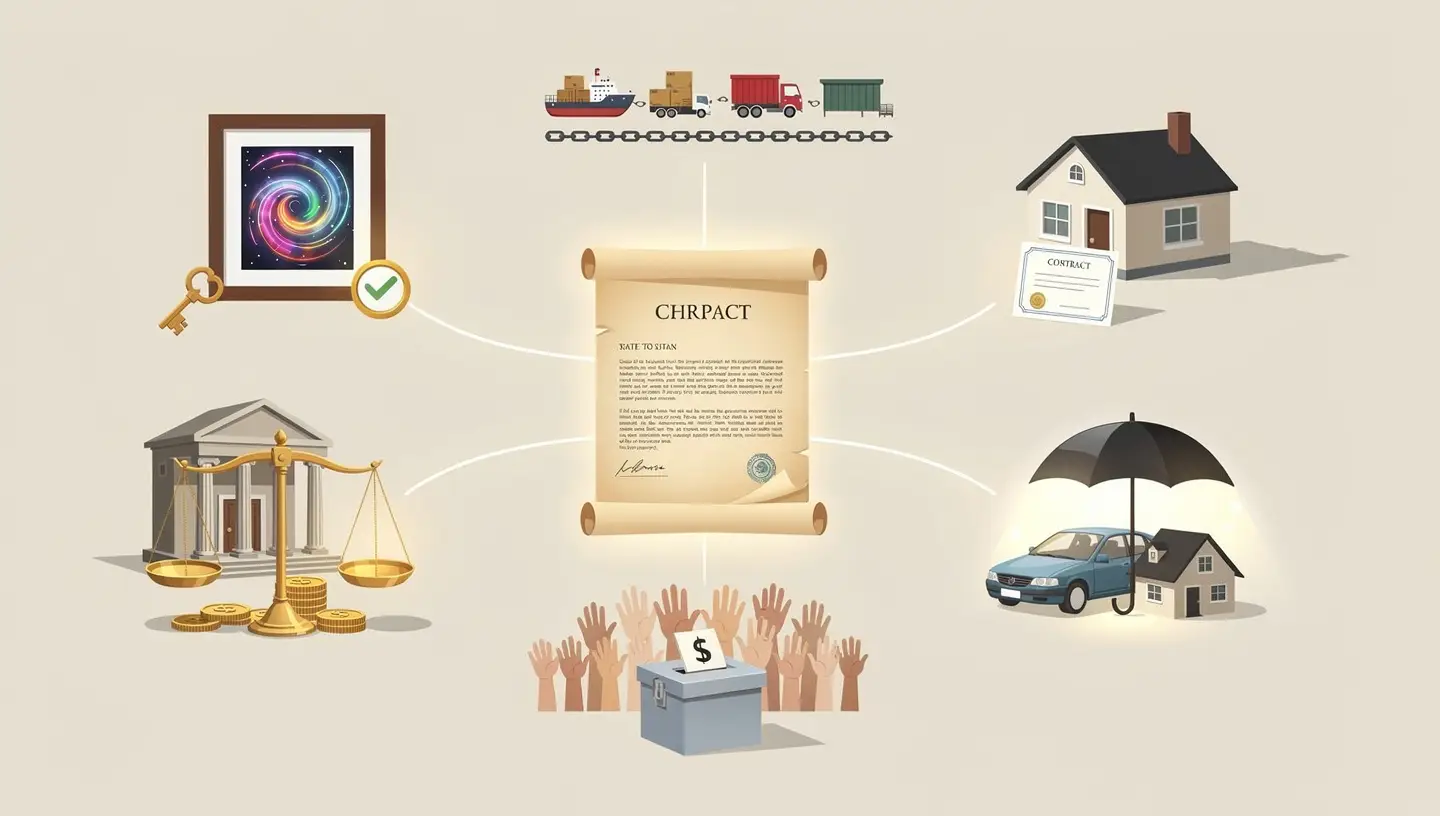
Decentralized Finance (DeFi)
Decentralized finance, commonly known as DeFi, is the largest and most active application of smart contracts. DeFi platforms use smart contracts to automate financial services such as lending, borrowing, and trading without banks or brokers acting as intermediaries. Compound and Aave allow users to deposit cryptocurrency and earn interest, or to borrow against collateral, with all terms and rates set automatically by the protocol. Uniswap allows two parties to swap tokens directly through a smart contract that calculates the exchange rate from a liquidity pool, without any matching engine or order book managed by a company.
The total value locked across DeFi protocols has reached hundreds of billions of dollars, driven entirely by smart contracts running on public blockchains. For a broader understanding of how these decentralized financial tools connect to the broader world of digital assets, the guide on crypto tokens vs. coins explains the types of digital assets that DeFi protocols use and issue.
NFTs and Digital Ownership
Non-fungible tokens, or NFTs, are one of the most widely known applications of smart contracts. Every NFT is created and governed by a smart contract that records who owns it, defines how many copies can exist, and specifies what percentage of future resales goes back to the original creator as royalties. The ERC-721 standard on Ethereum is the most widely used contract framework for NFTs. When an artist mints an NFT and a collector buys it, the transfer of digital ownership is executed by the smart contract automatically, without an auction house or gallery taking a large cut.
Supply Chain Management
Smart contracts address one of the oldest problems in commerce: verifying that goods actually moved from one place to another before releasing payment. In a traditional supply chain, verifying a shipment involves invoices, purchase orders, and confirmation emails passing through multiple parties over days. A smart contract can automate this by releasing payment the moment a sensor or verified data source confirms that the shipment arrived at the specified location in the specified condition.
IBM has deployed blockchain-based supply chain systems for clients including Walmart and Home Depot, using smart contracts to reduce invoice disputes and improve product traceability. Walmart Canada, specifically, combined smart contracts with IoT data to automate freight invoicing, eliminating the manual reconciliation process that previously required significant staff time.
Real Estate
Buying or selling property normally involves lawyers, title companies, escrow agents, and weeks of paperwork. A real estate smart contract can hold the buyer’s funds in escrow automatically, release them to the seller when all conditions are verified on-chain, and update ownership records simultaneously, without any of those traditional intermediaries being required to manually approve each step. The property transfer happens the moment the contract confirms that the payment, title verification, and any other agreed conditions have been satisfied.
Cook County, Illinois ran a pilot in 2016 that used blockchain to record and track property title transfers, with buyers receiving a digital token representing ownership alongside the traditional paper deed. This type of hybrid approach is where real estate blockchain adoption is currently focused.
Insurance
Claims processing is one of the most expensive and slow parts of the insurance industry. An insurance smart contract can automate payouts by connecting to verified data feeds through an oracle. A crop insurance contract, for example, can monitor weather station data and automatically trigger a payout if rainfall drops below a defined threshold during the growing season, without requiring a farmer to file a claim or an adjuster to visit the property. The automated payout happens as soon as the oracle confirms the triggering condition.
Fidelity cites climate-based agricultural insurance as one of the clearest examples of where smart contracts provide genuine value: in developing countries where claims are small and the cost of traditional processing exceeds the value of the payout itself, smart contracts make insurance economically viable for the first time.
Voting and Governance
Governance contracts allow decentralized organizations to make collective decisions without any central authority managing the vote. In a DAO, or decentralized autonomous organization, token holders submit and vote on proposals directly through a smart contract. The contract counts the votes, applies the result automatically, and records the outcome on the blockchain. No committee decides whether to implement the winning proposal. The contract executes it. This model is widely used across DeFi protocols for decisions about fee structures, protocol upgrades, and treasury management.
Types of Smart Contracts
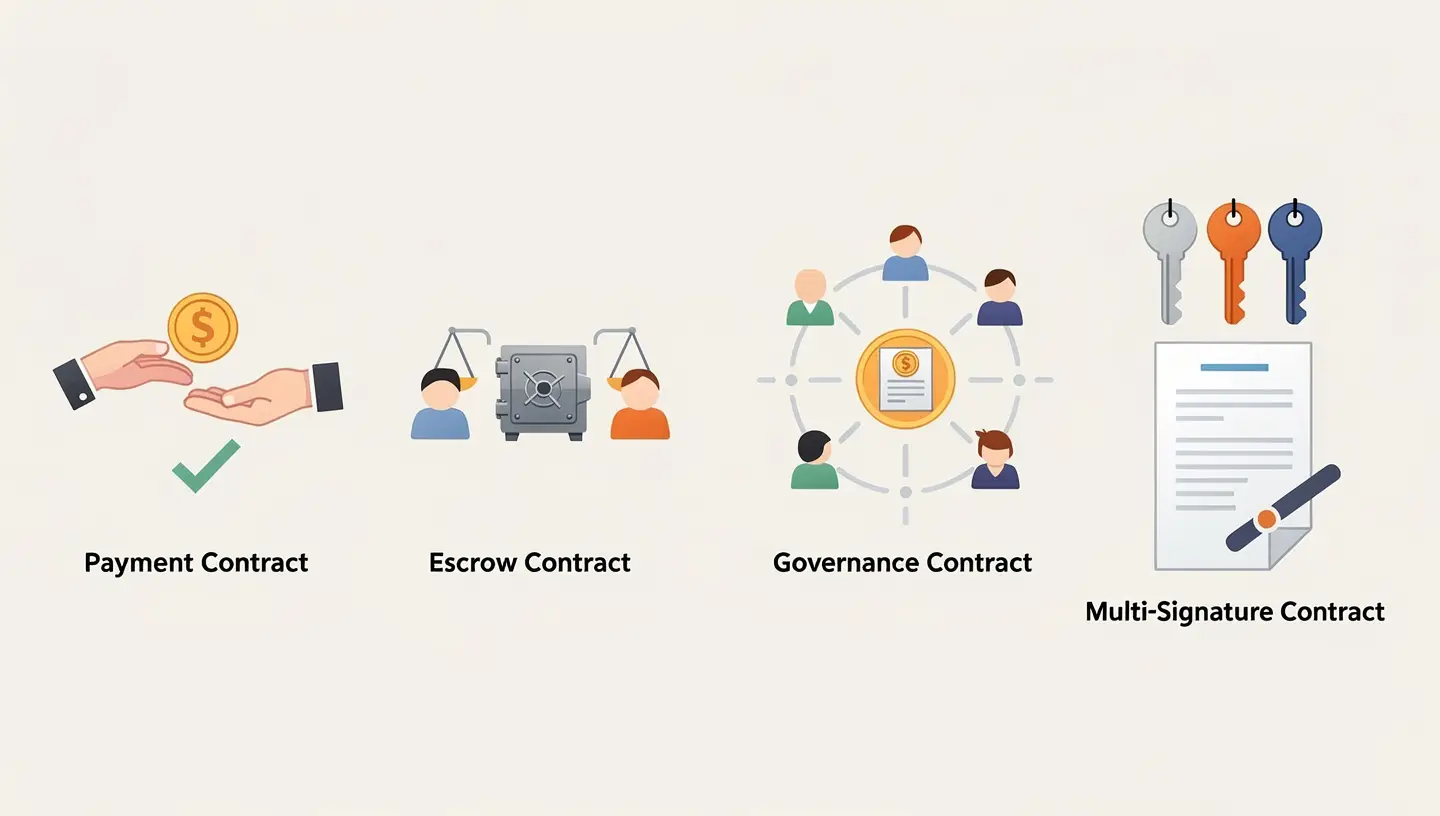
Not all smart contracts serve the same function. TechTarget classifies them into four broad categories based on what they are designed to do, and understanding these categories helps clarify which type of contract is appropriate for a given application.
Payment contracts are the simplest type. They automate fund transfers based on predetermined conditions: if goods are confirmed delivered, then release payment to the seller. The basic logic of most DeFi transactions follows this pattern.
Escrow contracts hold funds or assets on behalf of both parties until specified conditions are met, then release them appropriately. They provide the function that escrow services currently perform in real estate and high-value transactions, but without a human agent holding the funds or charging a fee. The trustless nature of the blockchain means neither party needs to trust the other or an agent: they both trust the code.
Governance contracts enable decentralized decision-making. Token holders in a protocol or organization vote through the contract, and the outcome is automatically applied. The contract enforces the rules of the vote and executes the result without any central administrator. DAOs run almost entirely on governance contracts.
Multi-signature contracts require approval from more than one party before a transaction can execute. A 2-of-3 multi-signature contract, for example, requires two out of three designated addresses to sign off before funds move. This adds a layer of security and is commonly used for treasury management in organizations where no single person should have unilateral control over funds.
Benefits of Smart Contracts
The case for smart contracts rests on the same properties that make blockchain generally appealing, applied specifically to the execution of agreements.
- Speed and efficiency: Once a condition is met, a smart contract executes immediately. There is no paperwork to process, no office hours to wait for, and no manual steps to complete. Transactions that traditionally take days can settle in seconds.
- Cost savings: By removing intermediaries, smart contracts cut the fees those intermediaries charge. Legal fees, notary charges, broker commissions, and escrow agent fees all disappear when the smart contract handles enforcement directly. The only cost is the network transaction fee paid to the blockchain.
- Transparency: The code of every smart contract is publicly visible on the blockchain. Anyone can audit it before interacting with it. Every transaction is recorded permanently. There are no hidden terms and no ability to alter the record after the fact. This level of transparency is unavailable in most traditional contractual relationships.
- Security: Smart contract data is encrypted on a shared ledger. Because each record is connected to every previous record in the chain, a hacker would have to alter every copy of the ledger across thousands of nodes simultaneously to change a single entry. The decentralized architecture makes the system resistant to the kind of single-point-of-failure attacks that hit centralized databases regularly. Trustless execution means the system does not depend on any single party behaving honestly.
- Accuracy and automation: Contracts written in code execute exactly as written, every time. There is no room for human error in the execution step. The self-executing nature of the contract removes the possibility of a clerk entering the wrong number, a bank processing the wrong account, or a third party delaying a step because their office is closed.
Risks and Limitations of Smart Contracts
Every property that makes smart contracts powerful also introduces risks that users and developers need to understand clearly. The technology is not a perfect solution, and the failure modes are unique.
Smart Contract Bugs and Security Vulnerabilities
Smart contract vulnerabilities are the most consequential risk in the space. Because the code is publicly visible, anyone can study it and look for logic errors that can be exploited. When a smart contract bug is found and exploited, the consequences are immediate and usually irreversible. There is no fraud department to call, no transaction to reverse, and no authority that can freeze the attacker’s wallet.
The most famous example remains The DAO hack of 2016. A vulnerability in a smart contract governing a decentralized investment fund allowed an attacker to drain approximately 60 million dollars worth of Ethereum through a reentrancy exploit. The incident led to a controversial hard fork of the Ethereum network, splitting it into Ethereum and Ethereum Classic. Professional smart contract audits by specialist firms have become standard practice for any protocol handling significant value, but they reduce rather than eliminate the risk. Smart contract security remains an active research field precisely because the attack surface is broad and the consequences of failure are severe.
For context on how Bitcoin’s proof-of-work model avoids this attack surface entirely by keeping its scripting language intentionally limited, the article on how does Bitcoin work explains the deliberate design tradeoffs Bitcoin’s creators made.
The Oracle Problem
A smart contract is only as reliable as the data it receives. The oracle problem refers to the fundamental difficulty of connecting the certainty of on-chain code execution with the messiness of real-world data. If an oracle is manipulated, fails, or provides inaccurate data, the smart contract executes based on false inputs and produces the wrong outcome, perfectly faithfully. The code ran correctly. The result was still wrong.
This is not a theoretical concern. Oracle manipulation attacks have been used to exploit DeFi protocols by feeding artificial price data into lending contracts, allowing attackers to borrow far more than the collateral should permit. Decentralized oracle networks like Chainlink address this by aggregating data from multiple independent sources, making manipulation significantly more expensive, but the oracle problem has not been fully solved and remains one of the primary constraints on how reliably smart contracts can interact with real-world data.
Immutability: A Feature That Can Become a Problem
The immutable nature of smart contracts is the property that makes them trustworthy. It is also the property that makes them unforgiving. Deploying a smart contract is genuinely permanent. There are no returns, no refunds, and no corrections after the fact. If the code contains a bug, the only options are to abandon the contract and deploy a new one, or to have written an upgrade mechanism into the original contract before deployment, which introduces its own complexity and potential vulnerabilities.
This immutability also means that if both parties to a contract want to change the terms after deployment, they cannot simply amend the agreement. A new contract must be written, audited, and deployed from scratch. For long-term commercial relationships where conditions change, this rigidity is a practical limitation.
Are Smart Contracts Legally Binding?
This is a widespread misconception that is worth addressing directly. Despite the name, smart contracts are not legal contracts by default. They are programs that execute transactions. Whether a particular smart contract execution creates a legally binding obligation depends entirely on the jurisdiction and the surrounding legal agreements. The code runs regardless of legal status. Whether a court would enforce the outcome, provide remedies, or recognize the transaction as legally meaningful varies widely.
In England and Wales, the Law Commission advised in 2021 that smart legal contracts are capable of being recognized and enforced under existing English law, provided the underlying agreement meets the requirements for a valid contract. In the United States, the legal framework remains fragmented by state. Some jurisdictions have enacted specific legislation recognizing blockchain-based records. Others have not. Anyone using smart contracts for significant financial or legal purposes should obtain specific legal advice about enforceability in their jurisdiction.
Scalability and High Gas Fees
Scalability is a persistent challenge for the most active smart contract platforms. On Ethereum, every contract execution requires paying gas fees to compensate the network’s validators. During periods of high network congestion, those fees can rise dramatically, making small transactions economically impractical. A smart contract designed to automate a five-dollar payment becomes nonsensical when the gas fee to execute it costs twenty dollars. Layer 2 networks built on top of Ethereum, such as Arbitrum and Optimism, address this by processing transactions off the main chain and batching them together, reducing fees significantly. But scalability remains an active engineering challenge across most major platforms.
The History of Smart Contracts
The term “smart contract” was coined by Nick Szabo in 1994, in a paper where he described a protocol that would automatically execute the terms of a contract without requiring parties to trust each other or rely on a third-party enforcer. Szabo proposed the vending machine as the clearest simple example: a machine that executes a sale automatically based on verified inputs, with no human judgment required. He also described more complex applications, including synthetic financial instruments combining derivatives and bonds that could be built and traded with low transaction costs because the term structures were encoded in software.
The problem in 1994 was that no suitable platform existed. Bitcoin, launched in 2009 by Satoshi Nakamoto, proved that a financial transaction could occur without a trusted intermediary on a public blockchain. But Bitcoin‘s scripting language was deliberately kept simple and limited in scope. Vitalik Buterin proposed Ethereum in 2013 specifically to extend Bitcoin’s concept into a general-purpose programmable platform. Ethereum launched in 2015, with Solidity as its primary contract language and the Ethereum Virtual Machine as the execution environment. For the first time, Nick Szabo‘s concept had infrastructure capable of supporting it at scale.
For a fuller account of how Bitcoin’s original architecture laid the groundwork for everything that followed, including the programmable blockchain platforms that run smart contracts today, the history of Bitcoin covers that story from the beginning.
Smart Contract Platforms
Ethereum remains the dominant platform for smart contract development by a significant margin, hosting the majority of DeFi activity, NFT collections, and DAO governance systems. The Ethereum Virtual Machine (EVM) is the runtime environment that executes contract code on the Ethereum network, and its standard has become widely replicated. Many competing platforms are EVM-compatible, meaning contracts written in Solidity for Ethereum can run on them with minimal modification.
Beyond Ethereum, several other smart contract platforms have gained meaningful adoption. Solana prioritizes speed and low transaction costs, using a different architecture from Ethereum that allows far higher throughput. Polkadot enables interoperability between multiple blockchains through its relay chain model, with smart contracts able to communicate across chains. Cardano takes a formally verified approach to contract development, using a language designed to make mathematical proofs of contract correctness more straightforward. Tezos uses an on-chain governance model that allows the protocol itself to be upgraded through a smart contract process, avoiding the hard forks that have divided other blockchain communities.
The proliferation of competing platforms reflects the genuine interest in smart contract infrastructure. Choosing the right platform for a given application involves tradeoffs between developer tooling, transaction costs, security track record, and the size of the existing user base on that network.
Understanding how staking mechanisms on proof-of-stake platforms like Ethereum connect to smart contract execution may also be useful context. The guide on what is crypto staking explains how validators on these networks earn rewards for processing transactions, including smart contract executions.
Are Smart Contracts the Future?
Smart contracts are already a functioning part of the financial and technology landscape, not a future possibility. Hundreds of billions of dollars move through DeFi protocols built entirely on smart contract infrastructure. Major corporations including IBM, Walmart, and Home Depot run supply chain applications on permissioned blockchains using smart contracts to automate invoicing and dispute resolution. Musicians, artists, and game developers use them to manage rights and royalties. The question is not whether smart contracts will be used but how broadly they will expand beyond their current base.
The limiting factors are the same ones that have slowed adoption from the beginning: scalability constraints, the oracle problem, legal uncertainty, and the significant technical expertise required to write and audit contracts safely. Web3 development is actively working on each of these. Layer 2 scaling solutions are reducing gas costs. Decentralized oracle networks are improving data reliability. Several jurisdictions are developing clearer legal frameworks. The tooling for writing, testing, and auditing smart contract code continues to improve.
The realistic trajectory is not that smart contracts replace all human institutions but that they automate the specific parts of agreements where automation produces clear benefits: high-volume, low-discretion transactions where the terms are unambiguous, the inputs are verifiable, and the savings from removing manual processing steps are significant. That is a large category of economic activity, and it is growing.
For those interested in how the altcoin landscape has grown specifically around smart contract platforms and the tokens that power them, the guide on what is an altcoin covers how these assets are categorised and what drives their value.
The Bottom Line
What is a smart contract in one sentence? It is a self-executing program stored on a blockchain that runs automatically when its conditions are met, without any third party enforcing or approving the outcome. The technology builds on the “if/then” logic that Nick Szabo described three decades ago and delivers it on the public, immutable, decentralized infrastructure that Ethereum and other platforms provide. The benefits are real: speed, cost reduction, transparency, and the removal of trusted intermediaries from transactions that do not need them. The risks are equally real: code bugs, oracle failures, immutable errors, and unresolved legal questions. Smart contracts do not make every problem simpler. They make specific, well-defined problems significantly easier to solve at scale, and the number of problems that fit that description keeps growing.
Frequently Asked Questions
What is a smart contract in simple terms?
A smart contract is a computer program stored on a blockchain that runs automatically when its conditions are met. Think of it like a vending machine: you put in the right input and the programmed output happens automatically, with no human needed to approve or execute the transaction. The terms are written in code rather than legal language, and the code enforces them directly.
Are smart contracts legally binding?
Not automatically. Smart contracts execute transactions, but whether those executions create legally binding obligations depends on the jurisdiction and the surrounding legal context. In England and Wales, the Law Commission has advised that smart legal contracts can be recognized under existing law. In many other jurisdictions, the legal framework is still developing. Anyone using smart contracts for significant financial or commercial purposes should get specific legal advice about enforceability in their location.
Can a smart contract be changed after it is deployed?
No. Once a smart contract is deployed to a blockchain, it is immutable. The code cannot be altered, corrected, or stopped by any single party. If a bug is discovered after deployment, the only option is to abandon the contract and deploy a new one. Some contracts are written with upgrade mechanisms from the start, but these add complexity and their own security risks.
What blockchains support smart contracts?
Ethereum is the most widely used smart contract platform and hosts the majority of DeFi and NFT activity. Other significant platforms include Solana, Polkadot, Cardano, and Tezos. Many newer blockchains are EVM-compatible, meaning they can run the same Solidity code written for Ethereum. Bitcoin’s scripting language supports limited smart contract functionality but is intentionally not Turing-complete.
What is the oracle problem in smart contracts?
The oracle problem is the challenge of getting reliable real-world data into a blockchain so that smart contracts can act on it. A blockchain is a closed system that cannot natively access external information. An oracle is a service that feeds verified external data into the blockchain. If the oracle is manipulated or wrong, the smart contract executes based on false inputs and produces an incorrect outcome even though the code ran perfectly. Decentralized oracle networks like Chainlink reduce this risk by aggregating data from multiple independent sources.
What programming language is used for smart contracts?
On Ethereum, the most widely used language is Solidity, which was created specifically for writing contract code on the Ethereum network. Other languages used on Ethereum include Vyper, which prioritizes security over flexibility. Other blockchain platforms use their own languages: Rust is commonly used on Solana, and Haskell-derived languages are used on Cardano. The choice of language affects what the contract can do and how easy it is to audit for security vulnerabilities.
What is the difference between a smart contract and a dApp?
A smart contract is the underlying code that executes on the blockchain. A dApp, or decentralized application, is the user-facing interface built on top of one or more smart contracts. Uniswap is a dApp. The smart contracts that manage its liquidity pools and execute its token swaps are what run on-chain. The website you visit to interact with Uniswap is the dApp layer. Most dApps depend entirely on smart contracts for their core logic, but the smart contracts themselves are not dApps.