Every blockchain needs a way to agree on which transactions are real. Unlike a bank that keeps a single master ledger, a blockchain runs across thousands of independent computers. None of those computers trust each other by default. A consensus mechanism is the set of rules that brings them all to the same conclusion about which transactions are valid and which version of history to accept. Without it, anyone could submit fake transactions, rewrite the ledger, or spend the same coins twice. The two consensus mechanisms that dominate the market today are proof of work (PoW) and proof of stake (PoS). Both solve the same core problem in fundamentally different ways. Proof of work relies on computing power and energy. Proof of stake relies on coin ownership and financial incentives. The biggest practical difference is that proof of stake uses crypto staking to select block validators, while proof of work uses competitive mining. Understanding how each works, where each falls short, and why Ethereum switched from one to the other in 2022 is what this guide covers.
What Is a Consensus Mechanism?
A consensus mechanism is the protocol a blockchain network uses to get all its participating computers, called nodes, to agree on a single shared version of the transaction record. When someone sends cryptocurrency to another address, that transaction does not become part of the permanent ledger until the network reaches consensus that it is legitimate. The consensus mechanism defines who gets to propose the next block of transactions, how the rest of the network verifies it, and what happens if someone tries to cheat.
The problem consensus mechanisms are designed to solve is called the double-spend problem. A digital file can be copied perfectly, with no degradation, an unlimited number of times. Without a reliable way to agree on which transaction happened first, a user could theoretically spend the same coins twice by broadcasting two conflicting transactions simultaneously. Traditional financial systems solve this with a central authority, such as a bank or payment processor, that maintains the authoritative ledger. Decentralized blockchains have no central authority, so the consensus mechanism takes its place.
As the computer scientist Demiro Massessi summarized it: blockchain consensus algorithms boil down to some kind of vote where the number of votes a user has is tied to the amount of a limited resource under their control. For proof of work, that resource is computing power. For proof of stake, it is staked cryptocurrency. Both make fraud expensive enough to be economically irrational for the vast majority of potential attackers.
What Is Proof of Work (PoW)?
Proof of work was the first consensus mechanism used on a public blockchain. Satoshi Nakamoto built it into Bitcoin in 2009 as a way to verify transactions without any central authority. It has run Bitcoin without a successful network-level attack for over 15 years, making it the most battle-tested security model in cryptocurrency. The name comes from the fact that participants must demonstrate they have performed a significant amount of computational work before the network accepts their proposed block.
How Bitcoin Mining Works
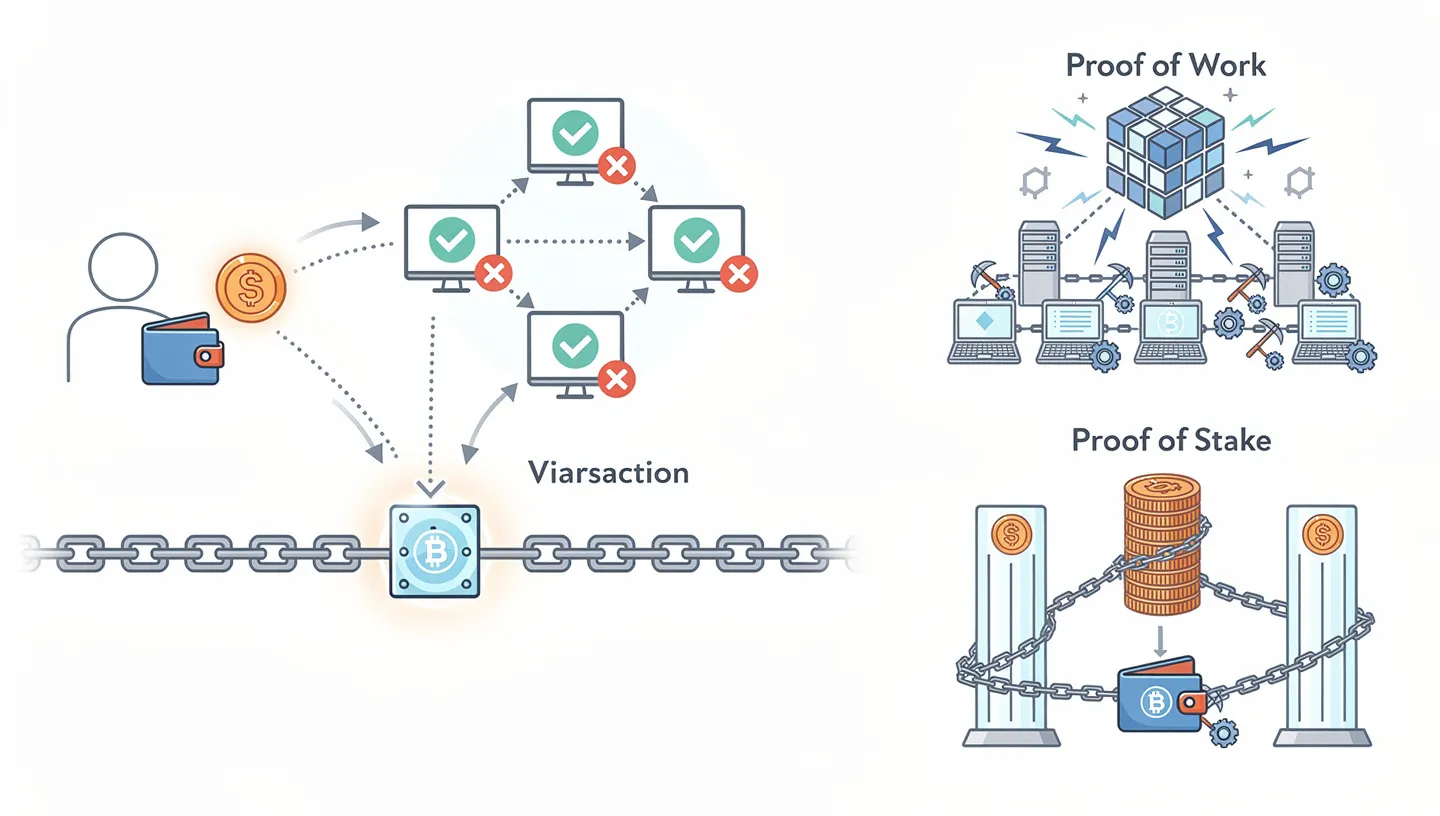
In a proof of work system, participants called miners compete to add the next block to the chain. They gather pending transactions from the network’s waiting pool, called the mempool, and race to solve a cryptographic puzzle. The puzzle requires finding a special number, called a nonce, that when combined with the block’s data produces a hash meeting the network’s current difficulty target. There is no shortcut to solving this puzzle. The only approach is brute-force trial and error, guessing billions of combinations per second until a valid answer is found.
One useful way to picture this is a combination lock with one million possible numbers. Whoever guesses the correct combination first wins the right to add the block. To participate in that guessing race at a competitive speed, you need a machine capable of making as many guesses as possible per second. That requires significant processing power, which requires significant electricity. This computational expenditure is by design: it makes fraud expensive. An attacker who wanted to rewrite history would need to redo all the work on every subsequent block faster than the honest network adds new ones, which becomes progressively more impractical as the chain grows.
Once a miner finds a valid solution, they broadcast it to the network. Other nodes verify the answer, confirm the transactions, and add the block to their copy of the chain. The winning miner receives a block reward in newly created cryptocurrency plus the transaction fees attached to every transaction in that block. The difficulty of the puzzle adjusts automatically based on how quickly blocks are being found, keeping the average block time consistent. For Bitcoin, that target is roughly 10 minutes per block.
Bitcoin is the most widely known proof-of-work network, but others include Litecoin, which uses a hashing algorithm called Scrypt, and Monero, which prioritizes privacy and resistance to specialized hardware. For a complete account of how Bitcoin’s architecture was designed and why Nakamoto chose proof of work, the guide to how Bitcoin works covers the full technical picture.
Proof of Work Security: The 51% Attack
The primary security guarantee of proof of work is that an attacker would need to control more than half of the network’s total computing power, measured in hashrate, to manipulate the chain. This is called a 51% attack. With majority control of the hashrate, an attacker could prevent certain transactions from being confirmed or attempt to spend the same coins twice, a fraud known as double-spending.
On large networks like Bitcoin, executing a 51% attack would require acquiring an enormous amount of specialized hardware, the ASICs that now dominate Bitcoin mining, and the electricity to run it. The Cambridge Bitcoin Electricity Consumption Index estimates that Bitcoin consumes around 120 terawatt-hours of electricity per year, comparable to the total annual electricity use of Argentina. Acquiring enough computing power to outpace that level of global hashrate would cost billions of dollars and would be immediately visible on the network. The economics make large-scale attacks on Bitcoin practically impossible under current conditions.
Smaller proof-of-work networks are more vulnerable. If a coin has a relatively small total hashrate, renting sufficient computing power to launch a 51% attack can be cheap enough to be profitable for an attacker. Several smaller proof-of-work cryptocurrencies have suffered successful 51% attacks.
Proof of Work Advantages
The strongest argument for proof of work is its track record. Bitcoin has operated continuously since January 2009 without its blockchain being successfully attacked. The security model is well understood, extensively studied, and has survived numerous exploitation attempts. The link between validation rights and real-world physical resources, hardware and electricity, creates a measurable commitment that is independent of the cryptocurrency’s own price. An attacker cannot simply buy their way into controlling the network by purchasing coins. They must control physical infrastructure.
Supporters also argue that proof of work is more genuinely decentralized than it appears. While mining pools have grown large, individual miners retain the ability to switch pools at any time. The hardware itself is distributed across dozens of countries, and no single entity has ever controlled 51 percent of Bitcoin’s hashrate for any sustained period.
Proof of Work Disadvantages
Energy consumption is the most persistent criticism of proof of work. The computational competition requires miners to run powerful computers continuously, competing on every block. Thousands of machines simultaneously attempt to solve the same puzzle, but only one solution is accepted per block. All the energy spent by losing miners is wasted by design. As Bitcoin’s price has risen, more miners have joined the network, pushing the difficulty and energy consumption higher.
The hardware barrier is the second major limitation. Modern Bitcoin mining requires purpose-built machines called ASICs, or application-specific integrated circuits, that cost thousands of dollars each and become obsolete within a few years. Personal computers stopped being competitive for Bitcoin mining around 2013. The high upfront cost and ongoing electricity bills have concentrated mining into large industrial operations and mining pools. Additionally, the transaction speed is slow: Bitcoin processes roughly 7 transactions per second at the base layer.
What Is Proof of Stake (PoS)?
Proof of stake was created in 2012 by developers Sunny King and Scott Nadal as a direct response to the energy demands of proof of work. Their first implementation was a coin called Peercoin. At launch, they estimated that Bitcoin’s proof-of-work model was consuming the equivalent of $150,000 in daily electricity costs. The core insight behind proof of stake was that security does not require energy expenditure. It requires participants to have something to lose. Locking up cryptocurrency as collateral provides that financial stake without burning electricity to prove commitment to the network.
How Validators Replace Miners
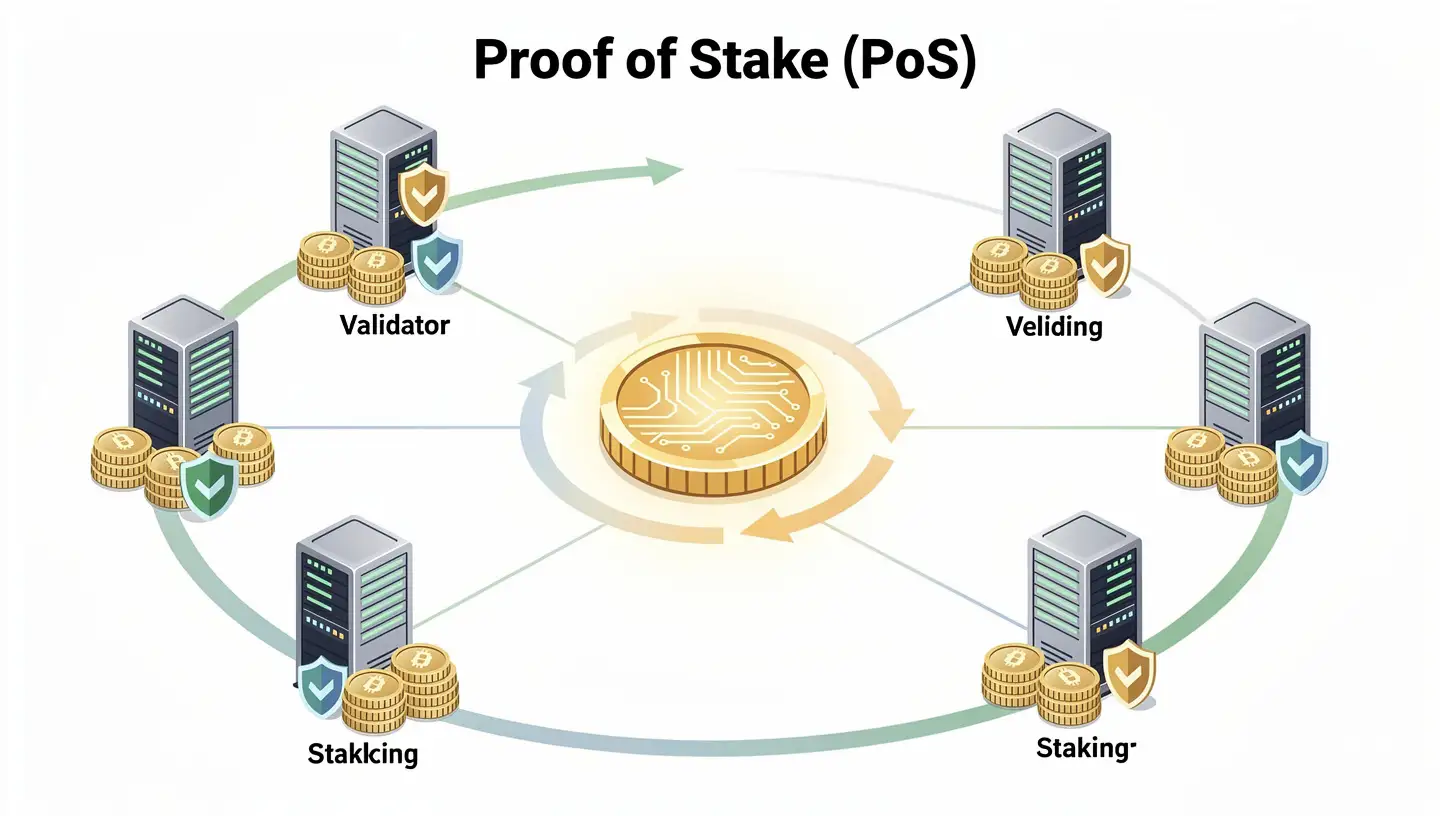
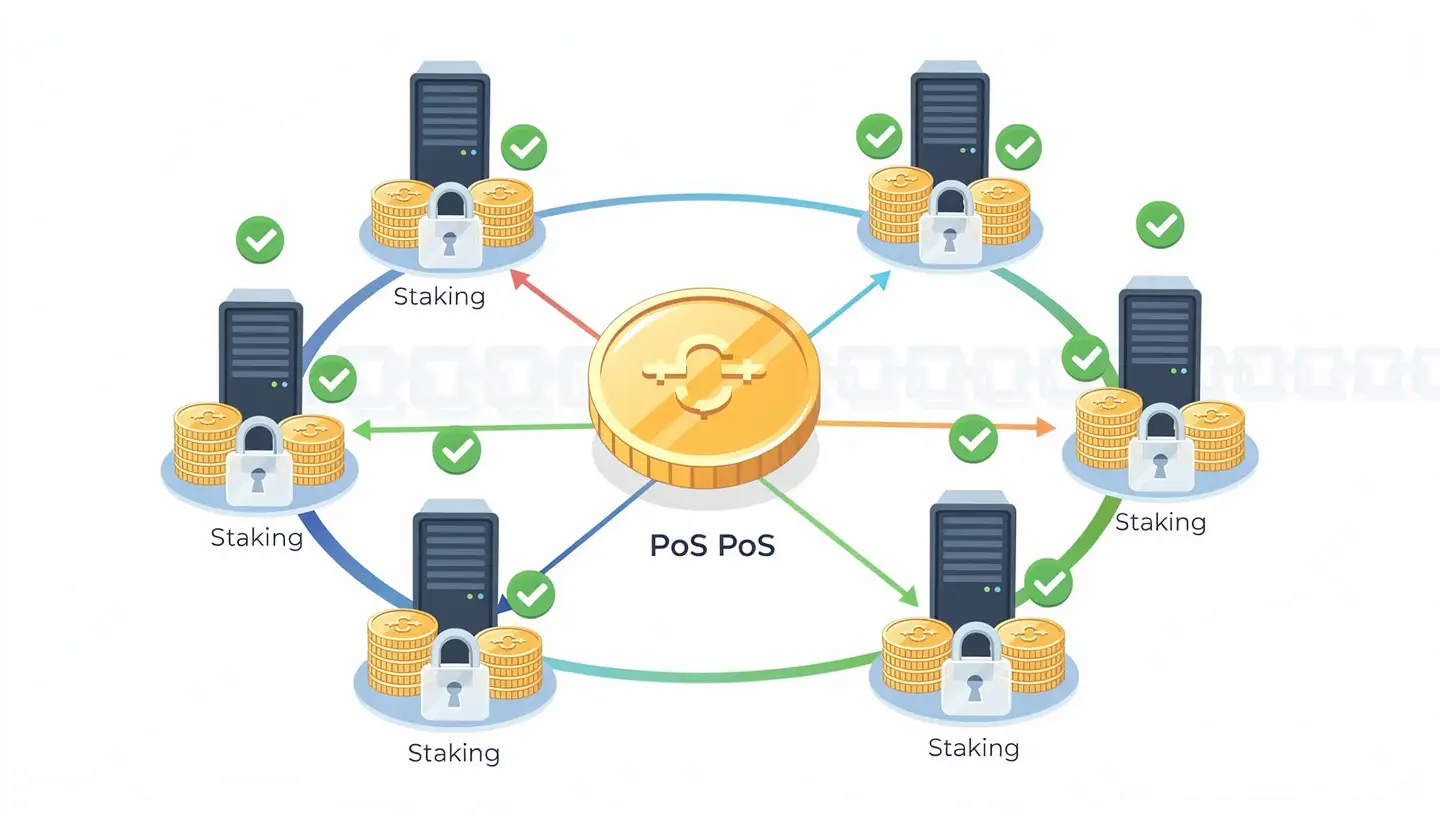
In a proof-of-stake system, participants called validators replace miners. Instead of competing to solve puzzles, validators lock up a set amount of the network’s native cryptocurrency in a validator pool as collateral. The network then uses a randomly weighted selection process to choose which validator gets to propose the next block. The weighting favors participants who have staked more: a validator who has locked up twice as many coins as another has roughly twice the probability of being selected in any given round.
The block creation process in proof of stake is sometimes called minting or forging rather than mining, though both terms are used depending on the network. After the selected validator proposes a block, a committee of other validators attest to its accuracy. When enough attestations accumulate, the block is added to the chain and the proposing validator receives a reward, usually paid in transaction fees and network-issued staking rewards. The energy required for this entire process is a tiny fraction of what proof-of-work mining demands, because there is no computational race. One validator is assigned each block before the work begins.
Think of staking like depositing money in a special bank account. The coins are locked and cannot be used for anything else while they are staked. For each new block, the blockchain selects one person with staked coins to update the ledger. This is closer to a lottery system than a competition. The more you deposit, the more tickets you hold, but anyone who participates has a chance.
Understanding what staking involves in practical terms, how rewards are calculated, and what the lock-up periods look like across major networks is covered in the guide to crypto staking.
Slashing: How Proof of Stake Punishes Bad Actors
Slashing is the penalty mechanism that makes proof of stake economically secure. If a validator tries to submit a fraudulent block, approves conflicting transactions, or goes offline for extended periods when they are supposed to be performing validation duties, the network destroys a portion of their staked coins. The amount destroyed depends on the network and the nature of the offence. On Ethereum, a minor infraction results in a small penalty. A coordinated attack involving multiple validators simultaneously triggering the same offence triggers what Ethereum calls the correlation penalty, which can result in up to 100 percent of a validator’s staked ETH being destroyed.
This design turns honest behavior from a moral choice into a rational financial calculation. A validator who cheats and gets caught loses the very coins they put up to participate. For large stakers, that could be millions of dollars. The potential penalty far exceeds the potential gain from any single fraudulent transaction, which is precisely the point. The financial disincentive to misbehave replaces the energy cost that serves the same function in proof of work.
Proof of Stake Advantages
The energy efficiency advantage is significant and well-documented. Ethereum’s switch from proof of work to proof of stake in September 2022, an event the community called the Merge, reduced the network’s energy consumption by more than 99 percent according to the Ethereum Foundation. The entire Ethereum network now uses roughly as much electricity as a small town, compared to the energy usage of a mid-sized country when it ran on proof of work.
The barrier to entry is meaningfully lower than proof-of-work mining. To stake on most networks, you need coins and an internet connection. You do not need specialized hardware that depreciates quickly and requires expensive electricity. On networks like Cardano and Cosmos, there is no minimum amount required to delegate your stake to a validator and earn rewards. Most proof-of-stake networks also process transactions significantly faster than Bitcoin, because validators do not spend time on energy-intensive computation before proposing blocks.
Proof of Stake Disadvantages
The most credible criticism of proof of stake is its tendency toward stake concentration. Because the probability of being selected to propose a block is proportional to the amount staked, wealthier participants earn rewards faster and compound their holdings more quickly than smaller ones. Over time, this concentrates validation power among fewer participants. On Ethereum today, a single liquid staking provider called Lido controls more than 30 percent of all staked ETH, and a handful of centralized exchanges account for much of the remainder. This concentration creates a potential governance bottleneck that some argue undermines the network’s decentralization.
There is also the “nothing at stake” problem that early critics raised. In a naive proof-of-stake system, a validator who receives a duplicate copy of their stake on both sides of a chain fork has no real cost to validating both chains simultaneously, which could enable double-spending. Modern implementations address this through slashing conditions that penalize validators for signing conflicting blocks, but the problem required careful protocol design to solve.
Proof of stake is also newer than proof of work and carries less historical evidence of resilience. Bitcoin’s 15-year unbroken record has no equivalent in the proof-of-stake world. Ethereum’s PoS implementation is a few years old, and its longer-term security properties under adversarial conditions remain to be fully demonstrated.
Proof of Work vs. Proof of Stake: Key Differences
The table below captures the most important differences across the categories that matter most for people comparing these two models.
| Category | Proof of Work (PoW) | Proof of Stake (PoS) |
|---|---|---|
| Resource used | Computing power and electricity | Staked cryptocurrency |
| Block producers | Miners competing to solve puzzles | Validators selected by weighted lottery |
| Energy consumption | Very high (Bitcoin ~120 TWh/year) | Very low (99%+ less than PoW) |
| Hardware needed | Specialized ASICs, expensive | Any standard internet-connected device |
| Attack cost | Must control 51% of hashrate | Must control 51% of staked coins |
| Penalty for fraud | Wasted electricity and hardware cost | Slashing: staked coins destroyed |
| Transaction speed | Slow (Bitcoin ~7 TPS) | Faster (varies by network) |
| Decentralization risk | Mining pool concentration | Stake concentration among large holders |
| Track record | 15+ years (Bitcoin, unbroken) | Newer, still maturing |
| Examples | Bitcoin, Litecoin, Monero | Ethereum, Cardano, Solana, Polkadot |
Energy Consumption
Energy use is the sharpest practical divide between these two models. Proof of work requires miners to run powerful computers continuously, competing against each other on every block. The Cambridge Bitcoin Electricity Consumption Index estimates that Bitcoin alone consumes approximately 120 terawatt-hours of electricity per year, more than countries including Belgium and Finland consume annually. Critics point to the environmental cost of this consumption, including carbon emissions and the e-waste produced when ASIC hardware becomes obsolete every few years.
Proof-of-work supporters argue that the energy comparison lacks context. A growing share of Bitcoin mining uses renewable energy sources or energy that would otherwise go unused. They also argue that the energy expenditure is what gives the network its security, and that a monetary network securing trillions of dollars in value requires a proportionate level of commitment from its participants.
Proof of stake requires no computational competition and therefore no energy expenditure beyond running a standard server. Ethereum’s energy consumption after the 2022 Merge dropped to roughly the level of a few thousand ordinary households. For networks where environmental impact is a deciding factor, this difference is decisive.
Security and Attack Risk
Both models make attacks expensive, but through completely different mechanisms. In proof of work, mounting a 51% attack requires controlling the majority of the network’s hashrate. For Bitcoin, that means acquiring and operating more computing power than the entire rest of the network combined, which represents an enormous physical infrastructure investment. Even if an attacker succeeded, the honest network would detect the attack quickly, and the economic damage to the attacker’s own holdings in the currency would be severe.
In proof of stake, an attacker would need to acquire and stake more than 51 percent of the total staked supply of the network’s native coin. On Ethereum, that would mean purchasing and locking up tens of billions of dollars worth of ETH. Any successful attack would cause the value of ETH to collapse, destroying the attacker’s own stake. The slashing mechanism would then destroy a large portion of the attacking validators’ staked coins as well, making the attack self-defeating on multiple fronts.
The “nothing at stake” problem is addressed in modern proof-of-stake implementations through slashing. Ethereum uses an algorithm called LMD-GHOST for fork choice, combined with the Casper finality gadget, to ensure the chain reaches finality faster and that validators who sign conflicting blocks face automatic penalties.
Decentralization
Both models face genuine centralization pressures, though from different sources. Proof of work is theoretically open to anyone. In the early days of Bitcoin, anyone with a laptop could mine competitively. Today that is no longer true. The economics of competitive mining have driven individual miners to join mining pools, collective operations that combine hashrate and share rewards proportionally. The largest mining pools collectively represent the majority of Bitcoin’s total hashrate, and large industrial mining farms in a handful of countries dominate the hardware landscape.
Proof of stake faces a different version of the same problem. Because the probability of being selected to propose a block is proportional to the amount staked, wealthier participants compound their holdings faster than smaller ones. On Ethereum, Lido alone controls more than 30 percent of all staked ETH. Some proof-of-stake networks attempt to address this with mechanisms such as coin age weighting, which factors in how long a stake has been held, or reward caps above certain thresholds that encourage large holders to delegate to smaller validators.
Neither model has fully solved the centralization problem. Both face it in different forms, and both continue to work on practical mitigations.
Speed and Scalability
Transaction speed is an area where proof of stake holds a clear advantage in most implementations. Bitcoin’s proof-of-work design produces a new block roughly every 10 minutes, capping the base layer at approximately 7 transactions per second. The computational competition that gives proof of work its security also limits its throughput, because the puzzle-solving process is the bottleneck and cannot simply be sped up without reducing security.
Proof-of-stake networks can set shorter block times without the same tradeoff, because block production is assigned in advance through the validator selection process rather than determined by a race. Ethereum on its base layer processes around 15 to 30 transactions per second. Solana, which combines proof of stake with a timekeeping mechanism called Proof of History, targets thousands of transactions per second at the base layer.
For applications that need to process large volumes of transactions quickly, such as decentralized finance protocols or gaming platforms, this scalability gap between proof of work and proof of stake is practically significant. The guide to decentralized finance covers how DeFi applications depend on this underlying infrastructure difference to function at scale.
The Ethereum Merge of 2022
In September 2022, Ethereum completed what its developers called the Merge: the transition from proof of work to proof of stake. It was one of the most technically complex upgrades ever executed on a live, high-value blockchain. The transition required replacing the entire consensus layer of the network while keeping all existing smart contracts, accounts, and transaction history intact. The new proof-of-stake chain had been running in parallel as the Beacon Chain since December 2020, accumulating validators and staked ETH. On September 15, 2022, the two chains merged and proof of work was switched off permanently.
The Ethereum Foundation reported that the Merge reduced Ethereum’s energy consumption by more than 99 percent. The transition is widely cited as evidence that large, active blockchains can change their fundamental consensus mechanism without losing continuity or destroying user funds. It is also the most prominent argument that proof of stake is a viable long-term alternative to proof of work at scale, demonstrated in practice on one of the two largest blockchain networks in existence.
Bitcoin’s developers have made clear they have no plans to transition to proof of stake. The commitment to proof of work is considered a core property of Bitcoin by most of its community. For a full account of the history of Bitcoin and the decisions that shaped its design, the history of Bitcoin covers that story from the beginning.
Which Cryptocurrencies Use Proof of Work and Which Use Proof of Stake?
Proof of work is used by a smaller but financially significant set of networks. Bitcoin is by far the largest, representing the majority of total cryptocurrency market value. Litecoin uses a PoW algorithm called Scrypt designed to be more resistant to ASIC hardware. Monero uses a PoW algorithm called RandomX designed to run best on ordinary CPUs, keeping accessibility for individual miners.
Proof of stake is now the dominant model across the broader altcoin landscape. Ethereum switched in 2022. Cardano was built on PoS from launch, using a formally verified implementation called Ouroboros. Solana combines PoS with Proof of History. Polkadot uses Nominated Proof of Stake, where token holders called nominators back validators with their own stake. Tezos uses Liquid Proof of Stake, allowing token holders to delegate without losing custody of their coins.
For a broader overview of the categories of coins and tokens that sit across these different consensus models, the guide on what is an altcoin covers the landscape clearly. For an understanding of how these infrastructure differences affect the total market value of individual networks, the article on what is market cap in crypto explains how those figures are calculated and what they represent.
Which Is Better: Proof of Work or Proof of Stake?
Neither model is objectively better in all circumstances. Each makes tradeoffs that make it more suitable for different goals.
Proof of work offers a 15-year security track record that proof of stake cannot yet match. Its security model is grounded in physical reality: controlling the Bitcoin network requires controlling physical machines and their power supply, which constrains potential attackers in ways that a purely financial model does not. For people who place maximum value on security, predictability, and proven resilience, proof of work remains compelling regardless of its energy cost.
Proof of stake offers dramatically lower energy consumption, faster transaction processing, lower barriers to participation, and more natural compatibility with scaling solutions. For applications that need to process high transaction volumes, offer staking yields to participants, or operate sustainably at large scale, proof of stake is the direction most of the industry has moved. The vast majority of new blockchain projects launched after 2017 use some form of proof of stake.
The debate will not resolve cleanly, because the two networks most associated with these models serve different purposes. Bitcoin is designed primarily as a monetary asset and a store of value. Its community treats the unchanging nature of proof of work as a feature. Ethereum is designed as a programmable platform for smart contracts and decentralized applications, and its community prioritizes scalability and sustainability. Both communities have made their choice based on what they value most, and both have legitimate arguments for that choice.
The Bottom Line
Proof of work and proof of stake are the two most widely used consensus mechanisms in cryptocurrency, and they represent genuinely different approaches to securing a decentralized network. Proof of work uses energy expenditure and computational competition to make fraud impractical. Proof of stake uses staked capital and financial penalties to achieve the same result at a fraction of the energy cost. Both face centralization pressures from different directions. Both have real attack vectors. The Ethereum Merge demonstrated that proof of stake can operate at scale on a major network. Bitcoin’s continued operation demonstrates that proof of work remains viable and unbroken. For anyone participating in the cryptocurrency market, understanding the difference between these two models is foundational to understanding what you are holding, how it works, and what risks exist at the protocol level.
Frequently Asked Questions
What is the main difference between proof of work and proof of stake?
The main difference is how each model selects who gets to add the next block of transactions to the blockchain. Proof of work uses competitive mining: participants race to solve a cryptographic puzzle, and the first to solve it wins the right to add the block. Proof of stake uses a weighted lottery among participants who have locked up their coins as collateral. No puzzle-solving is required, which eliminates the massive energy expenditure that proof of work demands.
Why did Ethereum switch from proof of work to proof of stake?
Ethereum switched in September 2022 primarily to reduce energy consumption and improve scalability. Running on proof of work, Ethereum consumed energy comparable to a mid-sized country. After the Merge, the Ethereum Foundation reported that energy use dropped by more than 99 percent. The transition also set the foundation for future scaling upgrades that are more compatible with a proof-of-stake architecture. Ethereum’s developers had planned the switch since the network’s early days, recognizing from the beginning that proof of work would eventually limit what the network could accomplish.
Is proof of stake more secure than proof of work?
Neither is definitively more secure. They have different security models. Proof of work requires an attacker to control more than 51 percent of the network’s physical computing power, which is an enormous logistical and financial undertaking for large networks. Proof of stake requires an attacker to control more than 51 percent of the staked supply, and slashing mechanisms destroy a significant portion of the attacker’s own funds if caught. Proof of work has a longer track record. Proof of stake is still maturing as a proven system at the scale of Bitcoin.
Can you earn money with both proof of work and proof of stake?
Yes, both offer ways to earn cryptocurrency for participating in network validation. With proof of work, you earn block rewards and transaction fees by mining, but this requires significant hardware investment and ongoing electricity costs. With proof of stake, you earn staking rewards by locking up coins as a validator or by delegating your stake to an existing validator. Staking has a lower barrier to entry and no hardware requirement, though it does require you to lock your coins for a period during which they cannot be sold or transferred.
What is slashing in proof of stake?
Slashing is the penalty mechanism in proof-of-stake networks that destroys a portion of a misbehaving validator‘s staked coins. If a validator tries to approve fraudulent transactions, signs conflicting blocks, or violates the network’s rules in ways that could harm its integrity, the blockchain automatically removes a percentage of their staked funds. The amount destroyed depends on the network and the severity of the offence. Slashing serves the same economic function as wasted energy in proof of work: it makes cheating more expensive than the potential reward.
Which uses more energy, proof of work or proof of stake?
Proof of work uses dramatically more energy. Bitcoin alone consumes approximately 120 terawatt-hours of electricity per year according to the Cambridge Bitcoin Electricity Consumption Index, comparable to entire countries. Proof-of-stake networks require no computational competition, so energy use is limited to running standard server hardware. Ethereum’s energy consumption after switching to proof of stake in 2022 dropped by more than 99 percent. Most PoS networks consume energy comparable to running a small number of ordinary computers.
Does Bitcoin use proof of work or proof of stake?
Bitcoin uses proof of work and has no plans to change. The Bitcoin community treats proof of work as a core property of the network, not a limitation to be replaced. The energy expenditure is considered a feature because it ties the security of the network to physical reality: controlling Bitcoin requires controlling physical hardware and its power supply. Bitcoin’s developers have been explicit that the network will not transition to proof of stake, in contrast to Ethereum, which completed that transition in September 2022.