In October 2009, a forum user sold 5,050 bitcoins for $5.02 through PayPal. The price per coin came out to $0.00099. By October 2025, one bitcoin reached $126,000. That is a gain of roughly eleven billion percent over sixteen years. No other financial instrument in history has come close to that kind of return in such a short period.
This page covers the full history of Bitcoin, from the first transactions that carried no monetary value to institutional funds, spot ETFs, and government strategic reserves. Every phase has its own story, and every major crash had a sequel that broke the previous record.
How Bitcoin was created and who stands behind it
Bitcoin did not come from a company or a funded startup team. It started with an anonymous nine-page document. On October 31, 2008, an unknown person or group writing under the pseudonym Satoshi Nakamoto published a white paper titled Bitcoin: A Peer-to-Peer Electronic Cash System on a cryptography mailing list. The document described a digital money system that works without banks, without a central authority, and without intermediaries.

For more on the origins and identity of Bitcoin’s founder, read our piece on who created Bitcoin.
On January 3, 2009, Nakamoto mined the first block on the network, the so-called genesis block. He embedded a headline from that day’s London Times: “Chancellor on Brink of Second Bailout for Banks.” That detail was not accidental. Bitcoin was built as a direct response to the 2008 financial crisis and a banking system whose poor management had just brought global markets to their knees.
Nine days later, on January 12, 2009, Nakamoto sent 10 bitcoins to developer Hal Finney, the first ever recorded Bitcoin transaction. The network was live, but it had no monetary value. No cash markets existed. No price had been set.
For a detailed breakdown of how this system actually works, see our guide on how Bitcoin works.
2009: the network goes live, the price does not exist
Throughout all of 2009, Bitcoin worked technically but had no market price. Miners received 50 BTC per block and could mine them with ordinary CPUs. Nakamoto kept the network alive by mining in the early weeks himself. Others gradually joined, mostly cryptographers and programmers who had read the white paper and understood what was being attempted.
Coins were exchanged on the BitcoinTalk forum without money, purely as a test of the system. Then a user called NewLibertyStandard set up the first informal exchange. Using a method based on electricity costs for mining, he calculated that one bitcoin was worth $0.00099.
In October 2009, a forum user named Sirius sent him 5,050 BTC and received $5.02 through PayPal in return. That was the first ever recorded exchange of bitcoin for real money. One satoshi was not even worth a thousandth of a cent.
2010: first transactions and first exchanges
The year that put Bitcoin on the map. Not because prices exploded, but because bitcoin was used as a medium of exchange for the first time.
On May 22, 2010, programmer Laszlo Hanyecz posted on the forum offering 10,000 BTC for two large pizzas. A user from England took the deal, ordered the pizzas, and received the coins. Hanyecz paid roughly $41 worth of bitcoin. That date has been celebrated as Bitcoin Pizza Day ever since, and it remains the most expensive meal in history, since those 10,000 BTC would have been worth more than a billion dollars at the 2025 peak.
In July of the same year, Mt. Gox launched as the first serious exchange for buying and selling bitcoin for dollars. Volume was thin, but at least there was infrastructure for price discovery.
By the end of 2010, bitcoin reached $0.39 and never crossed a dollar that year. Annual gain: +500%.
In August 2010, the most serious security vulnerability in the network’s history was discovered and patched. An attacker exploited a bug in the code and generated a transaction containing 184 billion bitcoins he did not own. Miners detected the problem within hours, rejected the bad block, and updated the protocol. The network survived.
2011: dollar parity and the first major crash
February 2011 brought the first psychological milestone. Bitcoin reached exactly $1 for the first time. For the people who had been following it from the start, that was a signal something serious was beginning.
By June, the price had climbed to nearly $30. An article in Time magazine in April 2011 brought the first wave of mainstream attention. That same year, BitPay was founded, giving businesses a way to accept bitcoin payments.
Then came the first serious crash. Mt. Gox was hacked and an attacker briefly manipulated prices from $17 down to $0.01, attempting to withdraw as many coins as possible. The damage was limited, but the news rattled an already thin market. By the end of 2011, bitcoin had fallen to $2 and closed the year around $4.70, a drop of 93% from the peak. For many observers it looked like the end of the story. It was not.
2012: consolidation and the first halving
A quiet year. Bitcoin spent most of 2012 trading between $5 and $13, with no dramatic moves. But what happened in November had lasting consequences.
On November 28, 2012, the first Bitcoin halving took place. The block reward was cut in half, from 50 BTC to 25 BTC. The supply reduction was written into the protocol from day one. Markets largely ignored it at the time, but history would show that every halving has preceded Bitcoin’s biggest price runs.
That same year, the Bitcoin Foundation was established, and WordPress became one of the first mainstream platforms to accept bitcoin as payment. The year closed at $13.50.
For a fuller explanation of what Bitcoin actually is as a technology and an asset, see our guide on what is Bitcoin.
2013: first time above $1,000 and the Mt. Gox era
This was the year Bitcoin first made it into financial headlines outside cryptography circles. At the start of the year the price was around $13. By April it had crossed $100. By November, $1,000. Annual gain: +5,575%.
What drove that run? Several things at once. Coinbase made buying easier for regular users. Mt. Gox at its height controlled more than 70% of all global trading volume. The first Bitcoin ATM opened in Vancouver. Media coverage picked up. Speculators entered the market.
The run was not smooth. In April, the price shot from $266 up to $230 and back down to $68, all within a week. Volatility was extreme, but the direction was clear. Bitcoin closed the year around $755, already pulling back from a December peak of $1,156. A bad sign for what was coming next.
2014-2015: the Mt. Gox collapse and a long winter
February 2014 remains one of the darkest periods in Bitcoin’s short history. Mt. Gox, the largest exchange in the world at the time, announced it had been hacked and that 850,000 bitcoins belonging to customers and the company itself had been stolen, worth around $450 million at the time. The company filed for bankruptcy.
Market confidence collapsed. The price fell from around $1,000 at the start of 2014 to $185 by mid-2015, a drop of more than 80% over less than two years. Development continued regardless. Ethereum was announced in 2014 and launched in 2015. Companies including Dell, Newegg, and Zynga started experimenting with bitcoin payments. The network kept running, developers kept building, and markets stayed quiet.
| Year | Low | High | Year close |
|---|---|---|---|
| 2009 | $0.00 | $0.00099 | $0.00099 |
| 2010 | $0.05 | $0.39 | $0.30 |
| 2011 | $0.29 | $29.60 | $4.70 |
| 2012 | $4.41 | $13.70 | $13.30 |
| 2013 | $13.30 | $1,156 | $755 |
| 2014 | $275 | $1,062 | $315 |
| 2015 | $185 | $495 | $430 |
2016-2017: second halving and the biggest bull run to that point
On July 9, 2016, the second halving cut the block reward from 25 to 12.5 BTC. The price at the time was around $650 and barely moved. That calm did not last long.
Through 2016, bitcoin climbed steadily, passing $700, $800, and closing the year around $1,000. Institutional interest was growing. Japan legally recognized bitcoin as a means of payment. Switzerland began working on a regulatory framework.
Then 2017 started. Bitcoin opened January at $1,000. By May it was at $2,300. By September $5,000. By November $10,000. On December 17, 2017, it hit $19,783. That peak was driven by mass media coverage, a flood of retail buyers, an ICO frenzy, and the launch of Bitcoin futures trading on the CME in Chicago. Annual gain for 2017: +1,335%. From $1,000 to $19,783 in twelve months.
2018-2019: crypto winter and slow recovery
After the December 2017 peak, one of the worst drawdowns in Bitcoin’s history began. By January 2018, the price was already below $12,000. By June, below $6,000. In December 2018, it sat at $3,200, a drop of 84% from the peak. The phrase “crypto winter” ran across financial media for months.
The infrastructure kept growing through it. The Lightning Network launched as a solution for faster, cheaper transactions. Fidelity received approval to offer bitcoin custody and trading to institutional clients. In 2019, markets stabilized. By June, bitcoin was back at $13,800 before pulling back again, closing the year around $7,200.
2020: pandemic, digital gold, and the third halving
In March 2020, COVID-19 brought global markets down. Bitcoin fell with them. Within 48 hours it dropped from around $9,000 to $3,800, one of the fastest single drops in its history.
Central banks then launched money printing at a scale not seen before. In August 2020, MicroStrategy announced it had bought bitcoin as its primary corporate treasury reserve, the first publicly listed company to do so. That move is widely credited with starting the “digital gold” narrative that carried through the next cycle.
On May 11, 2020, the third halving reduced the block reward to 6.25 BTC. By December 2020, bitcoin had broken through its old record of $19,783 and closed the year at nearly $29,000. Annual gain: +302%.
For more on the technology behind this asset, read our guide on what is blockchain.
2021: institutional wave and the $68,789 record
2021 was the year Bitcoin moved into the mainstream financial system in a way it never had before.
- February: Tesla buys $1.5 billion worth of bitcoin. Price crosses $50,000.
- April: Coinbase goes public on Nasdaq. Bitcoin reaches $64,863, a new all-time high at the time.
- May: China cracks down on mining. Musk reverses Tesla’s bitcoin stance. Price falls to $30,000.
- June-October: Stabilization and gradual recovery.
- November 2021: New absolute record, $68,789.
ProShares launched the first Bitcoin futures ETF in the United States. Companies including Square and PayPal opened bitcoin buying to millions of users. El Salvador became the first country in the world to adopt bitcoin as legal tender.
2022: the FTX collapse and the worst crash since Mt. Gox
2022 brought a systemic shock that took down some of the biggest names in the industry. In May, Terra/Luna collapsed. An algorithmic stablecoin worth $18 billion disappeared almost overnight, with estimates putting total losses at around $60 billion in market value within a matter of days.
In November, FTX, the third largest crypto exchange in the world at the time, filed for bankruptcy. Its founder, Sam Bankman-Fried, was later convicted of fraud and misuse of billions of dollars in customer funds. Bitcoin closed the year at around $16,500, a drop of 76% from the November 2021 peak, and the worst drawdown since the Mt. Gox era.
2023: quiet recovery and preparation for the next cycle
No new record in 2023. But in June, BlackRock, the world’s largest asset manager with more than $9 trillion under management, filed for a spot Bitcoin ETF. That single filing shifted market sentiment more than anything else that year. Bitcoin closed 2023 at $42,224, a gain of nearly 160% from the 2022 bottom.
2024: ETF approval and the first time above $100,000
On January 10, 2024, the U.S. Securities and Exchange Commission approved eleven spot Bitcoin ETFs at once, including funds from BlackRock, Fidelity, and Invesco. Within the first few weeks, the ETFs pulled in more than $10 billion in new assets. By March 2024, bitcoin had reached $73,737, a new all-time high.
On April 19, 2024, the fourth halving cut the block reward to 3.125 BTC per block. At the U.S. presidential election in November, Donald Trump won, having campaigned on making the United States “the crypto capital of the world.” Bitcoin jumped from $69,000 on election night to $103,679 by December 5, the first time in history it crossed six figures. Annual gain for 2024: +122%.
2025: strategic reserve and the $126,000 record
On January 20, 2025, Inauguration Day, bitcoin reached $109,350. Investors had expected concrete crypto announcements that same day, and when none came, the price pulled back temporarily.
On March 6, 2025, Trump signed an executive order establishing a U.S. Strategic Bitcoin Reserve. The government announced it would hold all confiscated bitcoins as a long-term national asset. Markets were disappointed by the absence of a concrete buying plan, and the price dipped. By May, bitcoin had broken through $111,000. In July it reached $122,780. On October 6, 2025, it set a new absolute record of $126,000.
| Year | Peak price | Year close | Key event |
|---|---|---|---|
| 2017 | $19,783 | $14,046 | CME futures, ICO boom |
| 2018 | $17,252 | $3,742 | Crypto winter begins |
| 2019 | $13,880 | $7,194 | Lightning Network growth |
| 2020 | $28,990 | $28,990 | MicroStrategy, third halving |
| 2021 | $68,789 | $46,311 | El Salvador, Coinbase IPO |
| 2022 | $47,956 | $16,547 | FTX collapse, Terra/Luna |
| 2023 | $44,706 | $42,224 | BlackRock ETF application |
| 2024 | $108,268 | $93,647 | Spot ETF approval, fourth halving |
| 2025 | $126,000 | ~$88,445 | U.S. Strategic Bitcoin Reserve |
What drives the price of Bitcoin
Bitcoin has no dividends, no management team that can change course, no central bank. Its price comes down to a relatively simple equation: supply and demand. But the factors that influence that equation are layered.
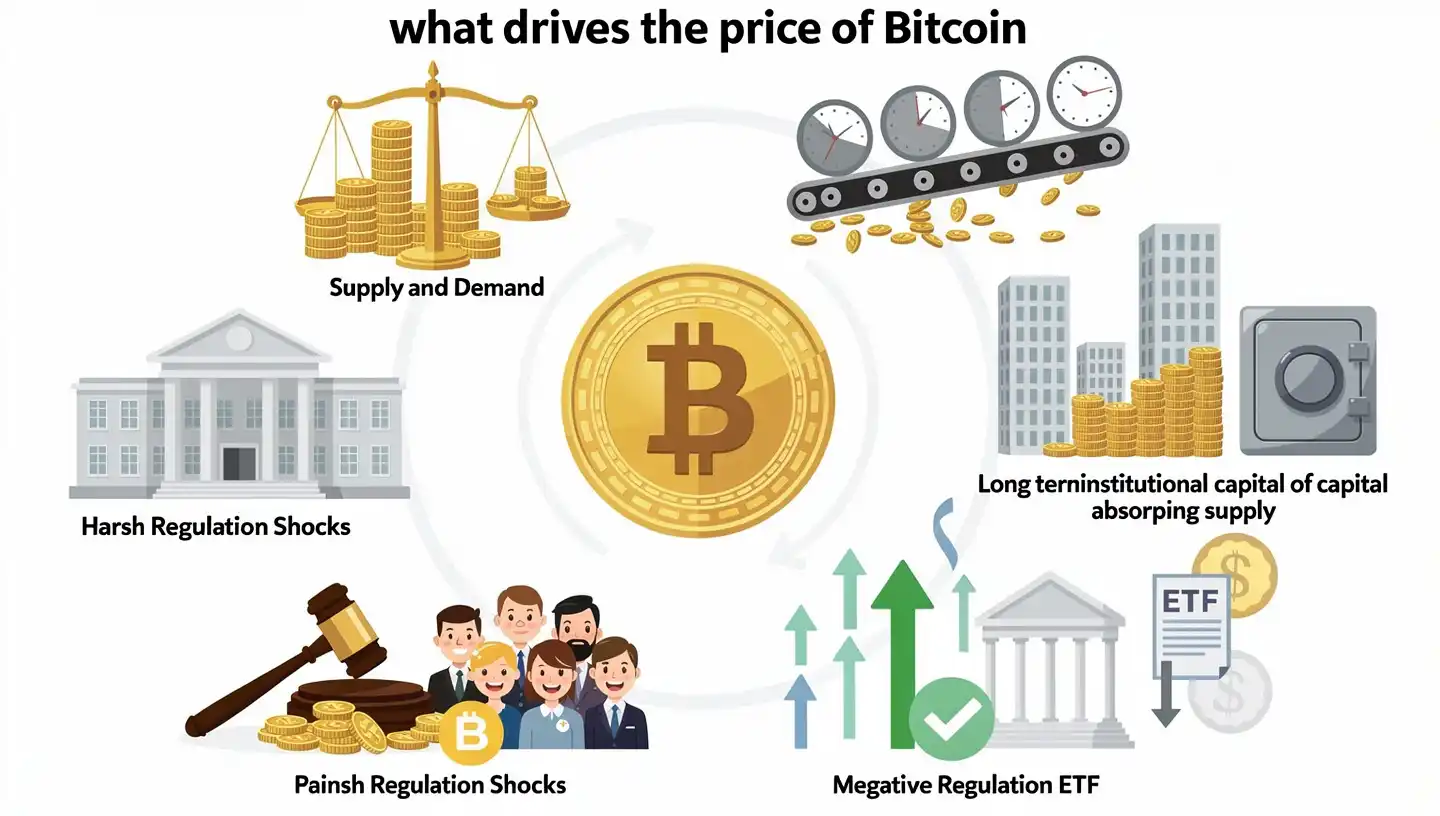
Halvings are probably the most important structural driver. Every four years the miner reward is cut in half, meaning the amount of new bitcoin entering the market drops. All four halvings to date (2012, 2016, 2020, 2024) were followed by major price runs within twelve to eighteen months.
Institutional capital has completely changed the nature of the market since 2020. When MicroStrategy, BlackRock, or Fidelity buy bitcoin, they are not selling it the next morning. That ties up liquidity and tightens available supply.
Macroeconomics matters too. Inflation rates, central bank decisions, and the strength of the dollar all have a direct impact. Bitcoin and the dollar have historically held a negative correlation: when the dollar weakens, bitcoin tends to strengthen.
Regulation can work both ways. China’s mining ban in 2021 cut the price roughly in half. The ETF approval in the U.S. in 2024 kicked off the next record cycle. For a broader look at how cryptocurrency works as an asset class, see our guide on what is cryptocurrency.
Bitcoin halvings: the full history of reward cuts
The protocol caps the total supply at 21 million bitcoins. That limit is enforced through the halving mechanism, which automatically reduces the miner reward every 210,000 blocks, roughly every four years.
| Halving | Date | Reward before | Reward after | Price on halving day |
|---|---|---|---|---|
| 1st | November 28, 2012 | 50 BTC | 25 BTC | ~$12 |
| 2nd | July 9, 2016 | 25 BTC | 12.5 BTC | ~$650 |
| 3rd | May 11, 2020 | 12.5 BTC | 6.25 BTC | ~$8,500 |
| 4th | April 19, 2024 | 6.25 BTC | 3.125 BTC | ~$63,800 |
The next halving is expected in 2028. The reward will drop to 1.5625 BTC. By that point, roughly 96.9% of all bitcoins that will ever exist will already have been mined.
The biggest Bitcoin crashes in history
No other instrument with comparable long-term gains has avoided severe corrections. Bitcoin has had four drops of 70% or more from peak to trough, and every single time it recovered and set a new record.
| Period | Peak | Trough | Drop | Main cause |
|---|---|---|---|---|
| 2011 | $29.60 | $2 | -93% | Mt. Gox hack, speculative bubble |
| 2013-2015 | $1,156 | $185 | -84% | Mt. Gox collapse, loss of confidence |
| 2017-2018 | $19,783 | $3,200 | -84% | ICO boom unwind, crypto winter |
| 2021-2022 | $68,789 | $15,479 | -77% | FTX, Terra/Luna, rising interest rates |
For further context on halving cycles and long-term price behavior: CoinDesk: Bitcoin halving history and why it matters.
Where Bitcoin stands today
In late 2025 and into 2026, bitcoin has been trading in the range of roughly $66,000-$88,000 after pulling back from the October record. ETFs continue to see regular inflows. Strategy (formerly MicroStrategy) holds more than 500,000 bitcoins. Several governments are studying the case for national strategic reserves.
Volatility is lower than in earlier cycles but has not disappeared. Bitcoin’s correlation with large-cap tech stocks has grown, while its correlation with the dollar remains negative. Across sixteen years and four halving cycles, Bitcoin has come back from every major crash with a new all-time high. The track record is consistent on that point.
For a broader look at the technology underpinning Bitcoin and how it is reshaping finance: Investopedia: What is blockchain technology?
Frequently asked questions
How much was Bitcoin worth at the very beginning?
The first recorded trade happened in October 2009, when 5,050 BTC were sold for $5.02 through PayPal, putting the price at $0.00099 per coin. For years before that, it had no monetary value at all.
When did Bitcoin first reach $1?
In February 2011, bitcoin hit dollar parity for the first time. It was the first major psychological threshold and brought the first wave of attention from outside the cryptography community.
What is Bitcoin Pizza Day?
On May 22, 2010, programmer Laszlo Hanyecz bought two pizzas for 10,000 BTC, the first known purchase of a physical product using bitcoin. At the 2025 peak, those 10,000 BTC would have been worth more than a billion dollars. The date is marked every year across the crypto community.
What is Bitcoin’s all-time high price?
The absolute record was set on October 6, 2025, when bitcoin reached $126,000. The previous record was $68,789 from November 2021.
How many Bitcoin halvings have there been?
Four to date: November 2012, July 2016, May 2020, and April 2024. Each time, the miner reward was cut in half. The next halving is expected in 2028.
Who holds the most Bitcoin?
Based on available data, Satoshi Nakamoto holds an estimated 1.1 million BTC that has never moved. Behind him, Strategy (formerly MicroStrategy) holds more than 500,000 BTC as a corporate treasury asset. The U.S. government holds several tens of thousands of confiscated bitcoins.
Has Bitcoin ever been banned?
China effectively banned bitcoin mining and trading for its citizens in 2021. Several other countries have placed restrictions on it. No major economy has managed to shut down the Bitcoin network itself, which continues operating regardless of national policy.
When was Bitcoin founded?
The white paper was published on October 31, 2008. The first transaction on the network happened on January 3, 2009, with the mining of the genesis block. 2009 is the year generally taken as Bitcoin’s founding date.